
TOPIC: TOILET HYGIENE – MEANING, TYPES AND PROPER USE
A: TEACHING AND LEARNING MATERIALS
- Pictures showing different types of toilets.
- Picture of a clean toilet.
- Picture of a dirty toilet.
- Toilet paper.
- Soap.
- Clean water.
- Small hand towel.
- Picture cards showing the correct steps in using a toilet.
- Chart showing good and poor toilet habits.
- Pupils’ writing books and pencils.
B: REFERENCE MATERIALS
- Scheme of work.
- Recommended Home Economics textbook for Primary 1.
- Online educational resources.
C: PREVIOUS KNOWLEDGE
The pupils have learnt about the different parts of the home and the items found in them. They know that the toilet is an important part of the home and that it should be kept clean.
Previous lesson: Primary 1 Home Economics Second Term Week 11
D: PERFORMANCE OBJECTIVES
By the end of the lesson, pupils should be able to:
- Explain the meaning of a toilet in simple words.
- Explain toilet hygiene in simple words.
- Mention common types of toilets.
- Identify a water-closet toilet and a pit toilet from pictures.
- Mention some items used in or around the toilet.
- State the correct steps for using a toilet.
- Explain why hands should be washed after using the toilet.
- Mention good toilet-hygiene habits.
- Identify poor toilet habits that should be avoided.
E: CONTENT
Meaning of a Toilet
A toilet is a place where people go to pass urine and faeces.
Urine and faeces are wastes that leave the body.
A toilet may be found:
- In the home.
- At school.
- In an office.
- At a hospital.
- At other public places.
A toilet should be used properly and kept clean.
Meaning of Toilet Hygiene
Toilet hygiene means keeping the toilet clean and using it properly.
Good toilet hygiene also includes keeping our hands and body clean after using the toilet.
A clean toilet should:
- Be properly used.
- Be regularly cleaned.
- Have waste properly contained or removed.
- Have water and soap available where possible.
- Not have rubbish scattered around it.
Why Toilet Hygiene Is Important
Good toilet hygiene helps to:
- Keep the toilet clean.
- Reduce bad smell.
- Keep flies and other pests away.
- Reduce the spread of germs.
- Keep the home and school environment pleasant.
- Help people develop good hygiene habits.
Safe sanitation and good hygiene help reduce the spread of diseases, particularly when toilet use is followed by proper handwashing.
Types of Toilets
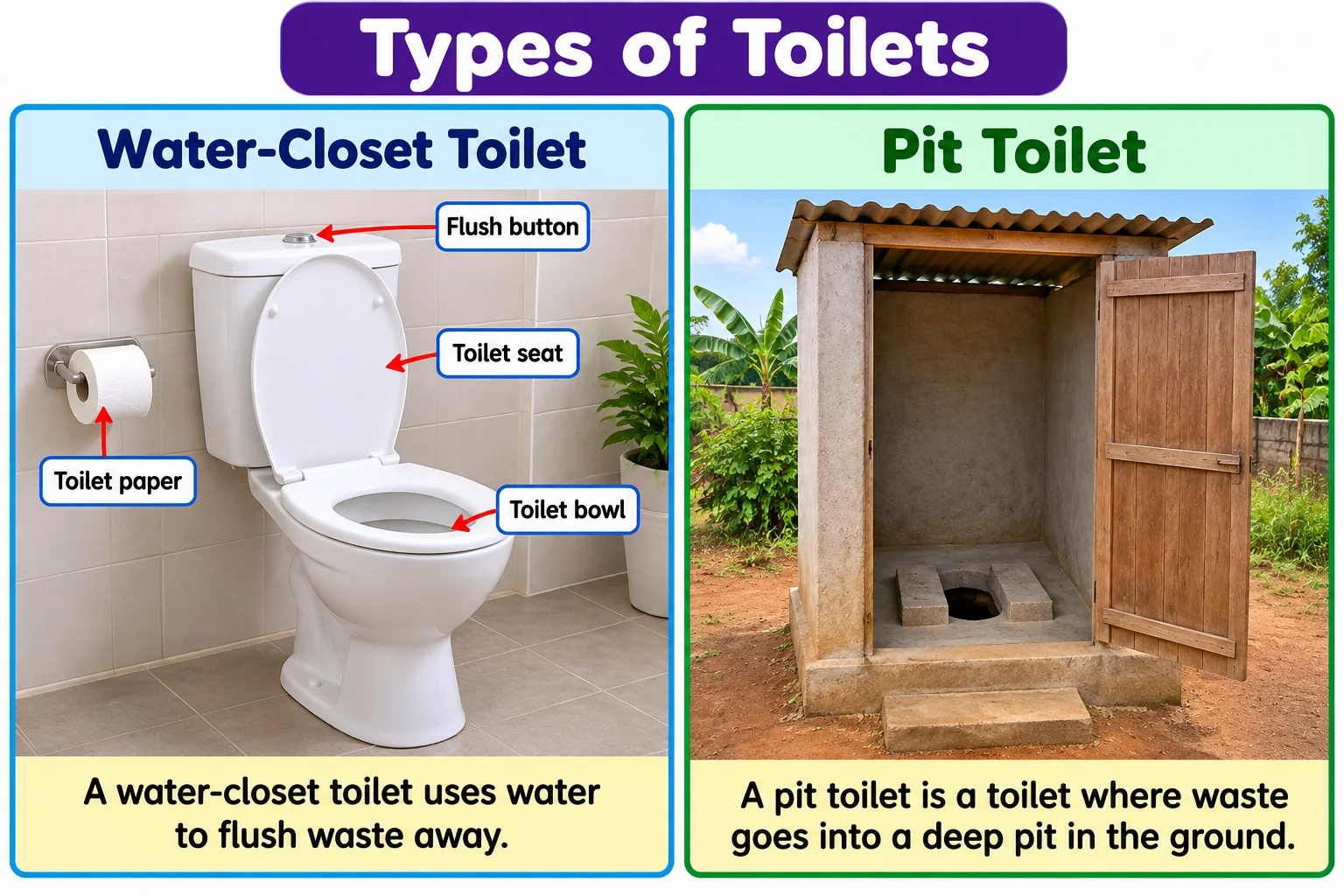
There are different types of toilets.
For this class, pupils should know two common types:
- Water-closet toilet
- Pit toilet
Types of Toilets at a Glance
|
Type of Toilet |
Simple Description |
|---|---|
|
Water-closet toilet |
A toilet that usually uses water to flush waste away |
|
Pit toilet |
A toilet where waste goes into a deep pit in the ground |
1. Water-Closet Toilet
A water-closet toilet, also called a flush toilet, has a toilet bowl.
After using it, water is used to flush the waste away.
A water-closet toilet may have:
- Toilet bowl.
- Toilet seat.
- Flush handle or button.
- Toilet paper.
- Water.
- Wash-hand basin.
- Soap.
2. Pit Toilet
A pit toilet is a toilet where waste goes into a deep pit in the ground.
A safe pit toilet should have a proper structure around it to give users privacy and protection.
Young children should use a pit toilet carefully and with appropriate adult guidance when necessary.
They should never:
- Play around the toilet opening.
- Drop toys into the pit.
- Push another child near the toilet.
- Enter an unsafe or damaged toilet.
Toilet Items
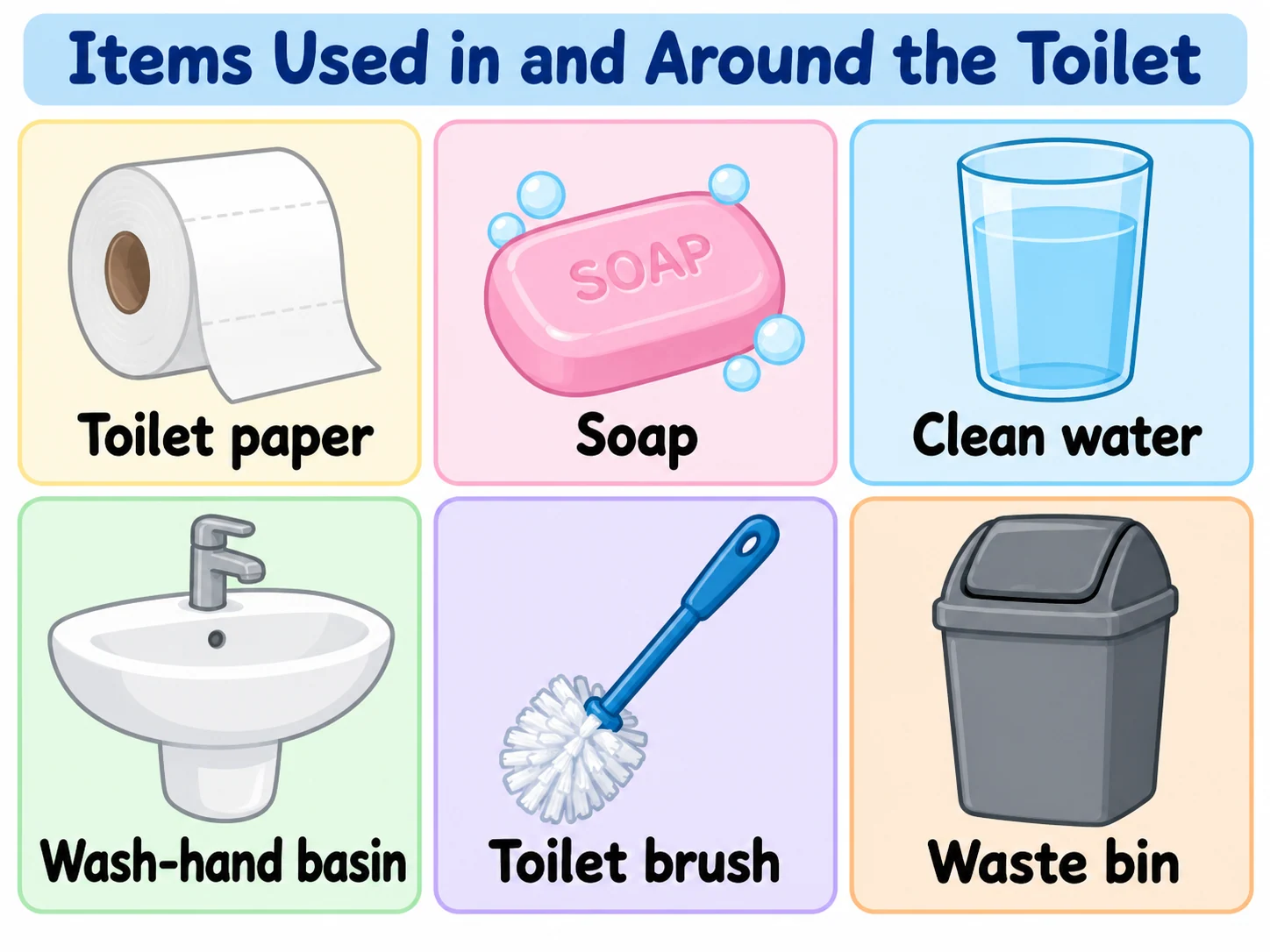
Different items may be used in or around a toilet.
Examples include:
- Toilet paper.
- Water.
- Soap.
- Wash-hand basin.
- Toilet brush.
- Waste bin.
- Hand towel where appropriate.
Toilet Items and Their Uses
|
Item |
Use |
|---|---|
|
Toilet paper |
Used for cleaning after using the toilet |
|
Water |
Used for flushing, cleaning and handwashing |
|
Soap |
Used for washing the hands |
|
Wash-hand basin |
Used for washing the hands |
|
Toilet brush |
Used for cleaning the toilet bowl |
|
Waste bin |
Used for suitable toilet waste |
|
Hand towel |
Used for drying clean hands |
Proper Use of the Toilet
A toilet should be used correctly.
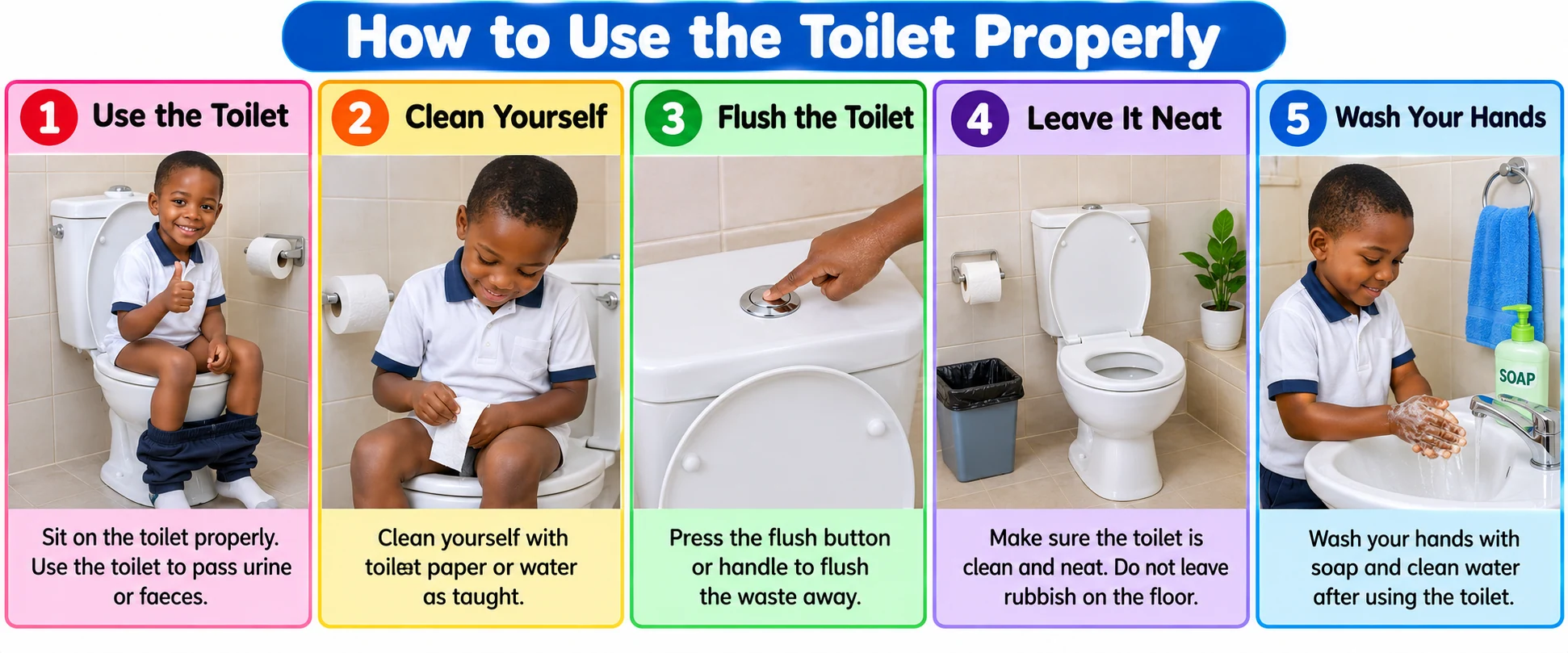
The following steps are suitable for young pupils:
Step 1: Enter the Toilet Properly
Walk carefully into the toilet.
Do not run or play inside the toilet.
Step 2: Use the Toilet Correctly
Use the toilet for passing urine or faeces.
Use the toilet bowl or proper toilet opening correctly.
Do not pass urine or faeces on the floor.
Step 3: Clean Yourself Properly
After using the toilet, clean yourself properly with suitable materials such as toilet paper and water as taught by a parent, guardian or teacher.
Step 4: Flush Where a Flush Toilet Is Used
If the toilet has a flush system, flush it after use.
Make sure the waste goes away.
Step 5: Leave the Toilet Area Neat
Do not throw rubbish on the floor.
Put suitable waste in the correct waste bin.
Step 6: Wash Your Hands
After using the toilet:
- Wet the hands with clean water.
- Apply soap.
- Rub the hands properly.
- Wash between the fingers.
- Rinse with clean water.
- Dry the hands.
WHO recommends washing hands with soap after using the toilet.
Simple Toilet-Use Flow Chart
USE THE TOILET
↓
CLEAN YOURSELF
↓
FLUSH IF NEEDED
↓
LEAVE IT NEAT
↓
WASH HANDS WITH SOAP
Washing Hands After Using the Toilet
Handwashing is a very important part of toilet hygiene.
Our hands may pick up germs when we use the toilet.
We should wash them with soap and clean water afterward.
Why We Wash Our Hands
Washing our hands:
- Removes dirt.
- Helps remove germs.
- Helps protect us from illness.
- Helps keep food and other things we touch cleaner.
Children should be taught and helped to wash their hands properly when necessary.
Good Toilet Habits
A pupil should:
- Use the toilet properly.
- Flush a flush toilet after use.
- Keep the toilet floor clean.
- Put suitable waste in the correct bin.
- Use toilet paper properly.
- Wash the hands with soap and clean water.
- Leave the toilet ready for the next person.
- Tell an adult when the toilet is dirty, blocked or damaged.
Poor Toilet Habits
We should not:
- Play inside the toilet.
- Throw rubbish on the floor.
- Leave faeces on the floor.
- Forget to flush a flush toilet.
- Leave the toilet very dirty.
- Leave without washing our hands.
- Write on toilet walls.
- Waste water.
- Put toys or other objects into the toilet.
Good and Poor Toilet Habits
|
Good Toilet Habits |
Poor Toilet Habits |
|---|---|
|
Using the toilet correctly |
Playing inside the toilet |
|
Flushing after use |
Leaving the toilet unflushed |
|
Washing hands with soap |
Leaving without washing hands |
|
Putting waste in the correct bin |
Throwing rubbish on the floor |
|
Leaving the toilet neat |
Making the toilet dirty |
|
Reporting a problem to an adult |
Playing with toilet equipment |
Clean Toilet and Dirty Toilet
A clean toilet:
- Has a clean floor.
- Has waste properly disposed of.
- Does not have rubbish scattered around.
- Has clean water where possible.
- Has soap for handwashing.
- Is comfortable to use.
A dirty toilet may:
- Have rubbish on the floor.
- Have a bad smell.
- Have visible dirt.
- Attract flies.
- Make it easier for germs to spread.
Toilet Safety
The toilet should also be used safely.
Children should:
- Walk carefully, especially when the floor is wet.
- Avoid playing with water.
- Avoid climbing on the toilet.
- Avoid touching cleaning chemicals.
- Tell an adult about a broken toilet.
- Tell an adult if the floor is very slippery.
- Avoid playing near an open pit toilet.
Toilet Cleaning Materials Are Not Toys
Adults may use cleaning materials such as:
- Toilet cleaner.
- Disinfectant.
- Bleach.
- Cleaning brushes.
Young children should not play with cleaning chemicals.
Such products should be kept where children cannot reach them.
Important Rules to Remember
Remember these simple toilet rules:
- Use it properly.
- Keep it clean.
- Flush when needed.
- Do not play there.
- Wash your hands with soap.
- Tell an adult when there is a problem.
F: LESSON PRESENTATION
F1: Teachers’ Activities
- Revises the pupils’ previous knowledge of the toilet as a part of the home.
- Displays pictures of different toilets.
- Explains the meaning of a toilet and toilet hygiene.
- Shows pictures of a water-closet toilet and pit toilet.
- Guides pupils to identify the two types.
- Displays toilet paper, soap, water and other safe toilet items.
- Explains the use of each item.
- Uses picture cards to demonstrate the correct order for using a toilet.
- Demonstrates correct handwashing movements.
- Displays pictures of clean and dirty toilets and guides pupils to compare them.
- Discusses good and poor toilet habits.
- Explains simple toilet-safety rules.
- Warns pupils not to touch toilet-cleaning chemicals.
- Asks oral questions and corrects pupils where necessary.
F2: Pupils’ Activities
- Identify a toilet from pictures.
- Explain the meaning of a toilet in simple words.
- Identify water-closet and pit toilets.
- Mention items used in or around the toilet.
- State the use of toilet paper, soap and water.
- Arrange picture cards showing proper toilet use in the correct order.
- Demonstrate handwashing movements.
- Identify good and poor toilet habits.
- Compare pictures of clean and dirty toilets.
- Mention toilet-safety rules.
- State what they should do when a toilet is dirty or damaged.
- Answer the teacher’s questions.
G: CONCLUSION
The teacher revises the meaning of toilet, toilet hygiene, the common types of toilets and the proper steps for using a toilet.
The teacher reminds pupils that a toilet should be used properly, kept clean and left neat for the next person.
The teacher places special emphasis on washing the hands with soap and clean water after every toilet visit and reminds pupils to report unsafe, dirty or damaged toilets to an adult.
H: EVALUATION GUIDE
Pupils should be able to answer the following questions:
- What is a toilet?
- What is toilet hygiene?
- Mention two types of toilets.
- What is another name for a water-closet toilet?
- Where does waste go in a pit toilet?
- Mention four items used in or around a toilet.
- What is toilet paper used for?
- What do we use soap for after using the toilet?
- What should you do after using a flush toilet?
- Mention four good toilet habits.
- Mention three poor toilet habits.
- Why should we wash our hands after using the toilet?
- What should you do if a toilet is dirty or damaged?
- Should children play with toilet-cleaning chemicals?
- Mention two toilet-safety rules.
- Complete: Use the toilet properly, leave it neat and wash your hands with ______ and clean water.