
TOPIC: CARE OF THE EARS AND NOSE
A: TEACHING AND LEARNING MATERIALS
- Chart showing the ears and nose.
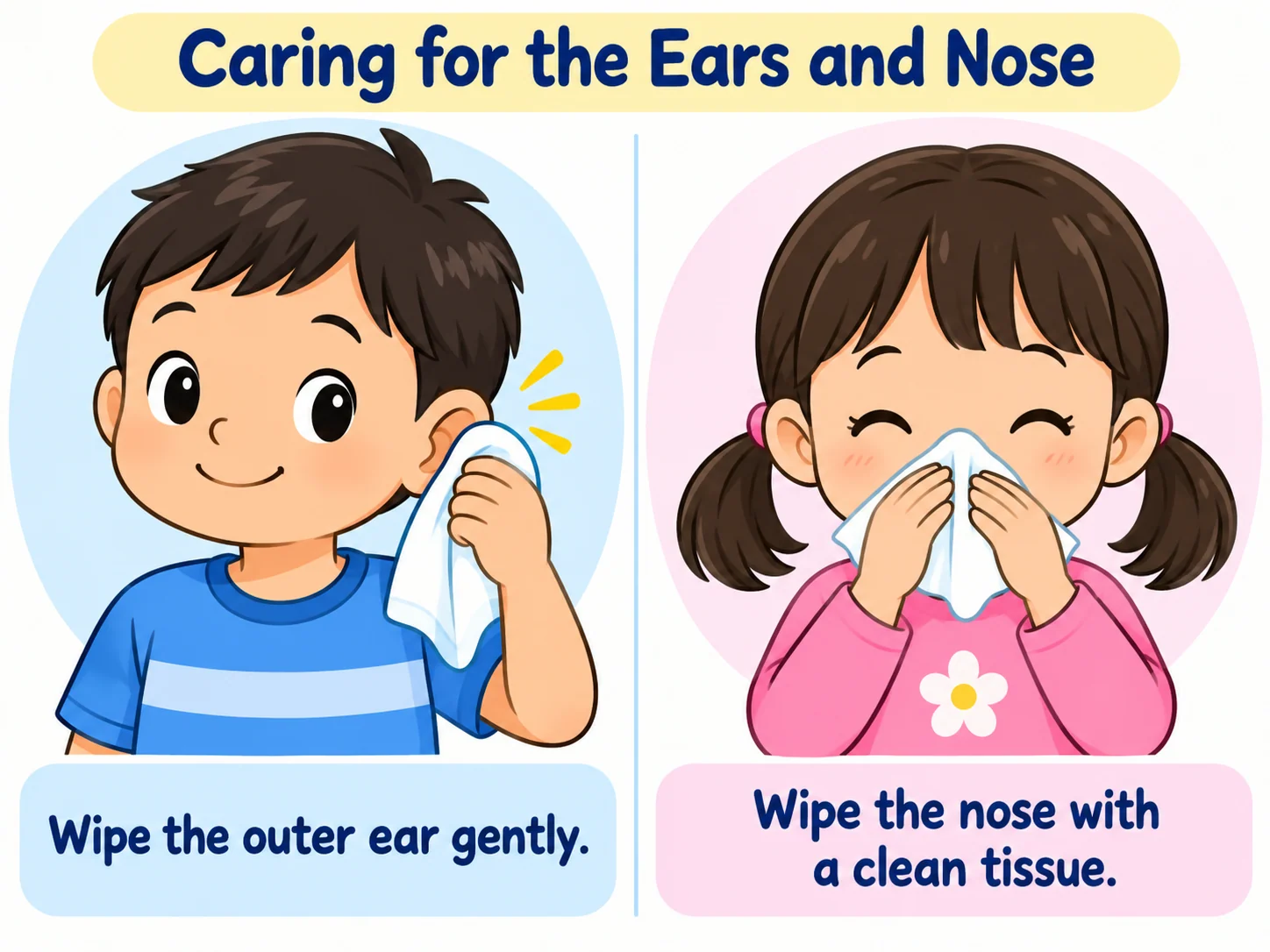
- Picture showing a child cleaning the outer ear correctly.
- Clean face towel or soft cloth.
- Clean cotton wool for wiping the outer ear only.
- Clean handkerchief.
- Tissue paper.
- Clean water.
- Waste bin.
- Picture cards showing good and bad ear and nose-care habits.
- Pupils’ writing books and pencils.
B: REFERENCE MATERIALS
- Scheme of work.
- Recommended Home Economics textbook for Primary 1.
- Online educational resources.
C: PREVIOUS KNOWLEDGE
The pupils have learnt about the ears and nose. They know that we have two ears and one nose. They also know that the ears help us to hear, while the nose helps us to smell and breathe.
Previous lesson: Primary 1 Home Economics Second Term Week 3
D: PERFORMANCE OBJECTIVES
By the end of the lesson, pupils should be able to:
- Explain why the ears and nose should be kept clean.
- Mention suitable materials for cleaning the outer ears and nose.
- Demonstrate the correct way of cleaning the outer ear.
- Demonstrate the correct way of wiping or blowing the nose.
- Mention things that should not be put inside the ears or nose.
- State good habits for caring for the ears and nose.
- Explain when they should tell an adult about a problem with the ears or nose.
E: CONTENT
Caring for the Ears and Nose
The ears and nose are important parts of the body.
The ears help us to hear sounds.
The nose helps us to smell and breathe.
Because they are important, we should keep them clean and protect them from injury.
Why We Should Care for the Ears
We should care for our ears because they help us to hear.
Good ear care helps us to:
- Keep the outer ears clean.
- Remove dirt from around the ears.
- Protect the ears from injury.
- Maintain good personal hygiene.
- Notice when there is pain or another problem.
Materials for Cleaning the Outer Ear
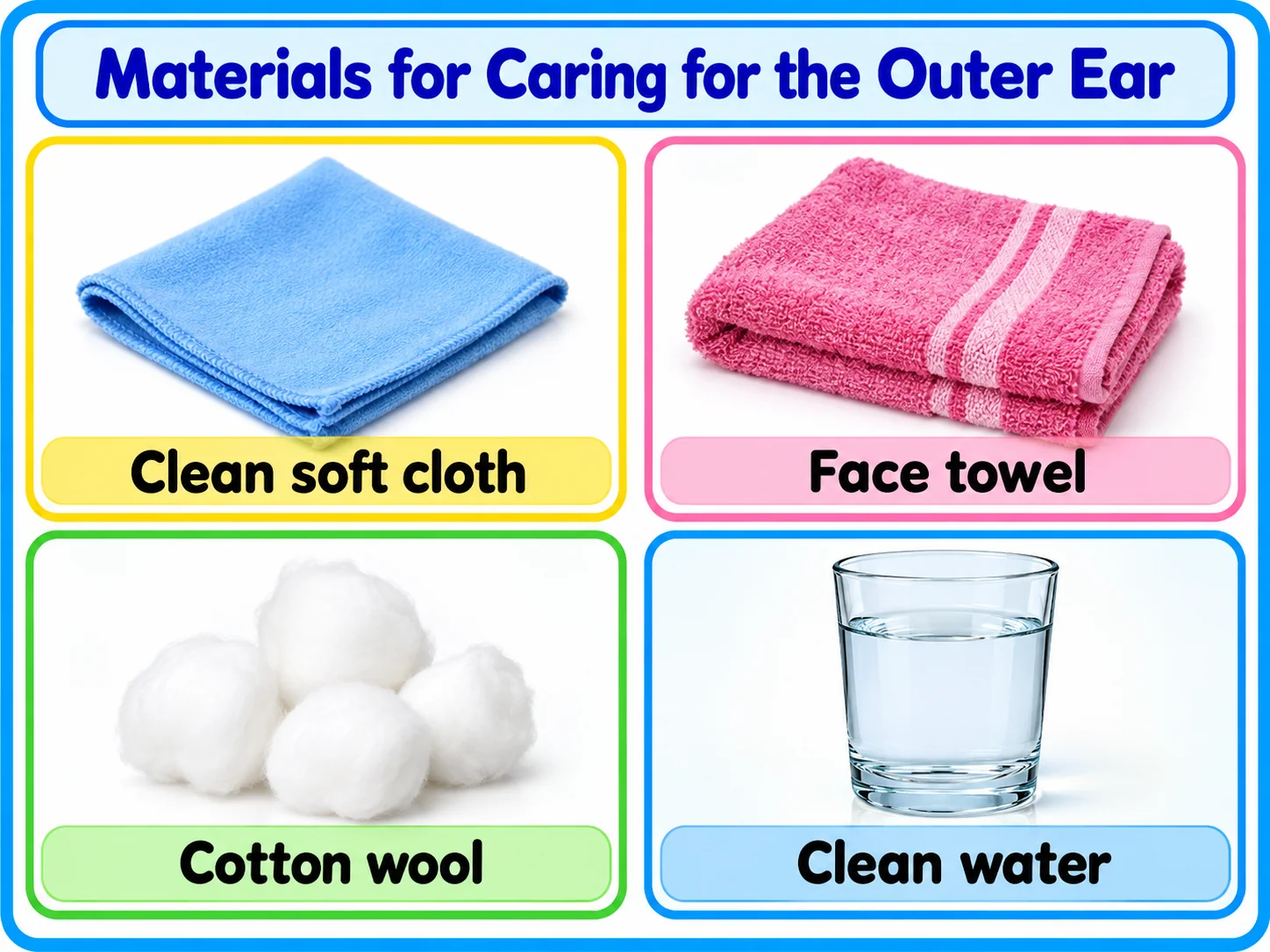
We can use the following materials to clean the outside of the ear:
|
Material |
Use |
|---|---|
|
Clean soft cloth |
Wiping around the outer ear |
|
Clean face towel |
Drying around the ear after bathing |
|
Cotton wool |
Gently wiping the visible outer part when necessary |
|
Clean water |
Washing around the ear during bathing |
How to Clean the Outer Ear
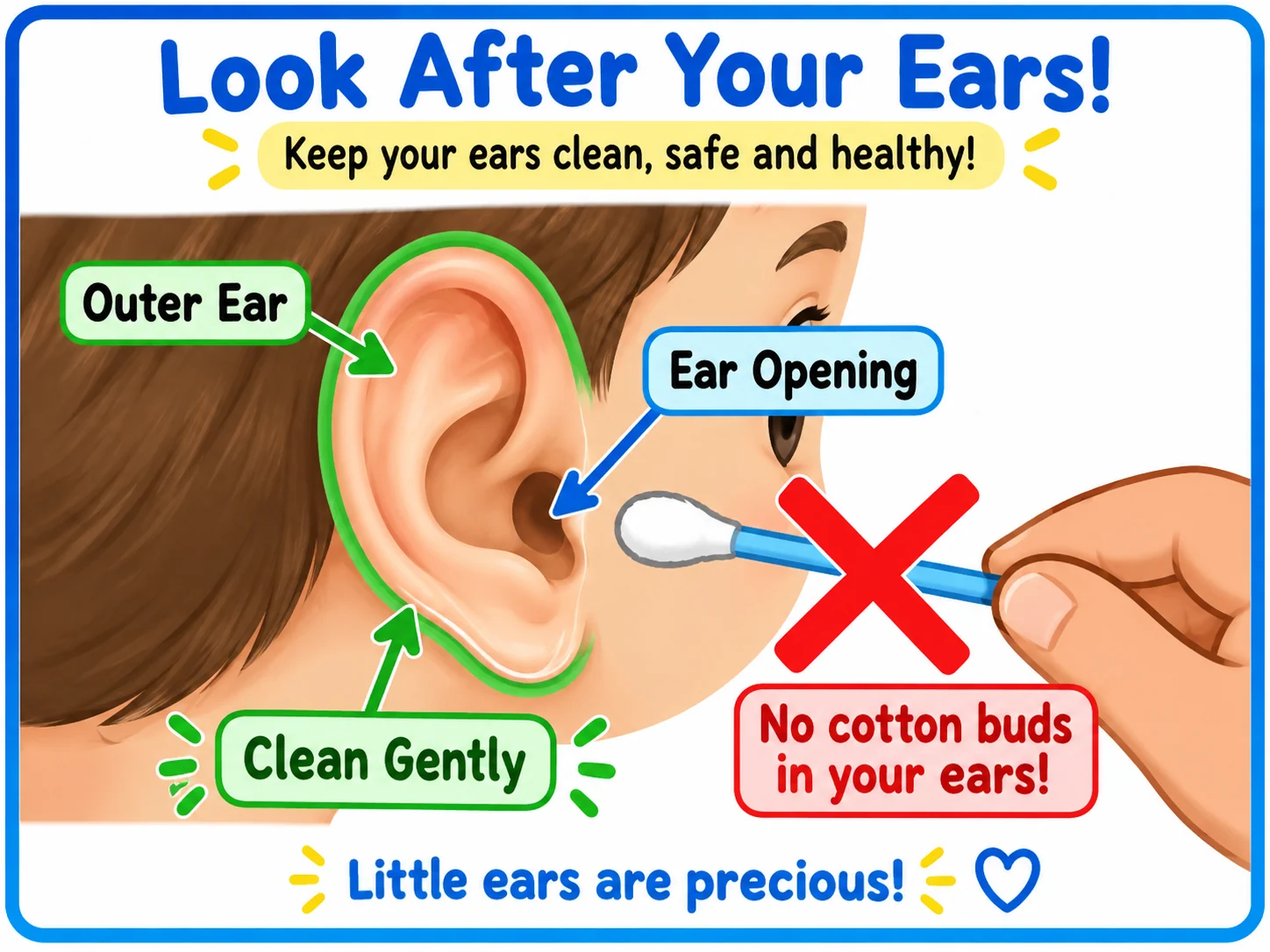
The part of the ear that we can see is called the outer ear.
We should clean only the outer part gently.
Simple steps are:
- Wet a clean soft cloth with clean water.
- Squeeze out excess water.
- Wipe gently around the outer ear.
- Wipe behind the ear.
- Dry the ear gently with a clean towel.
The ear canal does not need to be cleaned with objects.
Simple Ear-Care Diagram
Things We Should Not Put Inside the Ear
We should never put objects inside the ear.
Examples include:
- Cotton buds.
- Fingers.
- Matchsticks.
- Hairpins.
- Pens.
- Pencils.
- Small sticks.
- Other sharp objects.
Putting objects inside the ear can push wax deeper or injure the ear. Health guidance for children advises against putting cotton buds or other objects into the ear canal.
Do Not Try to Remove Earwax Yourself
Earwax is a natural substance found inside the ear.
A small amount of earwax is normal.
Pupils should not try to dig out earwax with their fingers, cotton buds or other objects.
If the ear feels blocked, painful or uncomfortable, they should tell a parent, guardian, teacher or another responsible adult.
Signs That an Adult Should Be Told
A pupil should tell an adult if:
- The ear is painful.
- Something becomes stuck inside the ear.
- Fluid is coming out of the ear.
- The pupil cannot hear properly.
- The ear becomes swollen.
- The ear is badly injured.
These problems should not be treated by putting objects or substances inside the ear without appropriate adult or medical guidance.
Why We Should Care for the Nose
The nose helps us to:
- Smell.
- Breathe.
The nose can collect mucus, dust and dirt.
We should keep it clean and avoid putting objects inside it.
Materials for Caring for the Nose
Materials that can be used include:
|
Material |
Use |
|---|---|
|
Clean handkerchief |
Wiping or gently blowing the nose |
|
Tissue paper |
Wiping the nose |
|
Clean water |
Washing the face and area around the nose |
|
Waste bin |
Proper disposal of used tissue |
How to Wipe the Nose
When the nose is running, we should:
- Take a clean tissue or handkerchief.
- Place it gently over the nose.
- Wipe the nose carefully.
- Put used tissue into a waste bin.
- Wash the hands afterward.
We should not wipe mucus on our clothes.
How to Blow the Nose
When we need to blow the nose:
- Take a clean tissue or handkerchief.
- Hold it over the nose.
- Blow gently.
- Wipe the nose clean.
- Throw used tissue into the waste bin.
- Wash the hands.
The nose should be blown gently, not too hard.
Covering the Nose When Sneezing
When we sneeze, tiny droplets can come from the nose and mouth.
We should:
- Use a tissue when available.
- Throw the used tissue into a waste bin.
- Wash our hands afterward.
If a tissue is not available, an adult can teach the child the appropriate hygienic way to cover a sneeze.
Things We Should Not Put Inside the Nose
We should not put objects into the nostrils.
Examples include:
- Fingers.
- Beads.
- Stones.
- Pieces of paper.
- Pencil ends.
- Seeds.
- Small toys.
A small object can become stuck inside the nose and cause pain or injury.
If something enters the nose and cannot be removed easily, the pupil should tell an adult.
Good and Poor Ear and Nose-Care Habits
|
Good Habits |
Poor Habits |
|---|---|
|
Wiping around the outer ear gently |
Putting cotton buds inside the ear |
|
Using a clean towel |
Using a dirty towel |
|
Using a clean tissue for the nose |
Wiping the nose on clothes |
|
Throwing used tissue into a bin |
Throwing used tissue on the floor |
|
Washing hands after blowing the nose |
Touching food with dirty hands afterward |
|
Telling an adult about ear pain |
Putting objects into a painful ear |
|
Keeping fingers out of the nose |
Picking the nose with dirty fingers |
Important Rules to Remember
For the Ears
- Keep the outer ears clean.
- Dry around the ears after bathing.
- Never push objects inside the ears.
- Do not try to dig out earwax.
- Tell an adult if the ear hurts.
For the Nose
- Wipe the nose with a clean tissue or handkerchief.
- Blow the nose gently.
- Put used tissues in a waste bin.
- Wash the hands after wiping or blowing the nose.
- Never put objects inside the nostrils.
F: LESSON PRESENTATION
F1: Teachers’ Activities
- Revises the functions of the ears and nose taught in the previous lesson.
- Shows pupils the outer ear and explains that only the visible outer part should be wiped.
- Displays a clean towel, soft cloth, tissue and handkerchief.
- Demonstrates how to wipe around the outer ear gently.
- Shows a picture of a cotton bud entering the ear and explains why this is unsafe.
- Demonstrates the correct way of wiping the nose.
- Demonstrates how to blow the nose gently using a tissue.
- Shows pupils where used tissues should be thrown away.
- Discusses objects that should never be placed inside the ears or nose.
- Uses picture cards to compare good and poor ear and nose-care habits.
- Explains when pupils should report ear or nose problems to an adult.
- Asks oral questions and corrects pupils where necessary.
F2: Pupils’ Activities
- Mention the functions of the ears and nose.
- Identify materials used for caring for the outer ears.
- Identify materials used for caring for the nose.
- Demonstrate gentle wiping around the outer ear using an imaginary or demonstration cloth.
- Demonstrate the correct way of using a tissue to wipe the nose.
- Show where a used tissue should be thrown away.
- Mention objects that should not be placed inside the ears.
- Mention objects that should not be placed inside the nose.
- Identify good and poor habits from picture cards.
- State what they should do if an ear becomes painful.
- Answer the teacher’s questions.
G: CONCLUSION
The teacher revises the proper care of the ears and nose.
The teacher reminds pupils that only the outer ear should be wiped gently and that nothing should be pushed inside the ear canal. The nose should be wiped with a clean tissue or handkerchief, and pupils should wash their hands afterward.
The teacher corrects pupils where necessary and encourages them to practise safe ear and nose-care habits at home.
H: EVALUATION GUIDE
Pupils should be able to answer the following questions:
- Why should we care for our ears?
- Mention three materials used for cleaning the outer ear.
- Which part of the ear should we wipe gently?
- Mention three things that should not be put inside the ear.
- Should we use a cotton bud to dig inside the ear?
- What should you do if your ear becomes painful?
- Mention two materials used for cleaning the nose.
- What should you use to wipe a running nose?
- Where should a used tissue be put?
- What should you do after wiping or blowing your nose?
- Mention three objects that should not be placed inside the nose.
- Mention two good ear-care habits.
- Mention two good nose-care habits.
- What should you do if an object becomes stuck in your ear or nose?