
TOPIC: THE EARS AND NOSE
A: TEACHING AND LEARNING MATERIALS
- Chart showing the human face.
- Picture cards showing the ears and nose.
- Mirror.
- Clean face towel.
- Clean handkerchief or tissue.
- Cotton wool for wiping only the outer part of the ear.
- Pictures showing good and bad care of the ears and nose.
- Pupils’ writing books and pencils.
B: REFERENCE MATERIALS
- Scheme of work.
- Recommended Home Economics textbook for Primary 1.
- Online educational resources.
C: PREVIOUS KNOWLEDGE
The pupils have learnt how to care for the hair and scalp. They also know that different parts of the body should be kept clean to help them stay neat and healthy.
Previous lesson: Primary 1 Home Economics Second Term Week 2
D: PERFORMANCE OBJECTIVES
By the end of the lesson, pupils should be able to:
- Identify the ears and nose.
- State the number of ears and nose a person has.
- Mention simple functions of the ears.
- Mention simple functions of the nose.
- Identify suitable materials used for cleaning the outer ears and nose.
- State simple ways of keeping the ears and nose clean.
- Mention things that should not be put inside the ears or nose.
E: CONTENT
The Ears and Nose
The ears and nose are parts of the human body.
They are found on the head.
We have:
- Two ears.
- One nose.
The ears are found on the two sides of the head.
The nose is found in the middle of the face, below the eyes.
Simple Diagram of the Face
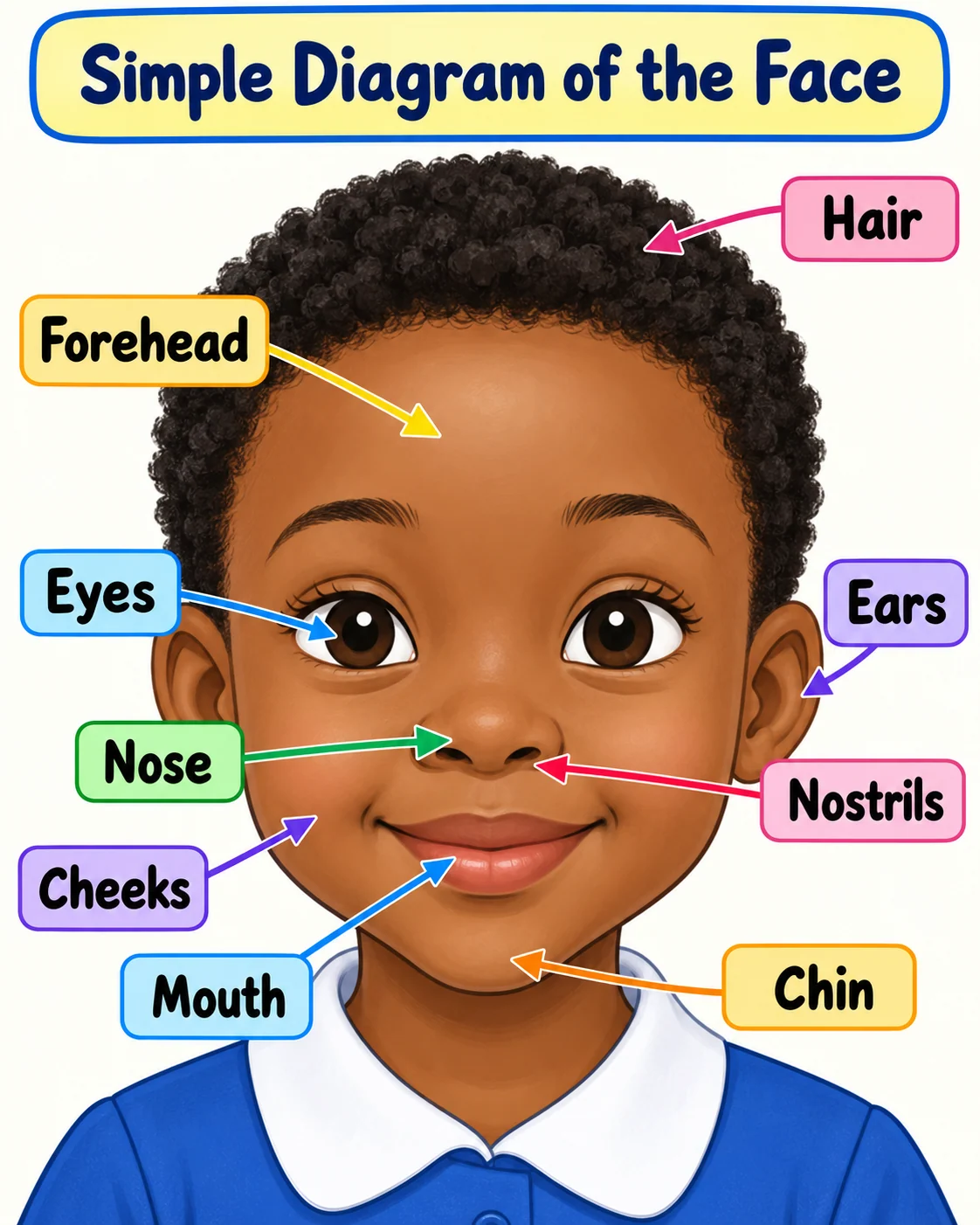
The teacher should allow pupils to point to their own ears and nose while naming them.
The Ears
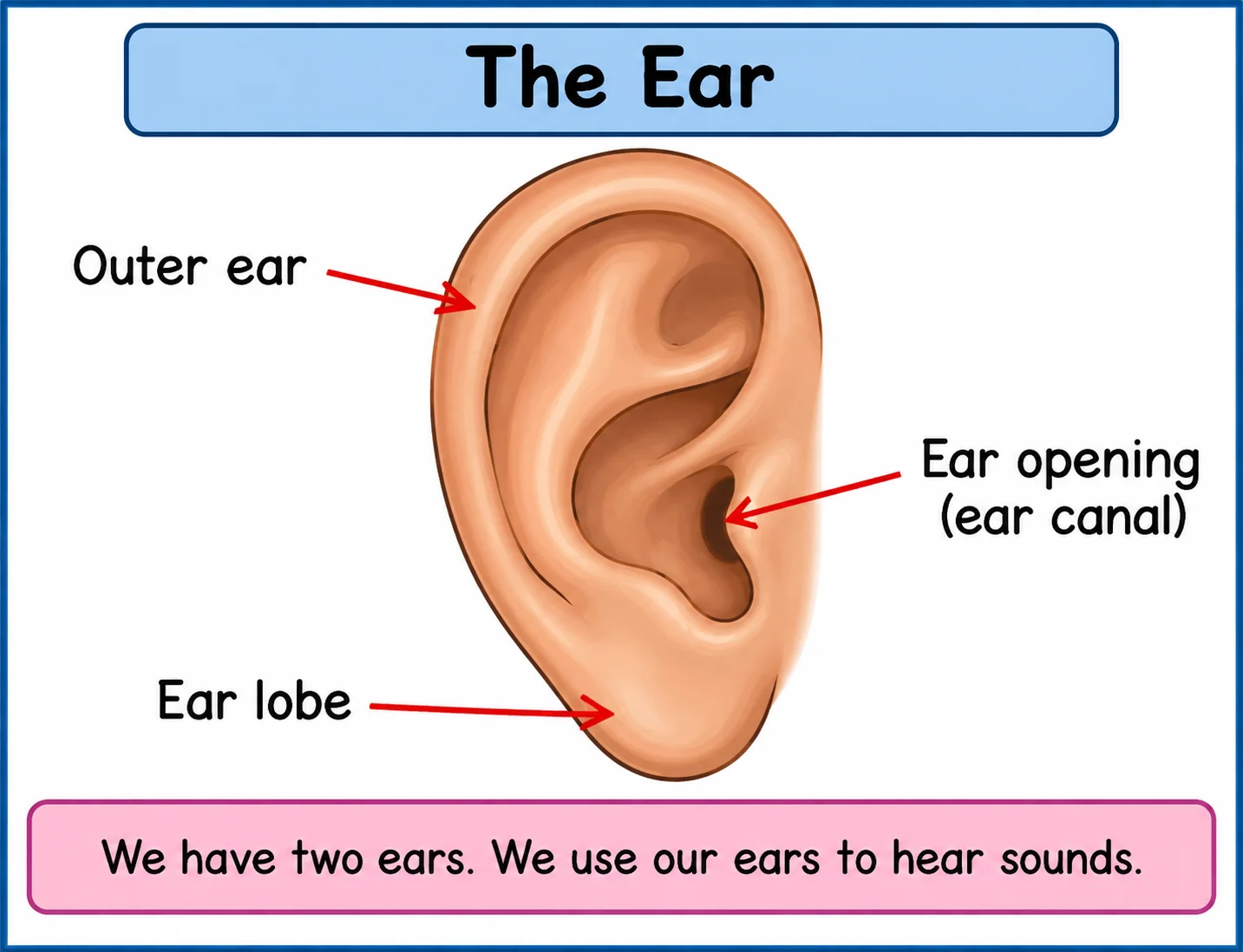
We have two ears.
One ear is on the left side of the head and the other is on the right side.
The ears help us to hear sounds around us.
Examples of sounds we hear are:
- A person speaking.
- A school bell ringing.
- Music playing.
- A car horn.
- Birds singing.
- Clapping of hands.
Functions of the Ears
The main function of the ears is hearing.
With our ears, we can:
- Hear people speaking.
- Listen to instructions.
- Hear music and other sounds.
- Know when someone calls us.
- Hear warning sounds such as a bell or horn.
The Nose
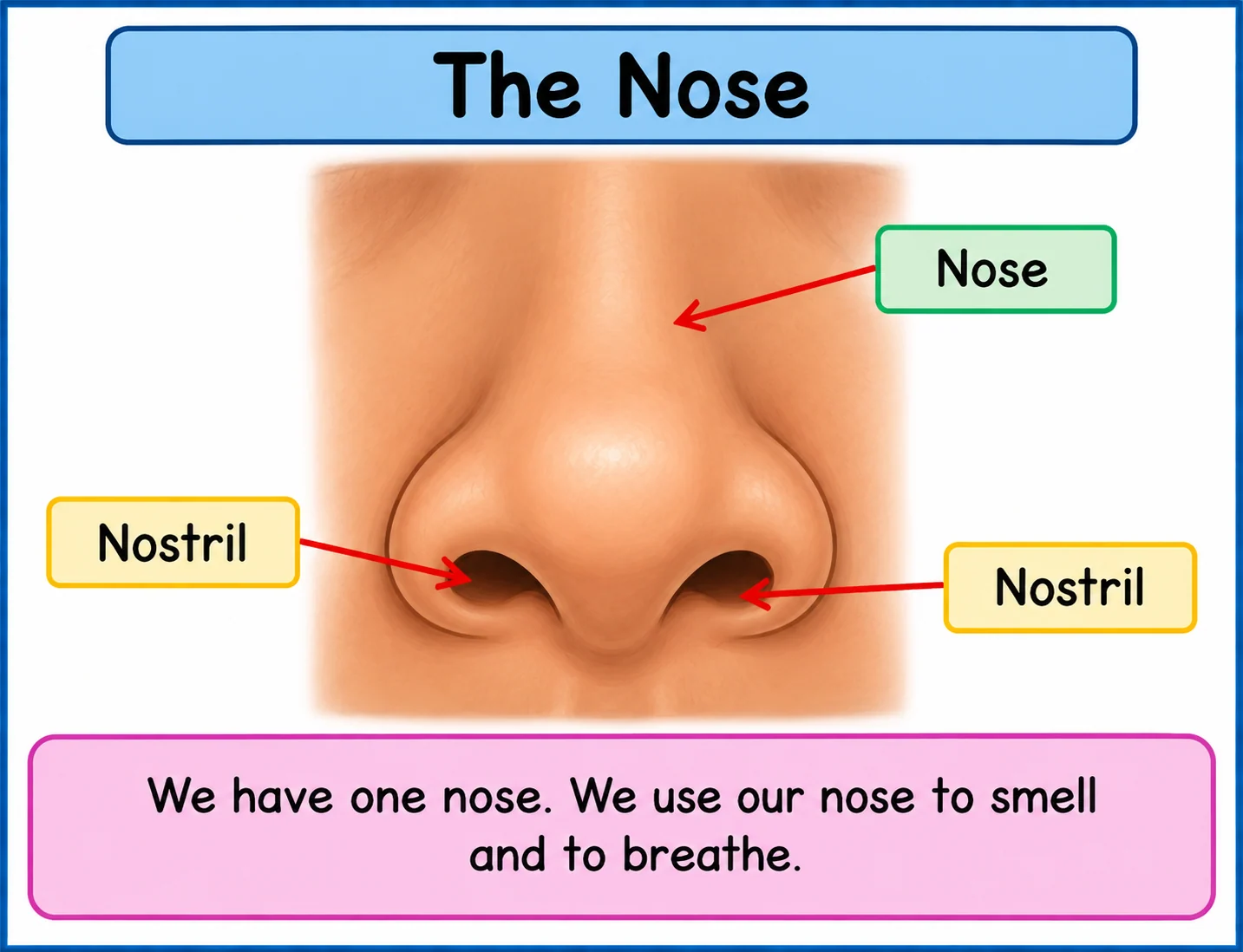
We have one nose.
The nose is found on the face.
It has two openings called nostrils.
We use the nose mainly for smelling and breathing.
Functions of the Nose
The nose helps us to:
- Smell things.
- Breathe in air.
- Notice pleasant and unpleasant smells.
Examples of things we can smell include:
- Food.
- Flowers.
- Soap.
- Perfume.
- Smoke.
Ears and Nose at a Glance
|
Body Part |
Number |
Main Use |
|---|---|---|
|
Ears |
Two |
Hearing sounds |
|
Nose |
One |
Smelling and breathing |
Materials for Caring for the Ears and Nose
Some simple materials used for keeping the outer ears and nose clean are:
|
Material |
Use |
|---|---|
|
Clean face towel |
Wiping the outside of the ears and face |
|
Clean handkerchief |
Wiping the nose |
|
Tissue |
Wiping or gently blowing the nose |
|
Clean water |
Washing the face and outer ear |
|
Cotton wool |
Gently wiping only the visible outer ear when necessary |
These materials should always be clean.
How to Keep the Ears Clean
The outer parts of the ears should be kept clean.
We can care for the ears by:
- Washing around the ears during bathing.
- Wiping the outer ear gently with a clean, damp cloth.
- Drying around the ears after bathing.
- Keeping dirty hands away from the ears.
- Telling an adult when the ear is painful or has unusual discharge.
The inside of the ear is delicate. Pupils should not put objects inside the ear canal.
Things We Should Not Put Inside the Ears
We should not put the following into the ears:
- Fingers.
- Matchsticks.
- Pens or pencils.
- Hairpins.
- Cotton buds deep inside the ear.
- Other sharp objects.
Putting objects into the ear can hurt the ear.
How to Keep the Nose Clean
The nose should also be kept clean.
We can care for the nose by:
- Wiping it gently with a clean handkerchief or tissue.
- Blowing the nose gently when necessary.
- Washing the face regularly.
- Using a clean handkerchief.
- Covering the nose with a tissue or handkerchief when sneezing.
- Washing the hands after blowing or wiping the nose.
Correct Way to Blow the Nose
The pupil should:
- Take a clean tissue or handkerchief.
- Hold it gently over the nose.
- Blow the nose gently.
- Wipe the nose clean.
- Throw used tissue into a waste bin.
- Wash the hands afterward.
Things We Should Not Put Inside the Nose
We should not put objects into our nostrils.
Examples include:
- Beads.
- Stones.
- Pieces of paper.
- Pencil ends.
- Fingers.
- Small toys.
Objects placed inside the nose can cause injury and may become stuck.
Good and Bad Habits
|
Good Habits |
Bad Habits |
|---|---|
|
Wiping the nose with a clean tissue |
Picking the nose with dirty fingers |
|
Washing around the ears |
Putting objects inside the ears |
|
Using a clean handkerchief |
Sharing a dirty handkerchief |
|
Washing hands after blowing the nose |
Wiping the nose on clothes |
|
Telling an adult when the ear hurts |
Trying to remove objects from the ear alone |
Why We Should Care for the Ears and Nose
We should keep the ears and nose clean because good care:
- Helps us stay neat.
- Removes dirt.
- Helps prevent bad smell.
- Helps us develop good personal hygiene.
- Helps protect these important parts of the body.
If a child has ear pain, fluid coming from the ear, hearing difficulty, or something stuck in the ear, an adult should be told rather than trying to remove it at home.
F: LESSON PRESENTATION
F1: Teachers’ Activities
- Revises the previous lesson on care of the hair.
- Displays a chart showing a human face.
- Points to the ears and nose and asks pupils to identify them.
- Guides pupils to count their ears and identify their nose.
- Produces simple sounds such as clapping or ringing a bell and asks pupils what part of the body helps them hear.
- Presents familiar items with safe, noticeable smells and explains that the nose helps us smell.
- Displays a face towel, handkerchief, tissue and other suitable cleaning materials.
- Demonstrates how to wipe the outer ear gently.
- Demonstrates the correct way to wipe or gently blow the nose.
- Explains that objects should never be pushed inside the ears or nose.
- Guides pupils to separate good hygiene habits from bad ones.
- Asks questions and corrects pupils where necessary.
F2: Pupils’ Activities
- Point to their ears and nose.
- Count their two ears.
- Listen to sounds made by the teacher.
- Mention some sounds they hear every day.
- Mention things they can smell.
- Identify materials used for cleaning the outer ears and nose.
- Demonstrate how to wipe the nose with a clean tissue or handkerchief.
- Mention objects that should not be placed inside the ears or nose.
- Identify good and bad hygiene practices from pictures.
- Answer the teacher’s questions.
G: CONCLUSION
The teacher revises the ears and nose, their functions and the materials used for keeping them clean.
The teacher reminds the pupils that the ears help us to hear, while the nose helps us to smell and breathe.
The teacher corrects pupils where necessary and reminds them never to put objects inside their ears or nose. Pupils are encouraged to use clean materials and practise good personal hygiene at home.
H: EVALUATION GUIDE
Pupils should be able to answer the following questions:
- How many ears do you have?
- How many noses do you have?
- What do we use our ears for?
- Mention two sounds you can hear with your ears.
- Mention two things we use the nose to do.
- Mention two things you can smell with your nose.
- Mention three materials used for keeping the outer ears and nose clean.
- How should the outside of the ears be cleaned?
- Mention two things that should not be put inside the ears.
- What should you use to wipe your nose?
- Mention two objects that should not be put inside the nose.
- What should you do after blowing your nose?