
TOPIC: BALANCED DIET AND CLASSES OF FOOD
A: TEACHING AND LEARNING MATERIALS
- Pictures or samples of common Nigerian foods.
- Rice, yam, beans, maize and bread or pictures of them.
- Fish, meat, eggs and milk or pictures of them.
- Fruits such as orange, banana, pawpaw and watermelon.
- Vegetables such as tomato, carrot and green leafy vegetables.
- Palm oil, groundnut oil or pictures of cooking oils.
- Clean drinking water.
- Chart showing different classes of food.
- Pictures of simple balanced meals.
B: REFERENCE MATERIALS
- Primary 2 Home Economics Scheme of Work (All Three Terms)
- Recommended Home Economics textbook for Primary 2 (school-approved edition)
- World Health Organization – Healthy Diet
C: PREVIOUS KNOWLEDGE
Pupils have learnt the meaning of food and the three simple food groups: energy-giving foods, body-building foods and protective foods.
They can identify foods such as rice, yam, beans, fish, eggs, fruits and vegetables. In this lesson, they will learn more about the different classes of food and how foods from different classes can be combined to make a balanced diet.
Previous Lesson: Primary 2 Home Economics First Term – Week 8: FOOD AND FOOD GROUPS
D: PERFORMANCE OBJECTIVES
By the end of the lesson, pupils should be able to:
- explain the meaning of a balanced diet;
- explain the meaning of classes of food;
- mention the main classes of food taught in the lesson;
- give examples of foods found in each class;
- state the main work each class of food does in the body;
- explain the importance of water to the body;
- identify simple balanced meals; and
- explain why we should eat different kinds of food.
E: CONTENT
Meaning of a Balanced Diet
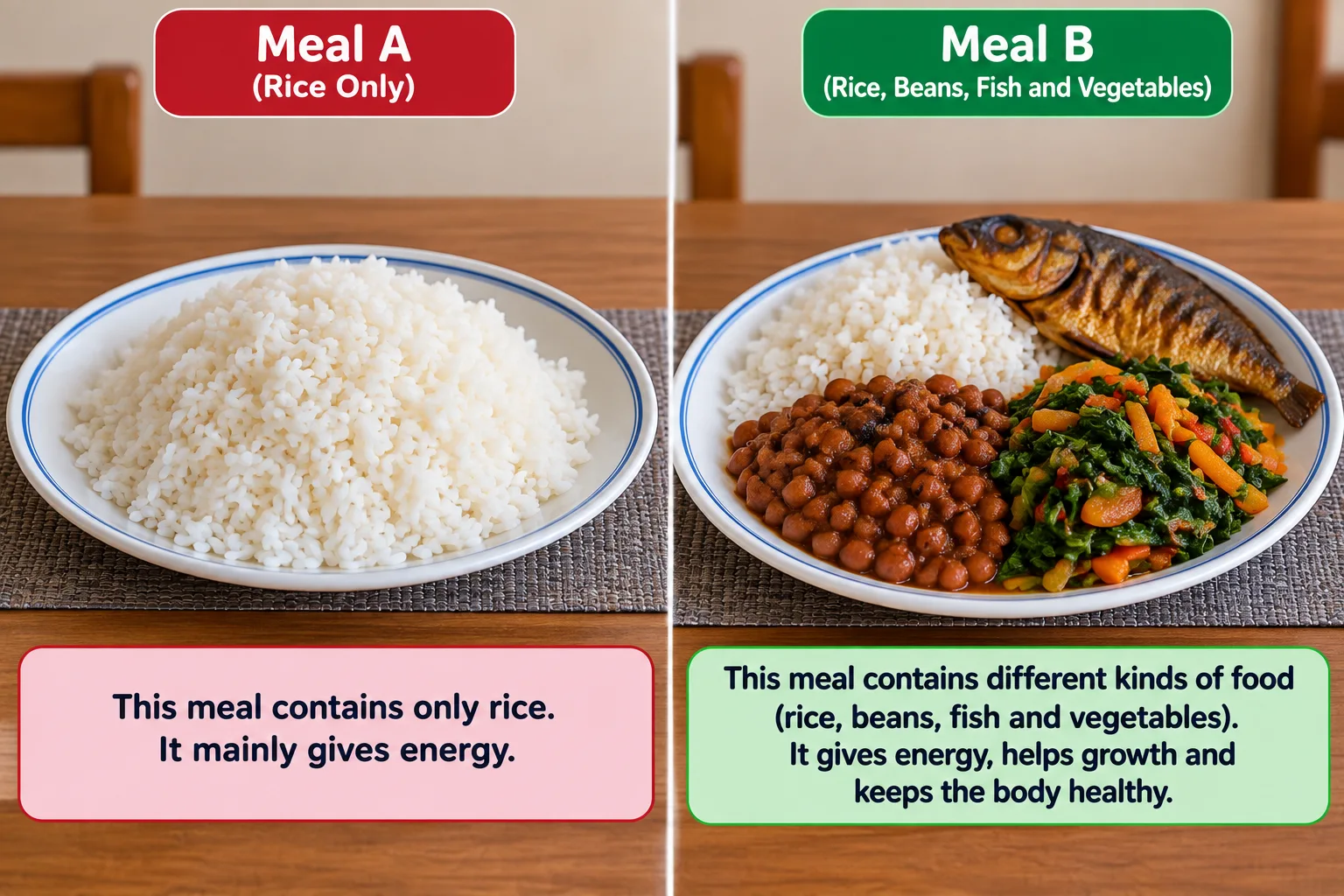
A balanced diet is a meal that contains different kinds of food in suitable amounts to help the body grow, get energy and remain healthy.
A balanced diet should not contain only one type of food.
For example, eating only rice every day does not give the body everything it needs.
A better meal may contain:
Rice + Beans + Fish + Vegetables + Fruit + Water
This meal contains different kinds of food that help the body in different ways.
Meaning of Classes of Food
Classes of food are groups into which foods are placed according to the nutrients they contain and the work they do in the body.
For this lesson, pupils will learn about:
- Carbohydrates
- Proteins
- Fats and oils
- Fruits and vegetables
- Water
Fruits and vegetables provide important vitamins and minerals that help keep the body healthy.
1. Carbohydrates
Carbohydrates are foods that mainly give the body energy.
We need energy to:
- walk;
- run;
- play;
- write;
- learn;
- exercise; and
- perform other activities.
Examples of Carbohydrate Foods
- rice;
- yam;
- garri;
- cassava;
- bread;
- maize;
- potatoes;
- plantain;
- pasta;
- pap.
Main Work of Carbohydrates
Carbohydrates mainly give the body energy.
A child needs energy to take part in school, play and other daily activities.
2. Proteins
Proteins are foods that help the body to grow and repair itself.
Children need protein because their bodies are still growing.
Examples of Protein Foods
- beans;
- fish;
- meat;
- eggs;
- milk;
- chicken;
- groundnuts.
Main Work of Proteins
Proteins help to:
- build the body;
- support growth;
- build muscles; and
- repair worn-out body tissues.
For this reason, protein foods are sometimes called body-building foods.
3. Fats and Oils
Fats and oils also provide the body with energy.
They are used when preparing many foods.
Examples of Fats and Oils
- palm oil;
- groundnut oil;
- vegetable oil;
- butter;
- margarine;
- fats found naturally in some foods.
Only a small amount of fats and oils is needed as part of a varied diet.
Main Work of Fats and Oils
Fats and oils:
- provide energy;
- help the body use some vitamins; and
- form part of many meals.
4. Fruits and Vegetables
Fruits and vegetables provide important vitamins and minerals.
They help support good health and are often called protective foods.
Examples of Fruits
- orange;
- banana;
- pawpaw;
- mango;
- pineapple;
- watermelon;
- guava.
Examples of Vegetables
- spinach;
- pumpkin leaves;
- carrot;
- tomato;
- okra;
- cabbage.
Main Work of Fruits and Vegetables
They help to:
- support good health;
- provide vitamins and minerals;
- help the body function properly; and
- provide fibre that helps normal digestion.
5. Water
Water is very important to the body.
We drink water every day because the body cannot work properly without enough water.
Sources of Water
We get water from:
- clean drinking water;
- fruits;
- vegetables;
- soups;
- some other foods and drinks.
Importance of Water
Water helps to:
- keep the body hydrated;
- help with digestion;
- carry useful substances around the body;
- help the body control temperature;
- replace water lost through sweating and urination.
Children should drink clean and safe water.
Simple Classes of Food Chart
|
Class of Food |
Main Work |
Examples |
|
Carbohydrates |
Give energy |
Rice, yam, garri, bread, maize |
|
Proteins |
Help growth and repair |
Beans, fish, meat, eggs, milk |
|
Fats and Oils |
Provide energy and help the body use some vitamins |
Palm oil, vegetable oil, butter |
|
Fruits and Vegetables |
Provide vitamins, minerals and fibre |
Orange, pawpaw, carrot, spinach |
|
Water |
Helps the body work properly |
Clean drinking water |
How Food Classes Work Together
Our body needs different nutrients.
That is why we should eat a variety of foods.
For example:
If a child eats only yam, the child gets mainly energy.
If the child eats:
Yam + Egg Sauce + Vegetables + Fruit + Water
the meal gives the body a wider variety of nutrients.
A Simple Balanced Meal
A balanced meal may contain:
- an energy food;
- a body-building food;
- vegetables or fruit;
- a small amount of fat or oil; and
- clean water.
Examples of Simple Balanced Meals
Example 1: Rice Meal
- Rice – carbohydrate
- Beans – protein and carbohydrate
- Fish – protein
- Vegetable stew – vitamins and minerals
- Water – hydration
Example 2: Yam Meal
- Yam – carbohydrate
- Egg sauce – protein
- Tomato and vegetables – vitamins and minerals
- Small amount of cooking oil – fat/oil
- Water – hydration
Example 3: Pap Meal
- Pap – carbohydrate
- Milk – protein and other nutrients
- Groundnuts or bean cake – protein
- Banana – fruit
- Water – hydration
Example 4: Garri and Soup
- Garri or eba – carbohydrate
- Vegetable soup – vitamins and minerals
- Fish or meat – protein
- Small amount of oil in the soup – fat/oil
- Water – hydration
Balanced and Unbalanced Meals
A meal is more balanced when it contains different useful foods rather than only one kind.
|
Meal |
Observation |
|
Rice only |
Mainly gives energy |
|
Rice + beans + fish + vegetables |
Contains different food classes |
|
Yam only |
Mainly gives energy |
|
Yam + egg + vegetables + fruit |
Contains different food classes |
|
Bread only |
Mainly gives energy |
|
Bread + egg + fruit + milk |
Contains different food classes |
Why We Should Eat Different Kinds of Food
We should eat different kinds of food because no single food gives the body everything it needs in the right amount.
Different foods help the body in different ways.
For example:
- carbohydrates give energy;
- proteins help growth;
- fats and oils provide energy;
- fruits and vegetables provide vitamins and minerals;
- water helps the body function properly.
Combining different foods helps us to obtain a wider range of nutrients.
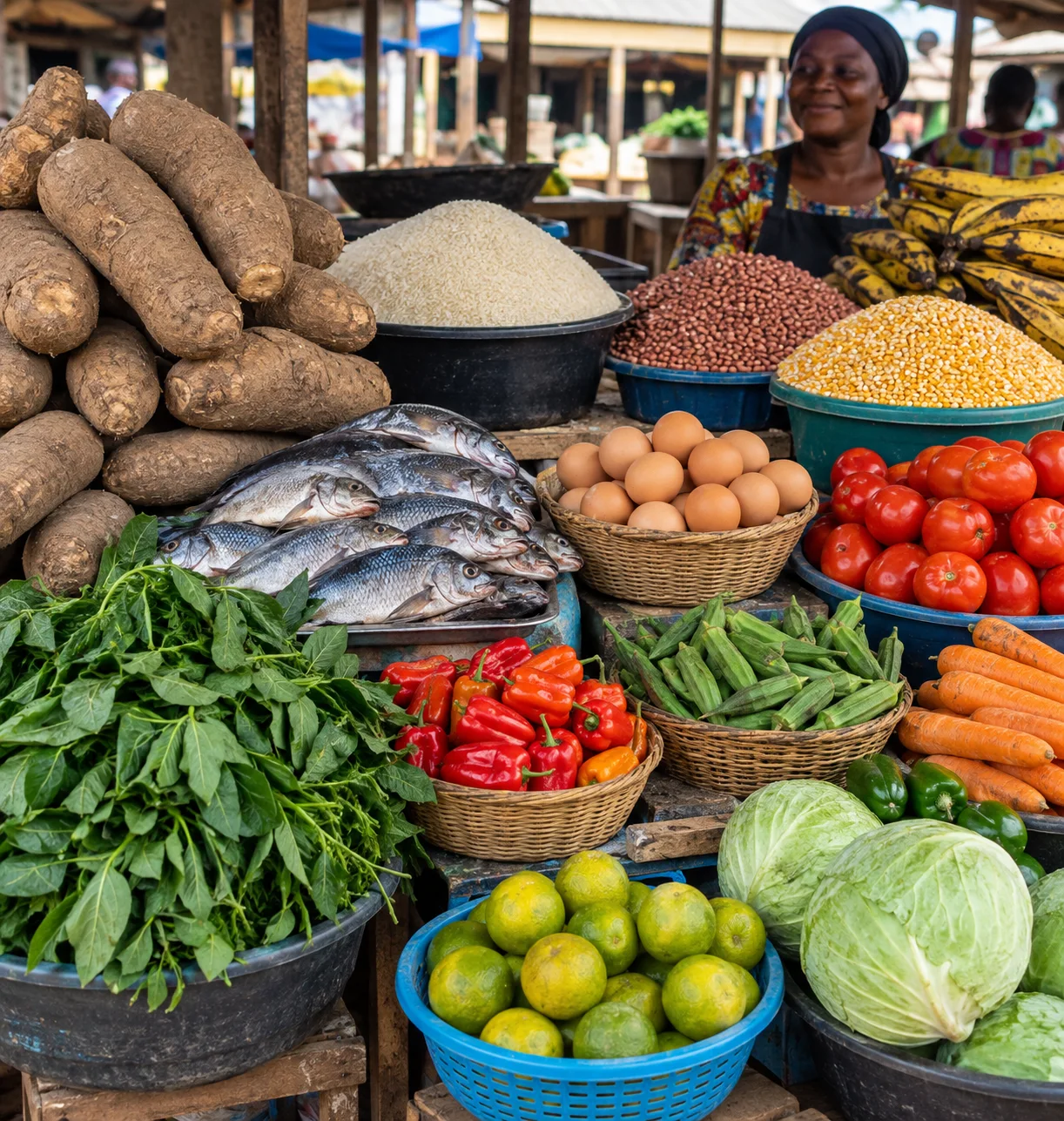
Choosing Local Foods
A balanced diet does not have to contain expensive foods.
Many foods commonly found in Nigeria can be combined to make good meals.
Examples include:
- rice and beans;
- yam and egg;
- pap and bean cake;
- garri and vegetable soup with fish;
- maize and beans;
- plantain and beans.
Fruits and vegetables that are available locally can also be added.
Healthy Eating Reminders
Pupils should remember to:
- eat different kinds of food;
- include fruits and vegetables in meals;
- eat protein foods regularly;
- drink clean water;
- wash their hands before eating;
- eat clean and properly cooked food;
- avoid spoiled food; and
- listen to parents or caregivers about healthy meals.
Remember
A balanced diet contains different types of food in suitable amounts to help the body grow, get energy and remain healthy.
Important classes of food include:
- carbohydrates – mainly give energy;
- proteins – help growth and repair;
- fats and oils – provide energy;
- fruits and vegetables – provide vitamins, minerals and fibre;
- water – helps the body work properly.
We should eat different kinds of food because each class performs an important job in the body.
F: LESSON PRESENTATION
F1: Teachers’ Activities
- The teacher revises Week 8 by asking pupils to name the three simple food groups.
- The teacher displays pictures or samples of different foods.
- The teacher asks pupils to identify the foods.
- The teacher introduces the meaning of a balanced diet.
- The teacher explains that a balanced meal contains different kinds of food.
- The teacher introduces carbohydrates and shows local examples.
- The teacher introduces proteins and explains their importance for growth.
- The teacher displays fats and oils and explains their simple function.
- The teacher displays fruits and vegetables and explains their protective role.
- The teacher shows clean drinking water and discusses its importance.
- The teacher draws or displays the classes-of-food table.
- The teacher presents examples of simple Nigerian balanced meals.
- The teacher compares a plate containing only one food with a plate containing different foods.
- The teacher gives pupils food picture cards and asks them to classify the foods.
- The teacher allows pupils to suggest simple balanced meals using familiar foods.
- The teacher corrects errors and summarises the lesson.
F2: Pupils’ Activities
- Pupils recall the food groups learnt in Week 8.
- Pupils identify the foods displayed by the teacher.
- Pupils repeat the meaning of a balanced diet.
- Pupils identify carbohydrate foods.
- Pupils identify protein foods.
- Pupils identify fats and oils.
- Pupils name familiar fruits and vegetables.
- Pupils state reasons why water is important.
- Pupils sort food pictures into the correct classes.
- Pupils compare balanced and less-varied meals.
- Pupils suggest simple balanced meals.
- Pupils answer questions and copy important notes.
G: CONCLUSION
The teacher revises the meaning of a balanced diet and asks pupils to name the different classes of food.
The teacher reminds pupils that the body needs different kinds of food, not just one food all the time.
Pupils are encouraged to eat familiar local foods in suitable combinations, include fruits and vegetables where available, drink clean water and maintain good food hygiene.
The teacher emphasises that a simple meal can be balanced when it contains foods that provide energy, growth and protection.
Next Lesson: Primary 2 Home Economics First Term – Week 10: IMPORTANCE OF GOOD FOOD AND GOOD EATING HABITS
H: EVALUATION GUIDE
Oral Questions
- What is a balanced diet?
- What do we mean by classes of food?
- Mention four carbohydrate foods.
- What do carbohydrates mainly give the body?
- Mention four protein foods.
- What do proteins help the body to do?
- Mention three examples of fats and oils.
- Mention four fruits and four vegetables.
- State three reasons why water is important.
- Give two examples of simple balanced meals.
Written Exercise
A. Fill in the blanks with suitable words.
- A __________ diet contains different kinds of food in suitable amounts.
- Rice and yam are examples of __________.
- Beans and fish are rich in __________.
- Fruits and vegetables provide vitamins and __________.
- We should drink clean __________ every day.
B. Match each food with its main class.
|
Food |
Class |
|
1. Rice |
A. Protein |
|
2. Fish |
B. Fruit |
|
3. Orange |
C. Carbohydrate |
|
4. Palm oil |
D. Fat/Oil |
|
5. Beans |
E. Protein |
C. Choose the Better Meal
Write A or B.
- A. Rice only
B. Rice, beans, fish and vegetables
Answer: _______ - A. Yam only
B. Yam, egg sauce and fruit
Answer: _______ - A. Bread only
B. Bread, egg, milk and banana
Answer: _______
Practical Activity
The teacher provides food picture cards showing:
- rice;
- yam;
- beans;
- fish;
- egg;
- palm oil;
- orange;
- carrot;
- banana;
- water.
Pupils should:
- sort the pictures into the correct food classes;
- select foods from different classes; and
- use the selected pictures to form a simple balanced meal.
Take-Home Activity
Write the names of five foods eaten in your home.
State the class of food each one belongs to.
Then draw and colour a plate showing one simple balanced meal.