
TOPIC: REST – MEANING AND IMPORTANCE
A: TEACHING AND LEARNING MATERIALS
- Pictures of children resting after different activities.
- Pictures of a bed, mattress, mat and chair.
- Chart showing activities that require rest afterwards.
- Pictures showing a tired child and a well-rested child.
- Flash cards containing words such as rest, work, play, tired and relax.
- A chair or mat for demonstrating simple ways of resting.
- Chart showing suitable periods for rest.
B: REFERENCE MATERIALS
- Primary 2 Home Economics Scheme of Work (All Three Terms)
- Recommended Home Economics textbook for Primary 2 (school-approved edition)
- CDC – About Sleep
C: PREVIOUS KNOWLEDGE
Pupils have learnt about exercise, different types of exercise and how to exercise safely.
They know that activities such as walking, running, jumping, skipping and playing make the body active. After using the body for work or exercise, the body also needs time to rest.
Previous Lesson: Primary 2 Home Economics First Term – Week 4: WHEN AND HOW TO EXERCISE
D: PERFORMANCE OBJECTIVES
By the end of the lesson, pupils should be able to:
- explain the meaning of rest;
- mention different ways of resting;
- state at least five reasons why rest is important;
- identify suitable periods for rest;
- explain the difference between activity and rest;
- demonstrate simple ways of resting; and
- state good resting habits.
E: CONTENT
Meaning of Rest
Rest means stopping work or activity for some time so that the body and mind can relax.
When we rest, we reduce our activities and allow the body to become calm.
For example, a child who has been running around the playground may sit quietly for some time to rest.
We can rest by:
- sitting quietly;
- lying down comfortably;
- relaxing after work;
- reducing active movement; or
- staying calm for a short period.
Rest is an important part of healthy living.
Rest Does Not Always Mean Sleep
Rest and sleep are related, but they are not exactly the same.
During ordinary rest, a person may still be awake.
For example:
- Ada sits quietly on a chair after sweeping.
- Musa lies on a mat and relaxes after playing football.
- Ngozi sits under a tree after running.
They are resting, but they may still be awake.
During sleep, the body enters a deeper period of rest and the person is usually not aware of normal activities around him or her.
Pupils will learn more about sleep in the next lesson.
Rest and Sleep
|
Rest |
Sleep |
|
We may remain awake. |
We are usually asleep. |
|
We stop or reduce activity. |
The whole body settles into deeper rest. |
|
We may sit or lie quietly. |
We normally lie down to sleep. |
|
Rest may be taken for a short period. |
Sleep usually lasts much longer. |
Why Do We Need Rest?
We use energy when we:
- run;
- play;
- study;
- walk;
- exercise;
- help with simple household work; and
- perform other daily activities.
After these activities, the body may become tired.
Rest gives the body an opportunity to relax before we continue with other activities.
Importance of Rest
Rest is important to everyone, especially growing children.
1. Rest Helps to Reduce Tiredness
After running, playing or working, the body may feel tired.
Rest helps the body to relax.
For example, after a Physical Education lesson, pupils may sit calmly for a short time before returning to another classroom activity.
2. Rest Helps the Body Recover After Activity
The body works during exercise and other physical activities.
A short period of rest afterwards allows the body to settle down.
3. Rest Helps Us to Feel Refreshed
A person who has rested properly may feel more comfortable and ready to continue with another activity.
4. Rest Helps Us to Concentrate
Children do many activities at school.
A suitable break between activities can help pupils return to their work feeling calmer and more ready to pay attention.
5. Rest Helps Us Balance Work and Activity
We should not work, play or exercise continuously without a break.
There should be time for:
- work;
- play;
- exercise;
- meals;
- rest; and
- sleep.
6. Rest Helps the Body Prepare for More Activities
After resting, the body may be ready for other suitable activities.
For example:
Play → Rest → Another Activity
When Should We Rest?
There are different times when children may need to rest.
1. After Exercise
Exercise makes the body active.
After running, skipping, playing football or doing other exercises, we should slow down and allow the body to rest.
2. After Playing
Children may become tired after active play.
A short period of quiet rest can help the body become calm again.
3. After School
Children may feel tired after spending several hours learning, writing, reading and taking part in school activities.
After returning home, a child may wash up, eat as appropriate and take a reasonable period of rest before other activities.
4. After Doing Simple Work
Children may help with suitable household duties such as:
- sweeping;
- arranging their room;
- putting away toys;
- arranging books; or
- helping to tidy the home.
After completing an activity, they may rest for a while if they are tired.
5. When We Feel Tired
Tiredness is one of the signs that the body may need a break.
A child who feels unusually weak or unwell should tell a parent, teacher or other responsible adult.
Signs That a Person May Need Rest
A tired person may:
- move more slowly;
- sit down often;
- feel weak;
- lose interest in continuing an activity;
- find it difficult to pay attention; or
- want to relax quietly.
These signs do not always mean illness, but if a child feels very weak, dizzy, sick or unusually tired, he or she should inform an adult.
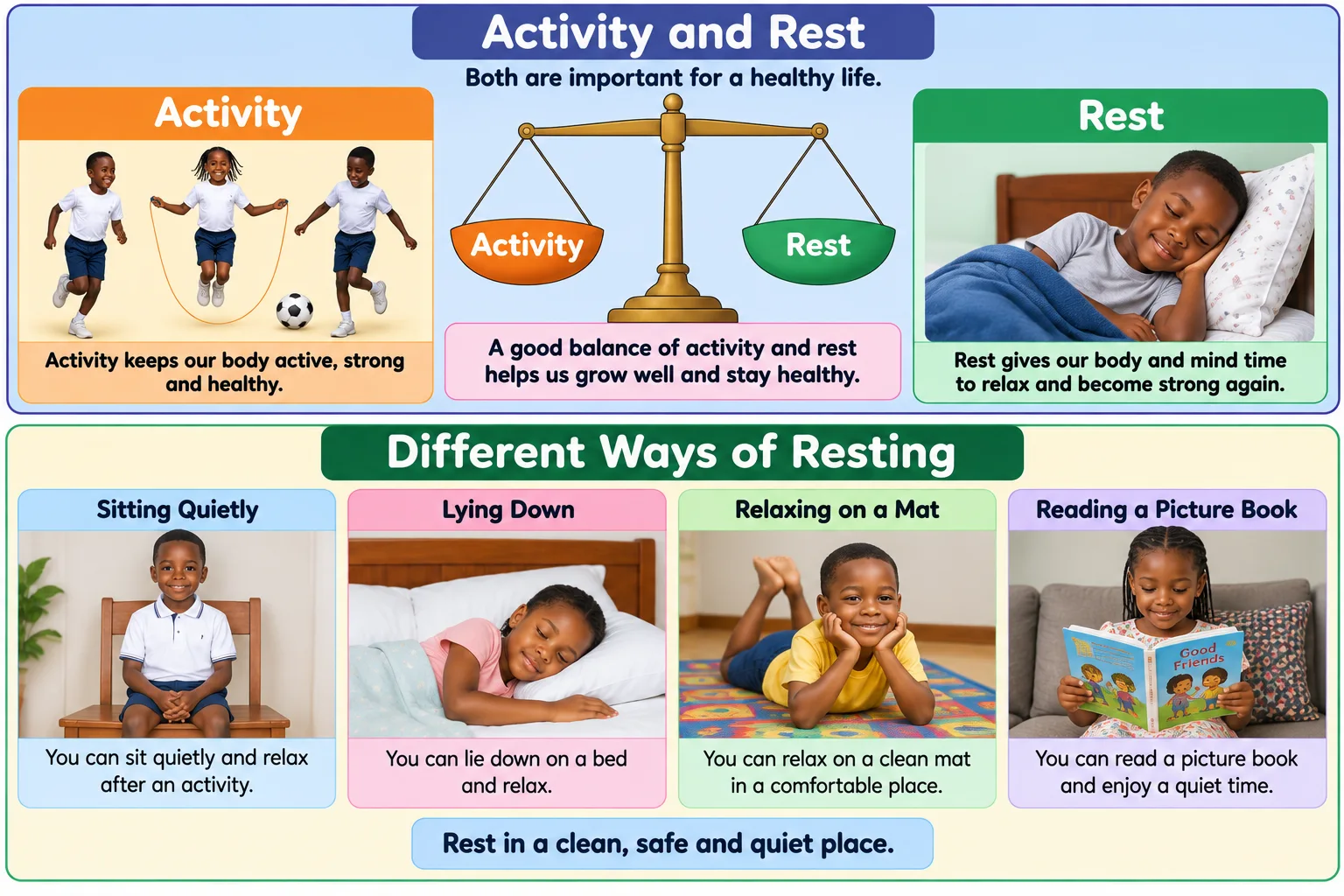
Ways of Resting
There are different healthy ways to rest.
1. Sitting Quietly
A person can sit comfortably on a chair, bench or other safe place.
2. Lying Down
A person may lie comfortably on a bed, mattress or clean mat.
3. Relaxing in a Quiet Place
Rest is easier in a place that is calm, comfortable and safe.
4. Taking a Break from Activity
Stopping active play or work for a short time is also a way of resting.
5. Doing a Calm Activity
Some calm activities may help a child relax, such as:
- sitting quietly;
- listening to a simple story;
- looking at a picture book; or
- talking quietly with a parent.
Suitable Places for Rest
We should rest in a place that is:
- clean;
- safe;
- comfortable;
- well ventilated; and
- free from unnecessary disturbance.
Suitable places may include:
- a clean bedroom;
- a comfortable sitting room;
- a shaded resting area;
- a clean mat; or
- another safe place chosen by a responsible adult.
We should not rest:
- on a busy road;
- near an open fire;
- beside dangerous machines;
- on a dirty floor;
- near broken bottles or sharp objects; or
- in any unsafe place.
Good Resting Habits
Good habits make rest more comfortable and useful.
Pupils should:
- rest after strenuous activities when necessary;
- choose a clean and safe place;
- sit or lie in a comfortable position;
- avoid disturbing someone who is resting;
- avoid playing roughly around a resting person;
- keep the resting area clean;
- return to suitable activities after enough rest; and
- tell an adult if tiredness does not improve or they feel unwell.
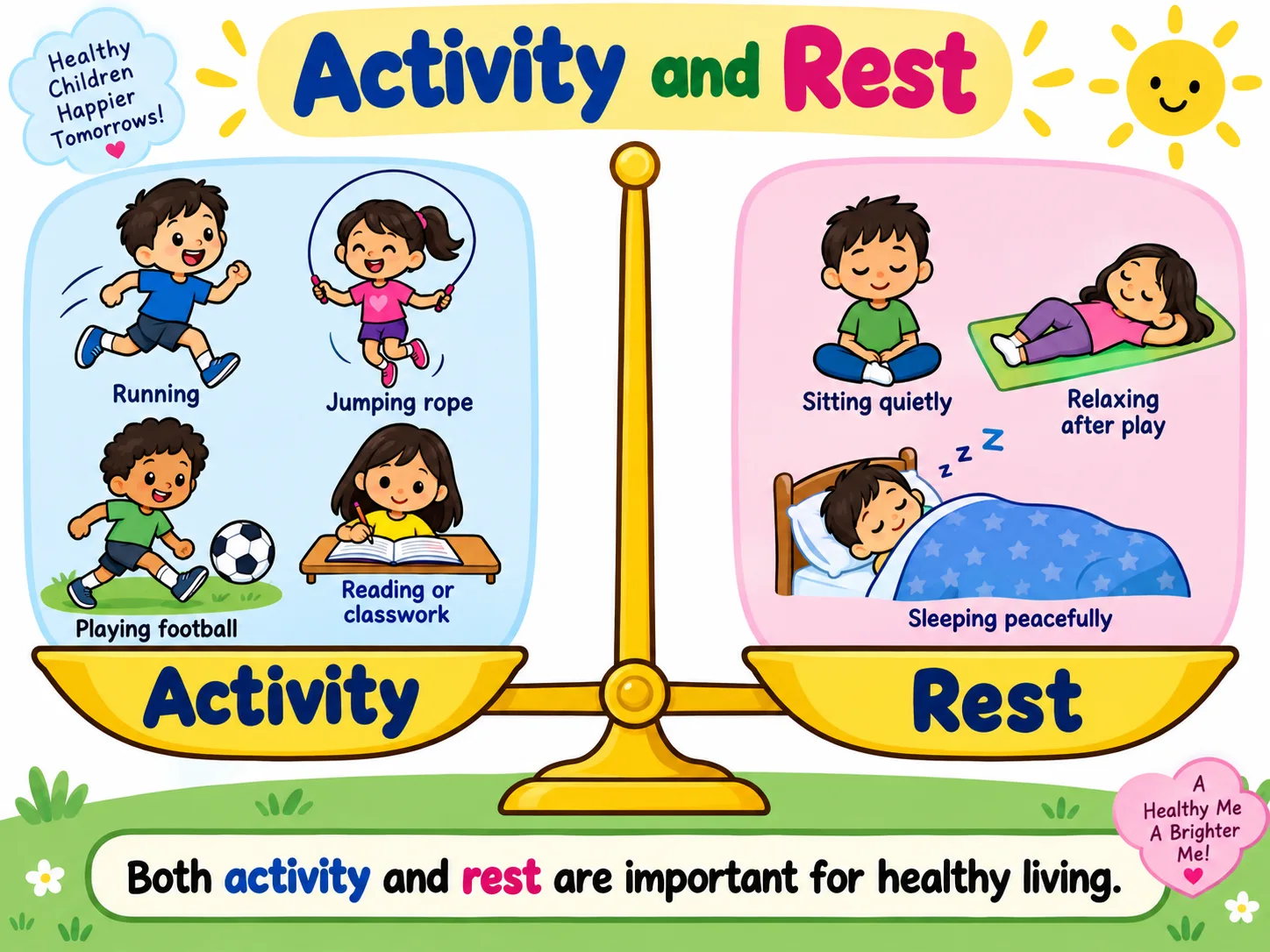
Activities and Rest
Our daily activities should have a good balance.
|
Activity |
What May Follow |
|
Running |
Slow down and rest |
|
Playing football |
Take a short break and drink water when needed |
|
School activities |
Have suitable break periods |
|
Household chores |
Rest when tired |
|
Studying for some time |
Take an appropriate break |
|
Active outdoor play |
Calm down and rest afterwards |
Remember
Rest means stopping or reducing work and activity for some time so that the body and mind can relax.
Rest is important because it:
- reduces tiredness;
- helps the body settle after activity;
- helps us feel refreshed;
- helps us return to activities with better attention; and
- helps us balance work, play and other daily activities.
We may need rest after exercise, after active play, after school, after work or whenever we become tired.
F: LESSON PRESENTATION
F1: Teachers’ Activities
- The teacher revises the previous lesson by asking pupils to mention different types of exercise.
- The teacher asks pupils how they feel after running or playing for a long time.
- The teacher introduces the topic Rest.
- The teacher explains rest as stopping or reducing activity so that the body and mind can relax.
- The teacher shows pictures of children resting in different ways.
- The teacher demonstrates resting by sitting quietly and lying comfortably on a mat where appropriate.
- The teacher explains the difference between rest and sleep in simple language.
- The teacher discusses the importance of rest with familiar examples.
- The teacher asks pupils to mention times when they usually feel tired.
- The teacher discusses periods when children may need to rest.
- The teacher shows pupils pictures of safe and unsafe places for rest.
- The teacher discusses good resting habits.
- The teacher allows pupils to demonstrate simple ways of resting.
- The teacher asks questions to check pupils’ understanding and corrects mistakes where necessary.
F2: Pupils’ Activities
- Pupils mention types of exercise learnt in the previous lesson.
- Pupils describe how they feel after running or playing.
- Pupils listen to the meaning of rest.
- Pupils observe pictures of people resting.
- Pupils mention different ways of resting.
- Pupils identify suitable times for rest.
- Pupils distinguish between rest and sleep.
- Pupils identify safe and unsafe resting places.
- Pupils demonstrate sitting quietly and relaxing appropriately.
- Pupils state reasons why rest is important.
- Pupils mention good resting habits.
- Pupils answer the teacher’s questions and copy important notes.
G: CONCLUSION
The teacher revises the lesson by asking pupils to explain the meaning of rest.
The teacher emphasises that rest is important after work, exercise and other tiring activities because it allows the body and mind to relax.
Pupils are reminded that healthy living requires a good balance between activity and rest.
The teacher also explains that rest is not exactly the same as sleep. A person can rest while still awake, while sleep is a deeper form of rest that pupils will study in the next lesson.
Next Lesson: Primary 2 Home Economics First Term – Week 6: SLEEP – MEANING AND IMPORTANCE
H: EVALUATION GUIDE
Oral Questions
- What is rest?
- Mention three ways of resting.
- State five reasons why rest is important.
- Mention four times when a child may need to rest.
- What is the difference between rest and sleep?
- Mention three suitable places for rest.
- Mention three places where we should not rest.
- What should you do when you become tired after exercise?
- Mention four good resting habits.
- Why should we balance activity with rest?
Written Exercise
A. Fill in the blanks with suitable words.
- __________ means stopping or reducing activity so that the body can relax.
- We may need to rest after __________.
- A clean bed or mat can be used for __________.
- Rest helps to reduce __________.
- During ordinary rest, a person may still be __________.
B. Write “Good” or “Bad” beside each resting habit.
- Resting in a clean and safe place. __________
- Lying beside broken bottles. __________
- Taking a break after active play. __________
- Disturbing another person who is resting. __________
- Sitting quietly when tired. __________
Practical Activity
The teacher presents pictures showing the following situations:
- A pupil resting after running.
- A child lying near a busy road.
- A pupil sitting quietly after school.
- A child resting on a clean mat.
- A child playing roughly beside someone who is resting.
Pupils should identify each situation as good resting practice or bad resting practice and explain their answers.
Take-Home Activity
Write five reasons why rest is important.
Draw and colour a picture of a child resting after playing.