
TOPIC: WHEN AND HOW TO EXERCISE
A: TEACHING AND LEARNING MATERIALS
- Pictures of children exercising in the morning and evening.
- Chart showing suitable times for exercise.
- Pictures showing safe and unsafe places for exercise.
- Sportswear or simple exercise clothes.
- Pair of sports shoes.
- Bottle of clean drinking water.
- Skipping rope.
- Exercise mat or clean floor space.
- Flash cards showing simple safety rules.
B: REFERENCE MATERIALS
- Primary 2 Home Economics Scheme of Work (All Three Terms)
- Recommended Home Economics textbook for Primary 2 (school-approved edition)
- World Health Organization – Physical Activity
C: PREVIOUS KNOWLEDGE
Pupils have learnt about different types of exercise. They can identify and demonstrate exercises such as walking, running, jogging, jumping, skipping, stretching, bending and dancing.
They also know that exercise helps to keep the body active and supports strong muscles and bones.
Previous Lesson: Primary 2 Home Economics First Term – Week 3: TYPES OF EXERCISE
D: PERFORMANCE OBJECTIVES
By the end of the lesson, pupils should be able to:
- mention suitable times for taking exercise;
- explain why some times are more comfortable for outdoor exercise;
- mention places where children can exercise safely;
- state simple steps to follow before, during and after exercise;
- identify suitable clothes for exercise;
- demonstrate a simple warm-up exercise; and
- state at least five safety rules to observe during exercise.
E: CONTENT
Revision: What Is Exercise?
Exercise is an activity in which we move our body to help keep it active, fit and healthy.
Examples of exercise include:
- walking;
- running;
- jogging;
- jumping;
- skipping;
- stretching;
- bending;
- dancing; and
- playing active games.
Exercise is good for children, but it should be done at a suitable time and in a safe way.
When Can We Exercise?
Children can be physically active at different times during the day.
For outdoor exercise, it is usually more comfortable to choose a time when the weather is not extremely hot.
1. In the Morning
Morning is a good time for simple exercise.
The weather is often cooler in the morning.
Examples of morning exercises are:
- stretching;
- walking;
- jogging;
- skipping; and
- simple jumping exercises.
A child may perform a few simple movements before getting ready for school, with the knowledge of a parent or responsible adult.
[Insert Image: A child doing simple stretching exercises outside the home in the cool morning.]
2. During Physical Activity at School
Children also exercise at school.
They may exercise during:
- Physical Education lessons;
- sports activities;
- supervised playground activities; and
- organised school games.
The teacher should guide pupils and make sure the exercise area is safe.
3. In the Late Afternoon or Early Evening
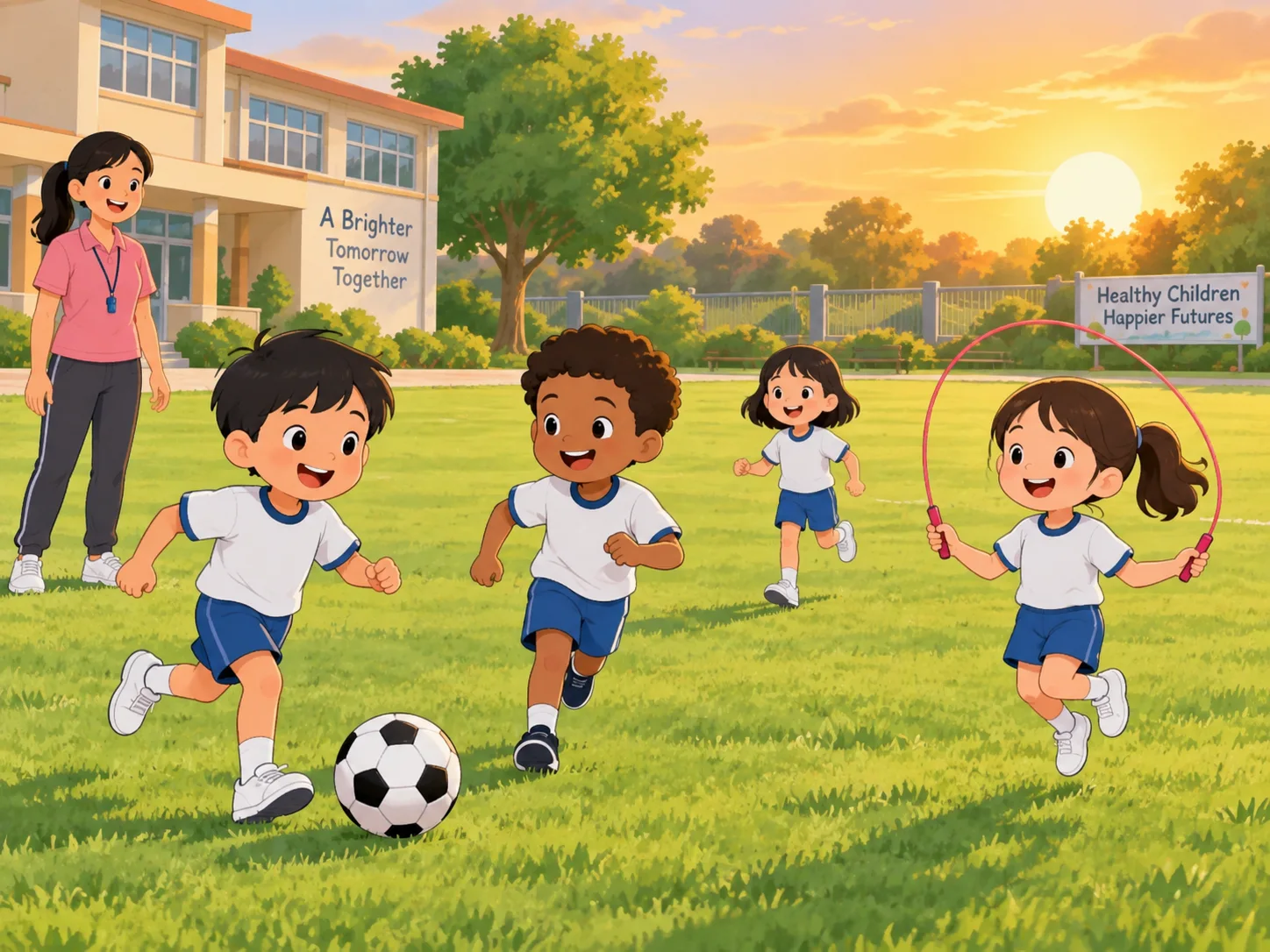
Children may also exercise in the late afternoon or early evening when the weather is cooler.
Examples include:
- playing football;
- skipping;
- taking a walk with an adult;
- dancing;
- running; and
- playing active games.
Children should exercise in a safe place and under proper supervision where necessary.
Choosing a Suitable Time for Exercise
Exercise can be done at different times. What is important is to consider the weather, place and safety.
|
Time or Condition |
What to Do |
|
Cool morning |
Suitable for walking, jogging, stretching and skipping |
|
School exercise period |
Follow the teacher’s instructions |
|
Cool late afternoon |
Suitable for outdoor games and exercise |
|
Very hot sunshine |
Avoid strenuous outdoor exercise when possible |
|
Heavy rain or dangerous weather |
Stay in a safe place |
|
When feeling sick or very weak |
Tell an adult and rest instead of forcing the body |
Exercise does not have to take place only at one particular hour. Children can be active at different times as long as the activity is suitable and safe.
Outdoor physical activity is generally safer and more comfortable when extreme heat is avoided. Children should also be given opportunities for regular, age-appropriate activity throughout the day.
How to Exercise Properly
There are simple things we should do before, during and after exercise.
Before Exercise
1. Choose a Safe Place
Exercise should be done in a safe place.
Suitable places may include:
- school playground;
- sports field;
- clean compound;
- open recreation area; and
- another safe space approved by an adult.
The exercise area should be free from:
- broken bottles;
- sharp objects;
- stones that may cause someone to fall;
- dangerous holes; and
- moving vehicles.
[Insert Image: Two pictures for comparison — a clean, open playground suitable for exercise and an unsafe area containing broken bottles, rubbish and other dangerous objects.]
2. Wear Suitable Clothes
Children should wear clothes that allow them to move comfortably.
Suitable exercise clothes may include:
- T-shirt;
- shorts or tracksuit;
- socks; and
- suitable sports shoes where needed.
Very tight, very heavy or uncomfortable clothing may make movement difficult.
3. Warm Up the Body
A warm-up is a few gentle movements we do before more active exercise.
Simple warm-up activities include:
- walking slowly;
- raising the arms;
- gently stretching the arms;
- gently stretching the legs;
- bending carefully; and
- jogging slowly for a short time.
Warming up prepares the body for more active movement.
During Exercise
1. Start Gently
Exercise should begin slowly.
For example, a pupil who wants to run may first:
- walk;
- jog slowly; and
- then run at a comfortable speed.
Children should not force themselves to perform exercises that are too difficult for them.
2. Keep Enough Space
Pupils should leave enough space between themselves and other people.
This helps to prevent:
- pushing;
- hitting another person;
- falling over one another; and
- accidents with ropes or balls.
3. Follow Instructions
At school, pupils should listen carefully to the teacher.
If the teacher says:
- stop;
- walk;
- form a line;
- keep your distance; or
- leave the field,
pupils should obey immediately.
4. Drink Clean Water
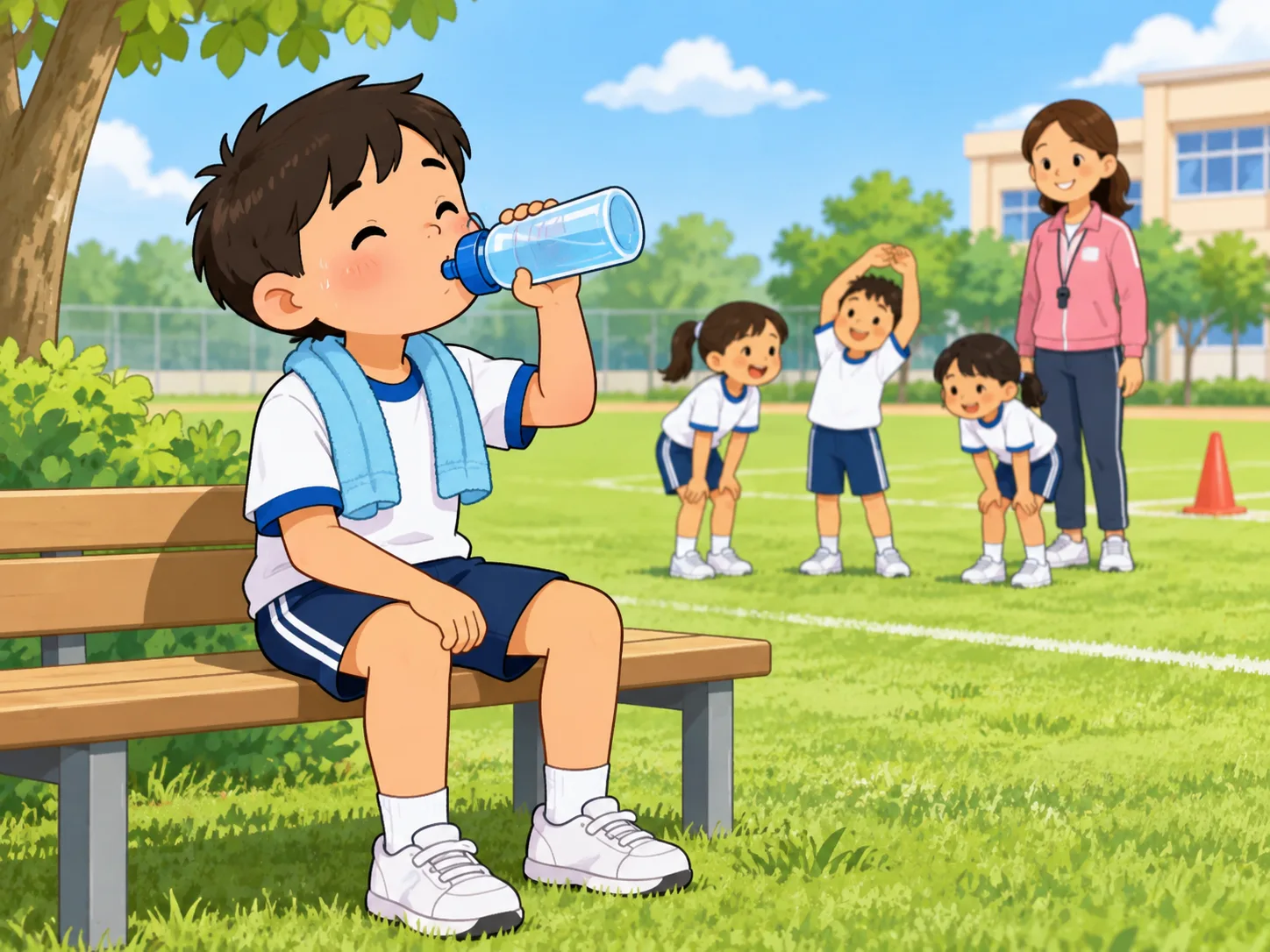
Exercise can make us feel hot and thirsty.
Clean drinking water should be available, especially during longer periods of activity or hot weather.
Children should be allowed to drink water when necessary.
5. Do Not Push Others
Exercise and games should be friendly.
Pupils should not:
- push;
- kick;
- trip;
- fight; or
- deliberately cause another person to fall.
After Exercise
1. Slow Down
After active exercise, do not suddenly continue running around.
Children can slow down by:
- walking gently;
- breathing normally;
- stretching gently; and
- standing or sitting calmly after movement has reduced.
This is sometimes called cooling down.
2. Rest
The body needs a short period of rest after strenuous activity.
Rest allows the body to become calm again.
3. Drink Water
Drink clean water when needed after exercise.
4. Clean the Body
Exercise may make the body sweat.
After heavy exercise, we should keep ourselves clean by:
- wiping sweat with a clean towel;
- washing the hands and face;
- changing very sweaty clothes when possible; and
- bathing when necessary.
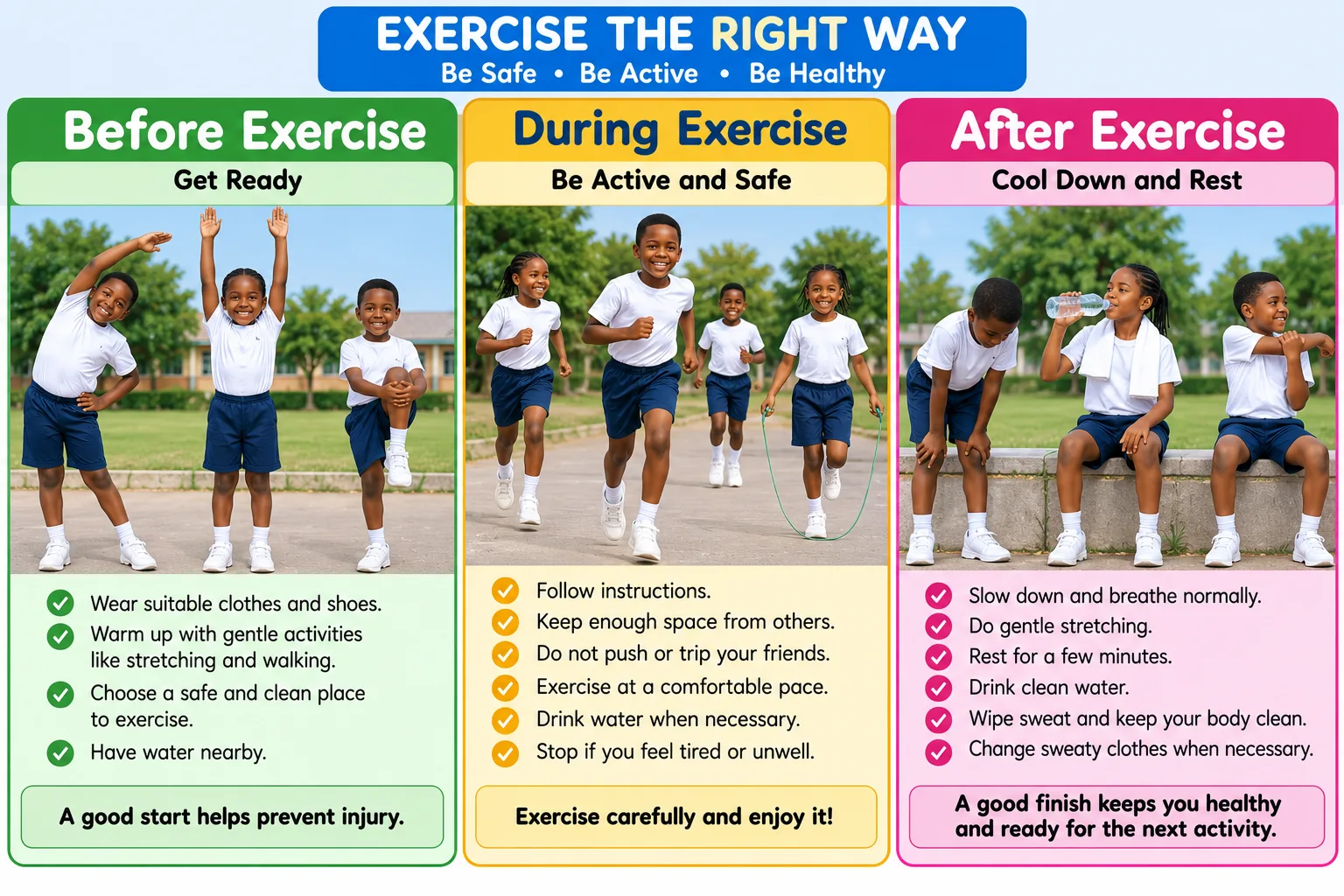
Before, During and After Exercise
|
Before Exercise |
During Exercise |
After Exercise |
|
Choose a safe place |
Follow instructions |
Slow down gradually |
|
Wear suitable clothes |
Keep enough space |
Rest |
|
Warm up gently |
Exercise carefully |
Drink water |
|
Check the surroundings |
Avoid pushing others |
Clean the body |
|
Prepare drinking water |
Stop if something is wrong |
Change sweaty clothes when necessary |
When Should a Child Stop Exercising?
Exercise should not cause a child to continue when something feels seriously wrong.
A pupil should stop and tell a teacher, parent or responsible adult if he or she:
- feels very weak;
- feels dizzy;
- has serious pain;
- finds it difficult to continue;
- gets injured; or
- becomes unusually unwell.
Children should never be forced to continue an activity when they are injured or unwell.
Safety Rules During Exercise
Pupils should remember these rules:
- Exercise in a safe place.
- Follow the instructions of the teacher or responsible adult.
- Wear suitable clothes and footwear.
- Warm up before active exercise.
- Do not push or trip other people.
- Keep away from dangerous objects.
- Drink clean water when necessary.
- Avoid strenuous outdoor activity under very hot sunshine where possible.
- Stop and tell an adult if you feel unwell or get injured.
- Exercise according to your age and ability.
Remember
Exercise can be done at different suitable times.
Morning, supervised school activity periods and cooler late-afternoon periods are convenient times for many outdoor exercises.
Before exercise, we should choose a safe place, wear suitable clothes and warm up.
During exercise, we should follow instructions, keep enough space and exercise safely.
After exercise, we should slow down, rest, drink water when needed and keep the body clean.
F: LESSON PRESENTATION
F1: Teachers’ Activities
- The teacher revises the previous lesson by asking pupils to mention different types of exercise.
- The teacher asks pupils when they usually run, skip, play football or perform other exercises.
- The teacher introduces the topic When and How to Exercise.
- The teacher displays pictures showing morning, school-time and late-afternoon exercise.
- The teacher explains why very hot conditions may not be suitable for strenuous outdoor activity.
- The teacher shows pupils suitable clothes and shoes for physical activity.
- The teacher takes pupils to a safe open space where possible.
- The teacher asks pupils to inspect the area and identify anything that could cause an accident.
- The teacher demonstrates a simple warm-up using walking, stretching and gentle jogging.
- The teacher allows pupils to perform the warm-up movements.
- The teacher demonstrates how pupils should keep enough space from one another.
- The teacher explains the importance of drinking clean water when necessary.
- The teacher demonstrates how to slow down and cool down after exercise.
- The teacher discusses situations in which a child should stop exercising and inform an adult.
- The teacher revises the safety rules with the class.
F2: Pupils’ Activities
- Pupils mention the exercises learnt in the previous lesson.
- Pupils state when they usually exercise.
- Pupils observe the pictures showing different times for exercise.
- Pupils identify suitable and unsuitable exercise conditions.
- Pupils inspect exercise clothes and footwear shown by the teacher.
- Pupils identify safe and unsafe exercise areas from pictures.
- Pupils practise simple warm-up movements.
- Pupils demonstrate how to keep enough space while exercising.
- Pupils practise walking, jogging or another simple activity under supervision.
- Pupils demonstrate a simple cool-down.
- Pupils state what they should do if they become injured or unwell during exercise.
- Pupils answer the teacher’s questions and copy important notes.
G: CONCLUSION
The teacher revises the lesson by asking pupils to mention suitable times and conditions for exercise.
The teacher reminds pupils that exercise can be done during the morning, school physical activity periods and cooler parts of the day, provided the place and conditions are safe.
Pupils are reminded to warm up before active exercise, follow instructions during exercise and slow down afterwards.
The teacher emphasises that exercise should be enjoyable and safe. Pupils should immediately tell a responsible adult if they become injured or feel unwell during physical activity.
Next Lesson: Primary 2 Home Economics First Term – Week 5: REST – MEANING AND IMPORTANCE
H: EVALUATION GUIDE
Oral Questions
- What is exercise?
- Mention three suitable times or periods when children may exercise.
- Why may very hot sunshine be unsuitable for strenuous outdoor exercise?
- Mention three safe places where children can exercise.
- What is a warm-up?
- Mention three simple warm-up activities.
- Mention three things we should do during exercise.
- What should we do after exercise?
- Why should we drink clean water when necessary during physical activity?
- Mention five safety rules for exercise.
Written Exercise
A. Fill in the blanks with suitable words.
- We should exercise in a __________ place.
- Gentle movements done before active exercise are called a __________.
- We should wear suitable __________ when exercising.
- We should drink clean __________ when necessary.
- A child who gets injured during exercise should tell a responsible __________.
B. Write “Safe” or “Unsafe” beside each activity.
- Stretching gently before running. __________
- Pushing another pupil while running. __________
- Exercising on a clean playground. __________
- Running close to broken bottles. __________
- Following the teacher’s instructions. __________
- Drinking clean water when necessary. __________
Practical Activity
The teacher should organise pupils into small groups.
Each group should demonstrate:
- one simple warm-up activity;
- one active exercise such as jogging or skipping; and
- one simple cool-down activity.
The teacher observes whether pupils follow instructions, keep enough space and perform the activities safely.
Take-Home Activity
Write five rules for safe exercise.
Draw and colour a picture showing a child exercising safely in a suitable place.