
TOPIC: TYPES OF EXERCISE
A: TEACHING AND LEARNING MATERIALS
- Pictures showing different types of exercise.
- Skipping rope.
- Football.
- Small playground ball.
- Exercise mat or clean floor space.
- Sportswear.
- Chart showing different body movements.
- Flash cards with names of exercises.
B: REFERENCE MATERIALS
- Primary 2 Home Economics Scheme of Work (All Three Terms)
- Recommended Home Economics textbook for Primary 2 (school-approved edition)
- World Health Organization – Physical Activity
C: PREVIOUS KNOWLEDGE
Pupils have learnt the meaning and importance of exercise. They know that exercise involves moving the body to keep it active, fit and healthy.
They have also learnt that exercise helps to strengthen the muscles and bones, improves body movement and helps children to remain active.
Previous Lesson: Primary 2 Home Economics First Term – Week 2: EXERCISE – MEANING AND IMPORTANCE
D: PERFORMANCE OBJECTIVES
By the end of the lesson, pupils should be able to:
- explain the meaning of exercise;
- mention at least six types of exercise;
- identify different exercises from pictures;
- describe how simple exercises are performed;
- demonstrate at least four simple exercises correctly;
- group exercises according to the main body movements involved; and
- state simple safety rules to observe during exercise.
E: CONTENT
Revision: Meaning of Exercise
Exercise is an activity in which we move our body to help keep it active, strong and healthy.
There are different types of exercise. Some involve the whole body, while others involve mostly the arms, legs or waist.
Examples include:
- walking;
- running;
- jogging;
- jumping;
- skipping;
- stretching;
- bending;
- dancing; and
- playing active games.
Types of Exercise
Let us look at some common types of exercise that Primary 2 pupils can perform safely.
1. Walking
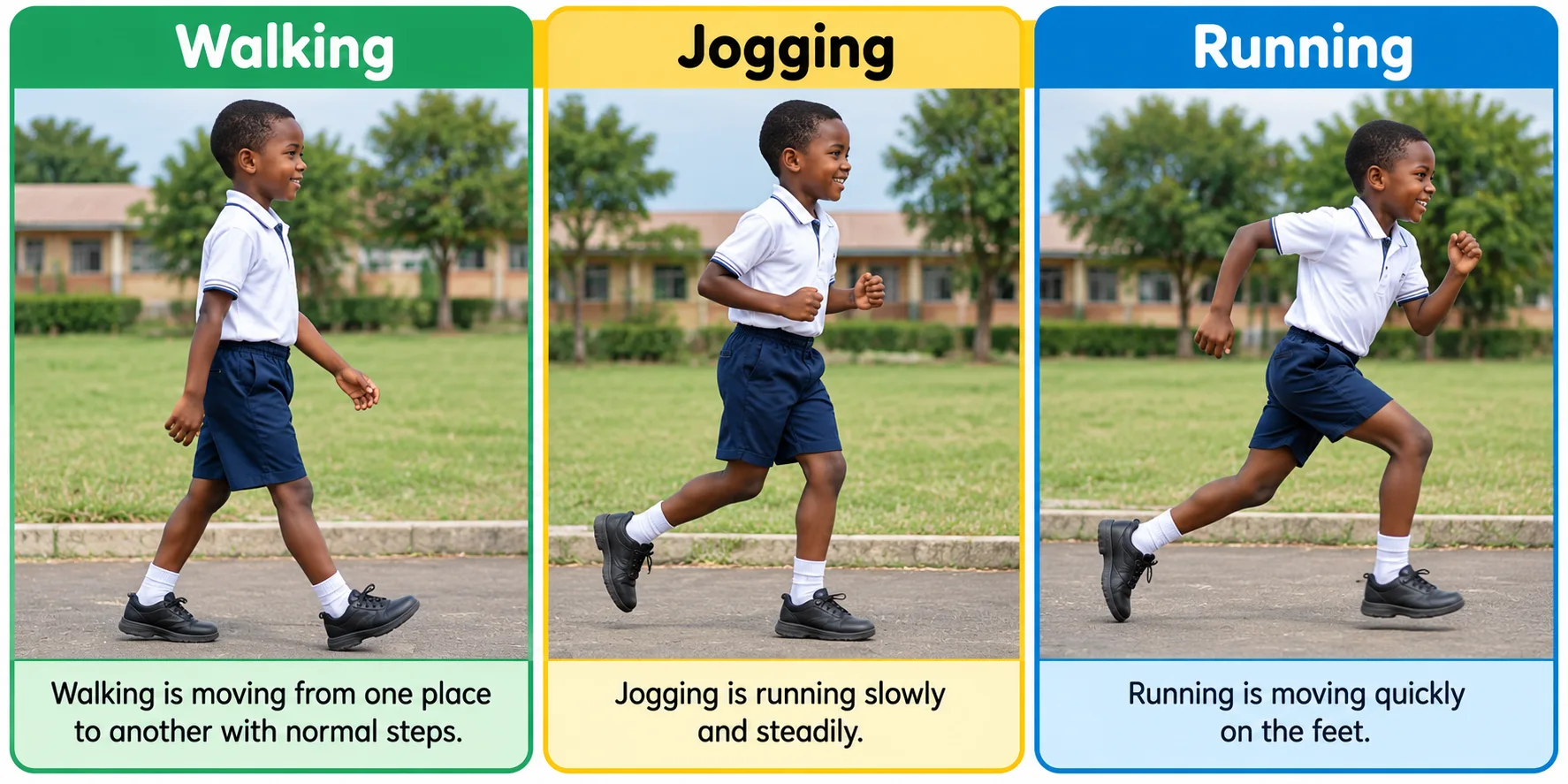
Walking is moving from one place to another by taking steps.
It is one of the simplest forms of exercise.
We walk when we:
- go from one classroom to another;
- walk around the playground;
- go on a short walk with an adult; or
- move around the home.
Walking mainly involves the legs, but the arms and other parts of the body also move.
2. Running
Running means moving quickly on the feet.
When we run, our legs move faster than when we walk.
Children may run:
- during sports;
- while playing;
- during Physical Education lessons; or
- in a short race.
Running makes many parts of the body move.
We should run only in a safe place where there are no sharp objects, holes or dangerous obstacles.
3. Jogging
Jogging is a slow and steady type of running.
It is faster than walking but usually slower than running.
A child may jog slowly around a playground or an open field.
Jogging is a good way to move the whole body.
Walking, Jogging and Running
|
Exercise |
How It Is Done |
|
Walking |
Moving with normal steps |
|
Jogging |
Running slowly and steadily |
|
Running |
Moving quickly on the feet |
The teacher can demonstrate these three movements so that pupils can see the difference.
4. Jumping
Jumping means pushing the body up from the ground with the legs.
When we jump, both feet may leave the ground for a short time.
Examples include:
- jumping up and down;
- jumping over a small line;
- jumping during a game; and
- jumping during sports activities.
Jumping helps children practise balance and body control.
Pupils should jump on a safe surface and should not jump from dangerous heights.
5. Skipping
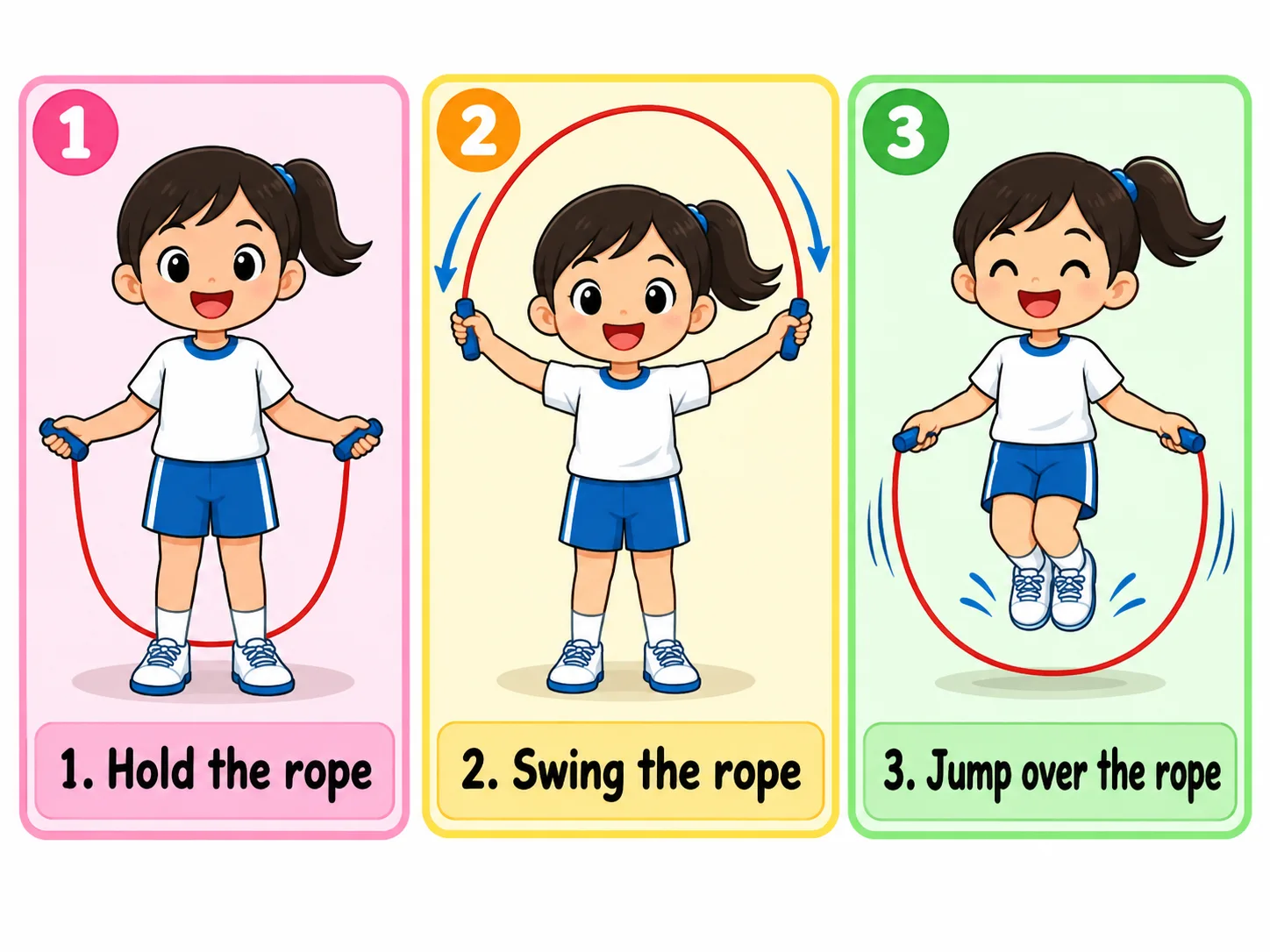
Skipping is an exercise in which a person jumps over a rope as it passes under the feet.
A skipping rope is commonly used for this exercise.
To skip:
- Hold one end of the rope in each hand.
- Place the rope behind the body.
- Move the rope over the head.
- Jump gently as the rope approaches the feet.
- Continue slowly and carefully.
Skipping mainly involves the arms and legs.
6. Stretching
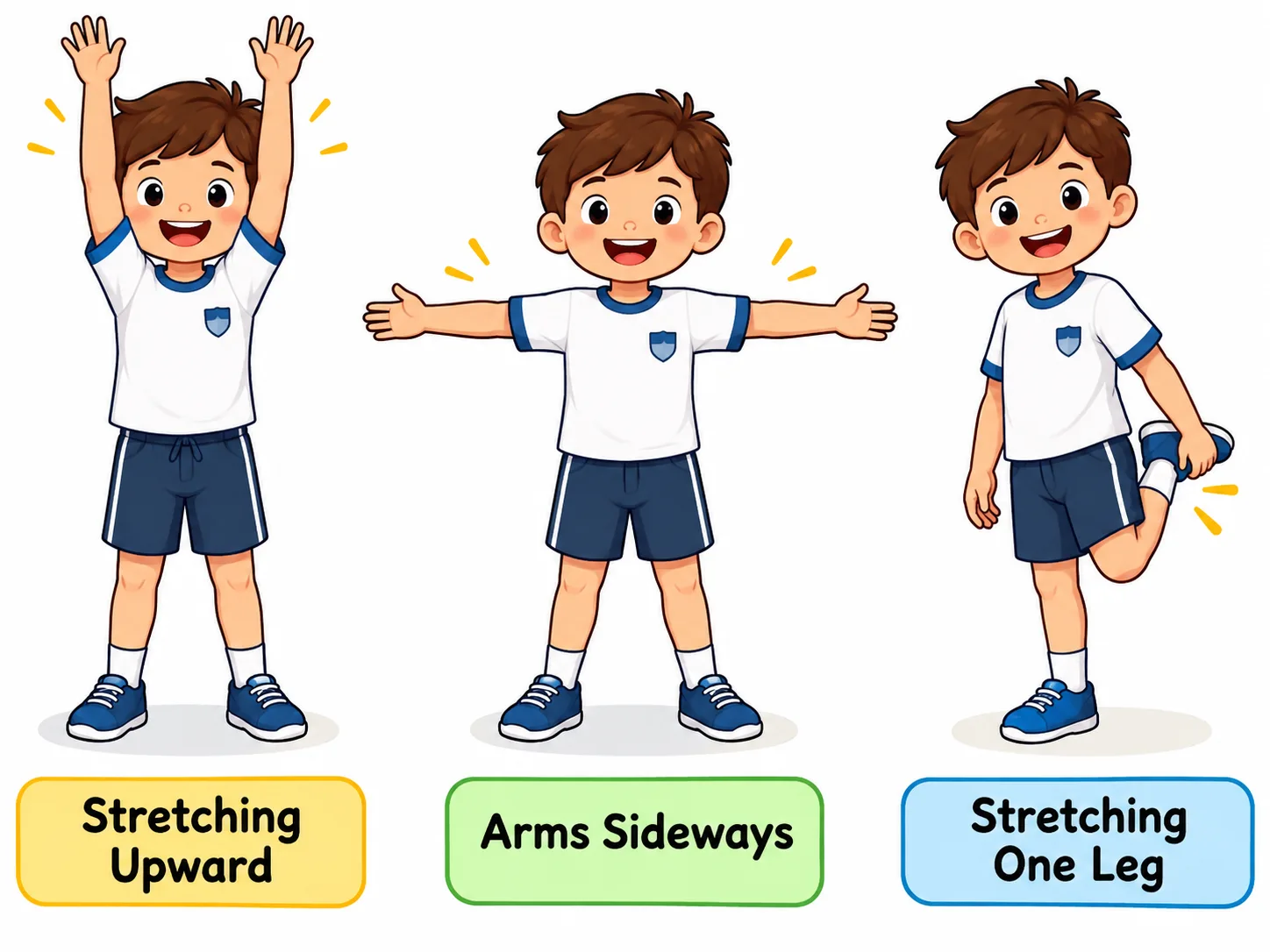
Stretching means gently extending parts of the body.
We can stretch:
- the arms;
- the legs;
- the sides of the body;
- the shoulders; and
- the back.
A simple stretching exercise is to stand straight and raise both hands above the head.
Another one is to stretch both arms out to the sides.
Stretching should be done gently. Children should not force the body into painful positions.
7. Bending
Bending involves moving part of the body forward, backward or sideways.
For example:
- Stand with the feet slightly apart.
- Bend the upper body forward slowly.
- Try to reach towards the knees, ankles or toes.
- Slowly return to the standing position.
The body can also bend gently to the left and right.
Bending should always be done carefully.
8. Dancing
Dancing is moving the body to music or rhythm.
During dancing, we may move:
- the hands;
- the legs;
- the shoulders;
- the waist; and
- the whole body.
Dancing can be a form of exercise because it involves body movement.
Children may dance during school activities, cultural events or at home.
[Insert Image: A group of Nigerian primary school pupils performing a simple dance movement in an open space.]
9. Playing Active Games
Some games are also forms of exercise because they involve body movement.
Examples include:
- football;
- running games;
- catching a ball;
- throwing a ball;
- simple relay games; and
- traditional outdoor games that involve movement.
A child playing football may run, kick, turn and stretch during the game.
10. Simple Household Activities
Some household activities also make us move different parts of the body.
Examples include:
- sweeping;
- arranging light household items;
- helping to tidy a room;
- washing small, safe items; and
- carrying out other suitable chores.
These activities involve body movement, although they should not replace normal play and exercise.
Exercises and Parts of the Body Used
Different exercises involve different parts of the body.
|
Type of Exercise |
Main Parts of the Body Used |
|
Walking |
Legs and arms |
|
Running |
Legs, arms and whole body |
|
Jogging |
Legs, arms and whole body |
|
Jumping |
Legs and whole body |
|
Skipping |
Arms and legs |
|
Stretching |
Arms, legs and body |
|
Bending |
Waist, back and legs |
|
Dancing |
Arms, legs, waist and whole body |
|
Football |
Legs and whole body |
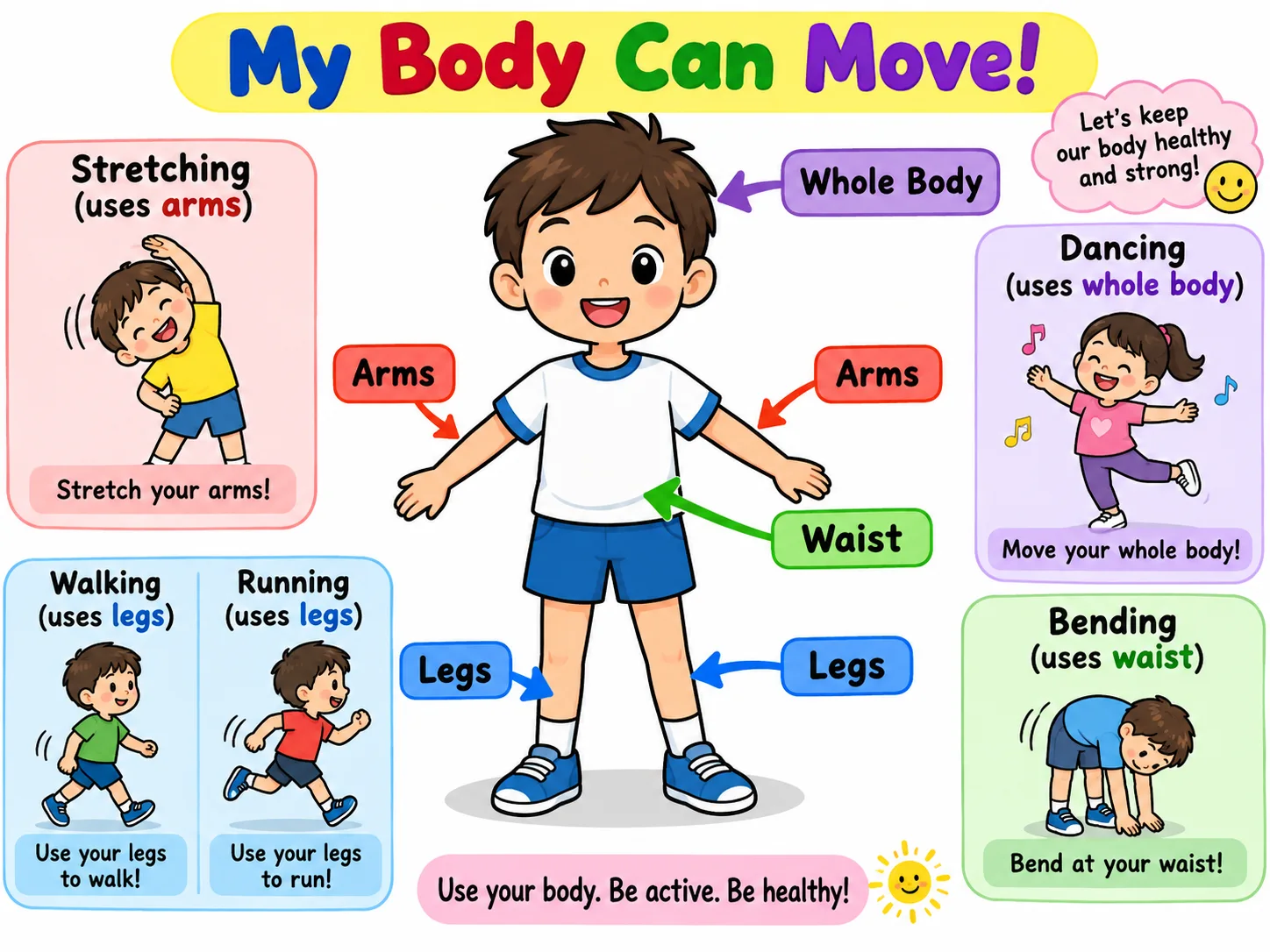
How We Can Group Exercises
For easier understanding, some exercises can be grouped according to the kind of movement involved.
Exercises involving movement from one place to another
Examples are:
- walking;
- jogging;
- running.
Exercises involving jumping movements
Examples are:
- jumping;
- skipping.
Exercises involving stretching and bending
Examples are:
- stretching the arms;
- stretching the legs;
- bending forward;
- bending sideways.
Exercises involving many body movements
Examples are:
- dancing;
- football;
- active outdoor games.
Simple Exercise Practice
The following activities can be demonstrated in class or on the playground.
Activity 1: Walking
Walk slowly for a short distance and return.
Activity 2: Jogging
Jog slowly over a short distance.
Activity 3: Stretching
Stand straight and raise both hands above the head.
Activity 4: Bending
Stand with the feet apart and bend forward gently.
Activity 5: Jumping
Jump gently up and down three times.
Activity 6: Skipping
Use a skipping rope and make a few gentle jumps.
The teacher should ensure that pupils have enough space before any practical activity begins.
Safety Rules During Exercise
Exercise should be enjoyable and safe.
Pupils should:
- exercise in a safe place;
- listen to the teacher’s instructions;
- avoid pushing other pupils;
- keep enough space between themselves and others;
- wear suitable clothes for exercise;
- avoid sharp and dangerous objects;
- exercise according to their ability;
- stop if they feel pain, dizziness or discomfort; and
- tell the teacher or another responsible adult if they get hurt.
Remember
There are many types of exercise.
Some common ones are:
walking, running, jogging, jumping, skipping, stretching, bending and dancing.
Different exercises move different parts of the body, but many exercises involve the whole body.
F: LESSON PRESENTATION
F1: Teachers’ Activities
- The teacher revises the previous lesson by asking pupils to explain exercise and mention some benefits of exercise.
- The teacher asks pupils to name exercises they have seen people perform.
- The teacher displays pictures showing different exercises.
- The teacher introduces the lesson as Types of Exercise.
- The teacher explains walking, running and jogging and demonstrates the difference between them.
- The teacher demonstrates jumping, stretching and bending.
- The teacher shows pupils how a skipping rope is used.
- The teacher allows pupils to demonstrate the exercises in small groups.
- The teacher asks pupils to identify the parts of the body used during each exercise.
- The teacher explains that dancing and some active games can also be forms of exercise.
- The teacher discusses simple safety rules to be observed during exercise.
- The teacher supervises a short practical exercise session.
- The teacher asks pupils questions to check their understanding.
- The teacher corrects mistakes and summarises the lesson.
F2: Pupils’ Activities
- Pupils explain what they learnt about exercise in the previous lesson.
- Pupils observe pictures of different exercises.
- Pupils name the exercises shown.
- Pupils observe the teacher’s demonstrations.
- Pupils practise walking, jogging and running over a short distance.
- Pupils demonstrate stretching, bending and jumping.
- Pupils practise simple skipping where a rope is available.
- Pupils identify body parts used during different exercises.
- Pupils classify exercises according to their movements.
- Pupils state safety rules for exercising.
- Pupils answer questions asked by the teacher.
- Pupils copy the important points into their notebooks.
G: CONCLUSION
The teacher revises the different types of exercise with the pupils.
Pupils are asked to mention and demonstrate exercises such as walking, running, jogging, jumping, skipping, stretching and bending.
The teacher reminds pupils that different exercises involve different parts of the body and that exercise should always be performed safely.
Pupils are encouraged to take part in suitable physical activities regularly while following the instructions of parents, teachers and other responsible adults.
Next Lesson: Primary 2 Home Economics First Term – Week 4: WHEN AND HOW TO EXERCISE
H: EVALUATION GUIDE
Oral Questions
- What is exercise?
- Mention six types of exercise.
- What is the difference between walking and running?
- What is jogging?
- What do we use for skipping?
- Mention two exercises that involve jumping.
- Mention two exercises that involve the whole body.
- Which parts of the body are mostly used when skipping?
- Mention two household activities that involve body movement.
- State four safety rules to follow during exercise.
Written Exercise
A. Fill in the blanks with the correct answers.
- Moving quickly on the feet is called __________.
- __________ is slow and steady running.
- We can use a rope for __________.
- Raising our arms and extending our body is called __________.
- Moving the body to music is called __________.
B. Match the exercise with the correct description.
|
Exercise |
Description |
|
1. Walking |
A. Moving the body to music |
|
2. Skipping |
B. Moving with normal steps |
|
3. Dancing |
C. Jumping over a moving rope |
|
4. Running |
D. Moving quickly on the feet |
|
5. Stretching |
E. Gently extending parts of the body |
Practical Assessment
The teacher should call pupils individually or in small groups to demonstrate any four of the following exercises:
- Walking
- Jogging
- Stretching
- Bending
- Jumping
- Skipping
The teacher observes whether pupils can identify and demonstrate each activity safely.
Take-Home Activity
Write the names of six types of exercise.
Draw and colour pictures showing two different exercises.