
TOPIC: EXERCISE – MEANING AND IMPORTANCE
A: TEACHING AND LEARNING MATERIALS
- Pictures of children doing different exercises.
- A skipping rope.
- A ball.
- Exercise mat or clean floor space.
- Chart showing simple exercises.
- Pictures showing active and inactive children.
- Flash cards containing names of simple exercises.
B: REFERENCE MATERIALS
- Primary 2 Home Economics Scheme of Work (All Three Terms)
- Recommended Home Economics textbook for Primary 2 (school-approved edition)
- World Health Organization – Physical Activity
C: PREVIOUS KNOWLEDGE
Pupils have learnt about healthy living and some good habits that help to keep the body clean and healthy. They know that eating good food, drinking clean water, keeping the body clean, resting and keeping the surroundings clean are important for healthy living.
In this lesson, pupils will learn that exercise is also an important part of healthy living.
Previous Lesson: Primary 2 Home Economics First Term – Week 1: INTRODUCTION TO HOME ECONOMICS AND HEALTHY LIVING
D: PERFORMANCE OBJECTIVES
By the end of the lesson, pupils should be able to:
- explain the meaning of exercise in simple words;
- mention at least five examples of exercise;
- demonstrate some simple exercises;
- state at least five benefits of exercise;
- identify activities that involve body movement; and
- mention simple safety rules to observe during exercise.
E: CONTENT
Meaning of Exercise
Exercise is an activity in which we move our body to keep it active, strong and healthy.
Exercise involves moving different parts of the body, such as the hands, legs, waist, shoulders and head.
For example, when we walk, run, jump or skip, different parts of our body are moving.
Exercise is an important part of healthy living.
Children exercise when they play active games, take part in Physical Education activities or perform simple body movements.
Examples of Exercise
There are many simple exercises that children can do.
They include:
- Walking
- Running
- Jumping
- Skipping
- Stretching
- Bending
- Dancing
- Jogging
- Playing football
- Throwing and catching a ball
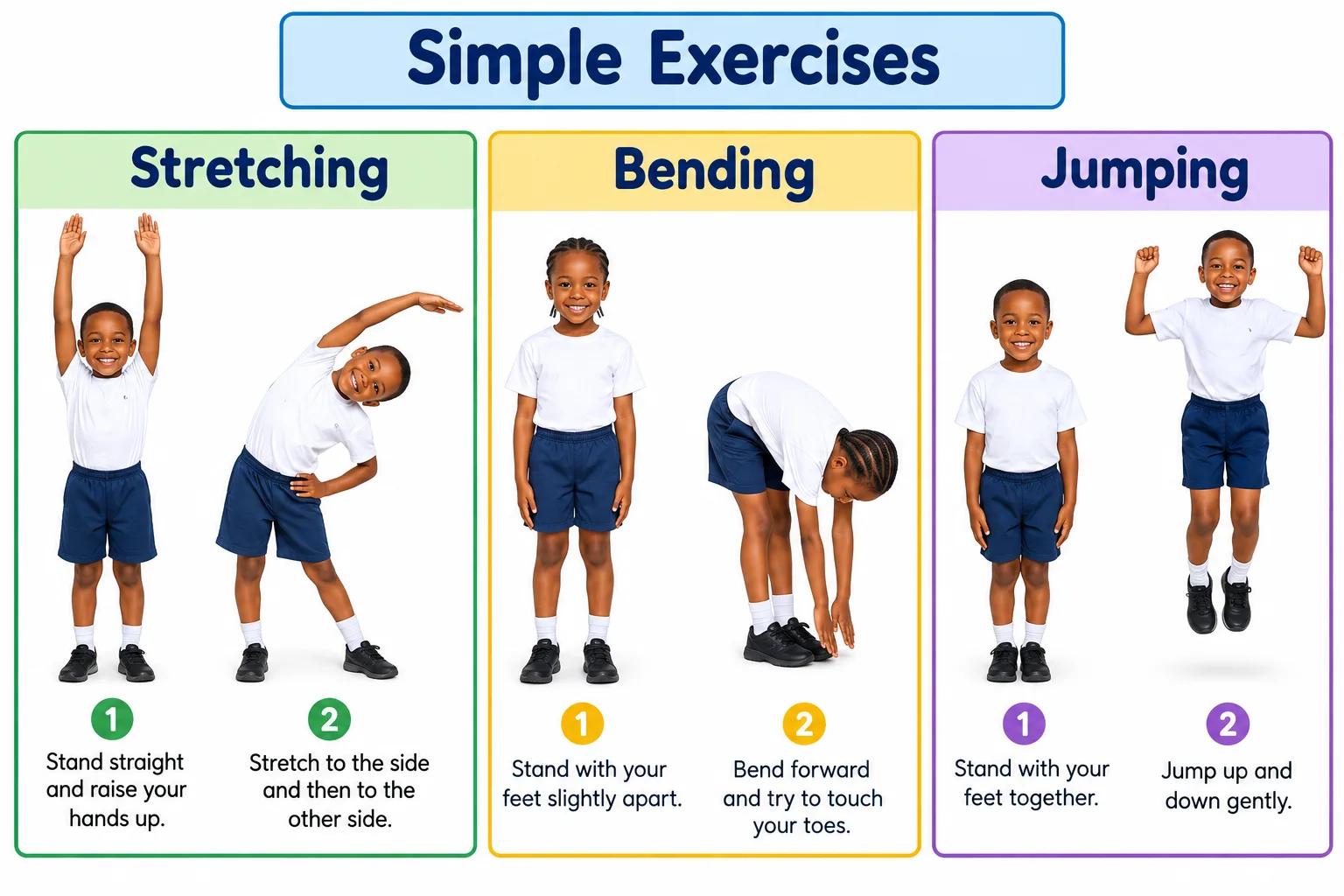
Simple Exercise Demonstration
The teacher may ask pupils to stand where there is enough space and perform the following simple movements:
1. Walking
Walk slowly from one point to another.
2. Stretching
Stand straight and gently stretch both hands upward.
3. Bending
Stand with the feet slightly apart and gently bend the body forward.
4. Jumping
Jump gently up and down without pushing anyone.
5. Skipping
Use a skipping rope to jump over the rope as it passes under the feet.
6. Running
Run slowly over a short and safe distance.
Importance of Exercise
Exercise is good for the body. It helps children to grow and remain active.
Some benefits of exercise are explained below.
|
Benefit of Exercise |
Simple Explanation |
|
Keeps the body fit |
Exercise helps the body remain active and ready for daily activities. |
|
Makes muscles stronger |
Moving the arms and legs helps the muscles to develop. |
|
Helps to build strong bones |
Activities such as walking, running and jumping help the bones develop properly. |
|
Helps the heart and lungs |
Active movement makes the heart and lungs work during exercise. |
|
Improves body movement |
Exercise helps us to move, bend, run and balance better. |
|
Helps us feel good |
Playing and exercising can be enjoyable. |
|
Helps us sleep well |
Being active during the day can support good rest and sleep. |
|
Helps children play together |
Group exercises and games teach children to cooperate with others. |
Exercise Keeps the Body Fit
A person who exercises regularly keeps the body active.
Exercise helps the body to perform activities such as:
- walking;
- running;
- climbing;
- carrying light objects;
- playing; and
- doing simple household duties.
When the body is active, it becomes easier to perform everyday activities.
Exercise Makes the Muscles and Bones Strong
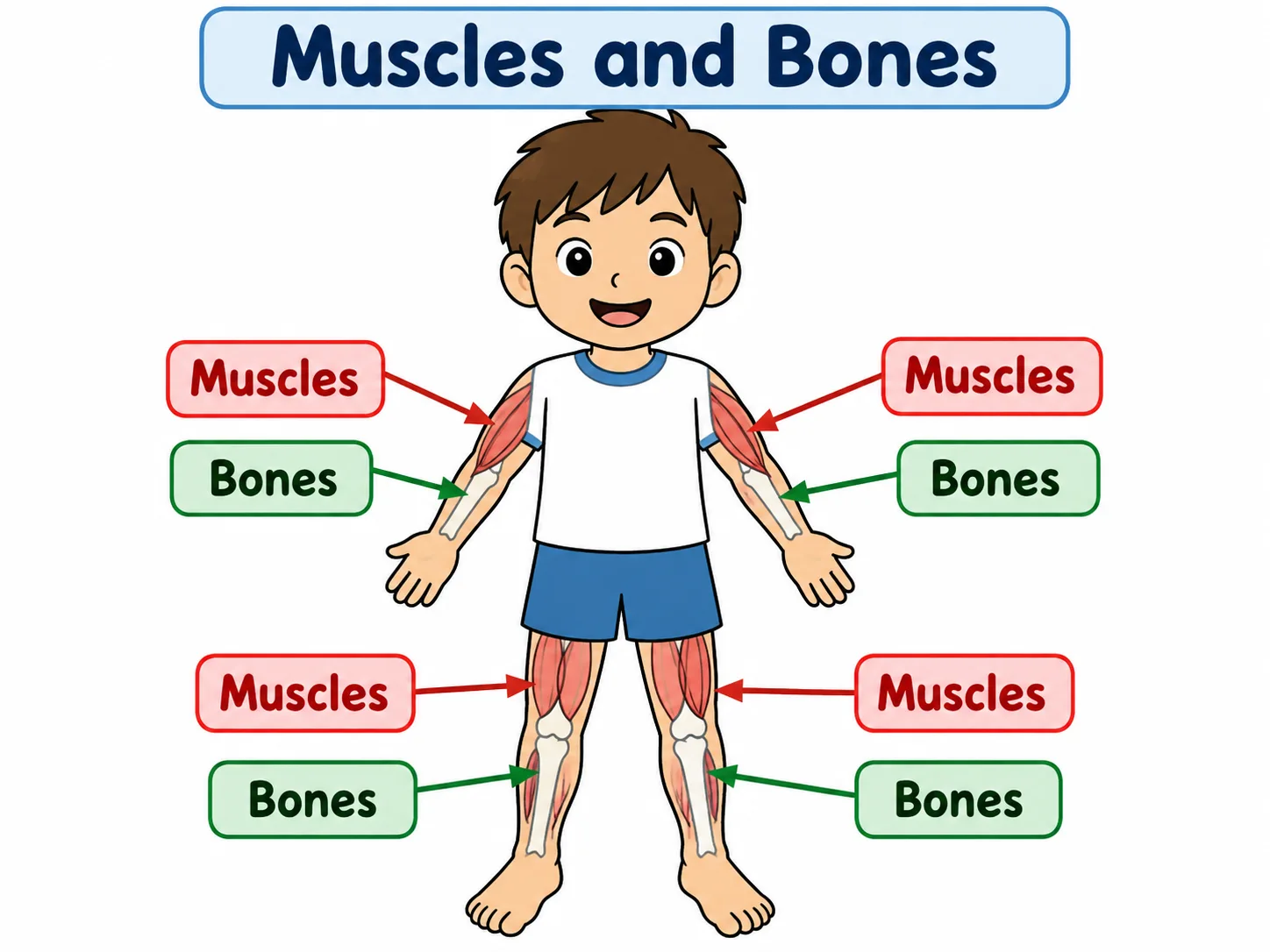
Our body has bones and muscles.
Bones give the body shape and support. Muscles help us to move different parts of the body.
When children take part in suitable physical activities, the muscles and bones are used and developed.
Activities such as walking, running, jumping and skipping are good examples.
Exercise Helps Us to Move Better
Exercise helps children develop good movement skills.
For example:
- running helps us move quickly;
- jumping helps us lift our body from the ground;
- stretching helps us move different parts of our body;
- throwing and catching improve the way we use our hands and eyes together.
Regular physical activity also helps children improve their balance and coordination.
Exercise Can Be Fun
Exercise does not always have to be difficult.
Children can exercise while enjoying activities such as:
- dancing;
- skipping;
- playing football;
- running with friends;
- throwing and catching a ball;
- playing safe outdoor games.
These activities help children to move their bodies while having fun.
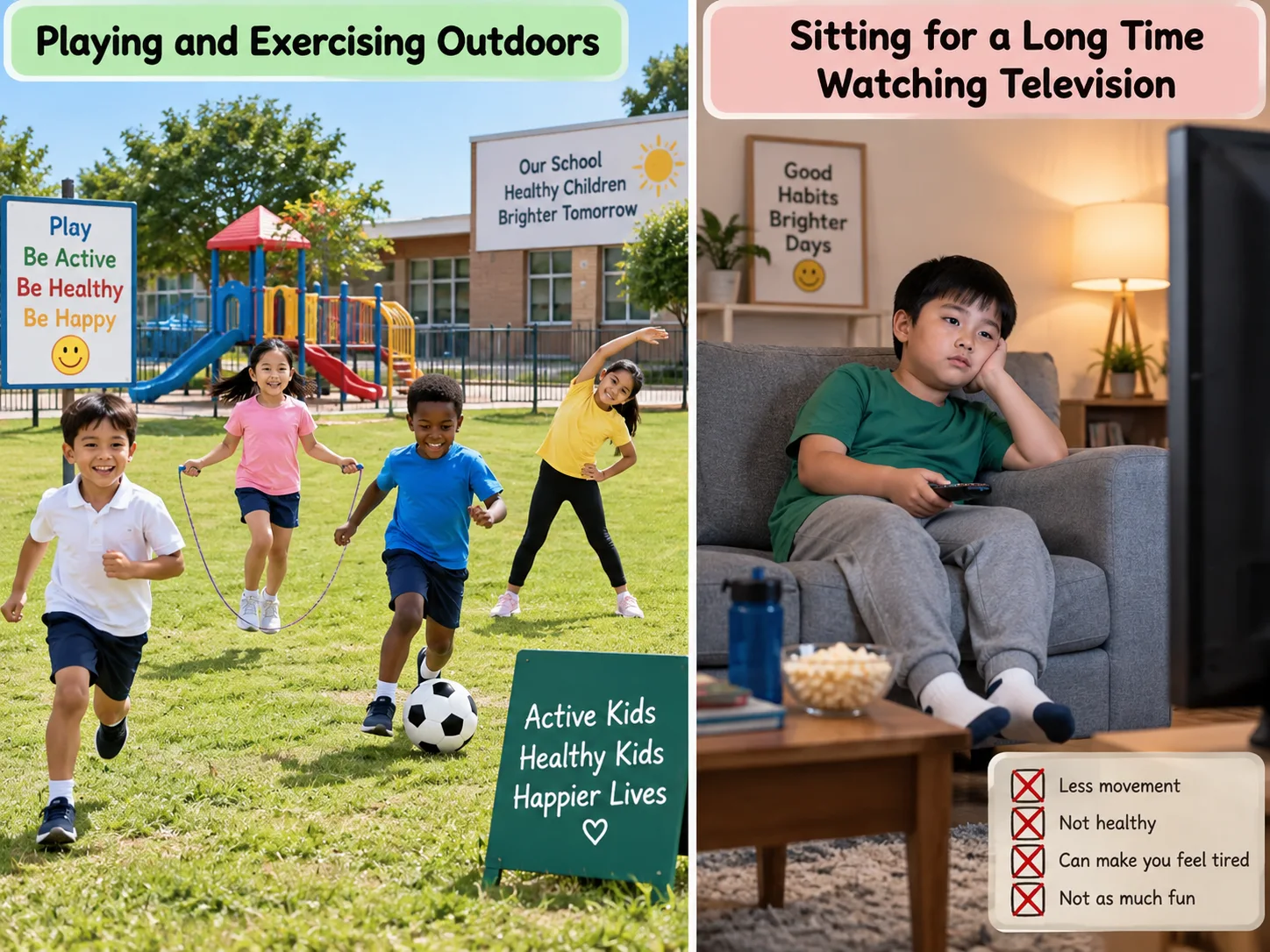
Active and Inactive Activities
Some activities require us to move our bodies a lot, while others involve little movement.
|
Active Activities |
Activities with Little Movement |
|
Running |
Sitting for a long time |
|
Skipping |
Watching television |
|
Dancing |
Sitting and playing a video game |
|
Playing football |
Sitting quietly for a long period |
|
Jumping |
Lying down when we are not resting or sleeping |
|
Walking |
Sitting and watching other people play |
It is good for children to have time for both activity and rest. The body needs movement, but it also needs proper rest.
Safety During Exercise
Exercise should be done carefully.
Children should:
- exercise in a safe and open place;
- wear suitable clothes and footwear where necessary;
- avoid pushing other children;
- keep away from sharp or dangerous objects;
- follow the teacher’s instructions;
- drink clean water when necessary;
- stop and inform an adult if they feel unwell or get injured; and
- avoid dangerous exercises that are not suitable for children.
Remember
Exercise means moving the body to help keep it active, fit and healthy.
Examples of exercise include walking, running, jumping, skipping, stretching and dancing.
Exercise is important because it helps us to develop strong muscles and bones, move better, stay active and enjoy healthy living.
F: LESSON PRESENTATION
F1: Teachers’ Activities
- The teacher revises the previous lesson by asking pupils to mention some healthy living habits.
- The teacher asks pupils what happens when they run, jump or play football.
- The teacher introduces the word exercise and explains its meaning.
- The teacher displays pictures of children walking, running, skipping, stretching and jumping.
- The teacher asks pupils to identify the activities shown in the pictures.
- The teacher demonstrates simple exercises such as walking, stretching, bending and jumping.
- The teacher allows pupils to perform the exercises in a safe and orderly manner.
- The teacher explains the importance of exercise using simple examples.
- The teacher displays the table of active and less-active activities and discusses it with the pupils.
- The teacher explains simple safety rules that pupils should follow during exercise.
- The teacher asks individual pupils to mention one exercise and one benefit of exercise.
- The teacher corrects pupils where necessary and summarises the important points.
F2: Pupils’ Activities
- Pupils mention healthy habits learnt in the previous lesson.
- Pupils observe the pictures and teaching materials.
- Pupils repeat the meaning of exercise.
- Pupils mention examples of exercises they know.
- Pupils demonstrate walking, stretching, bending, jumping and other simple exercises.
- Pupils identify active activities from pictures.
- Pupils state some benefits of exercise.
- Pupils mention safety rules to follow during exercise.
- Pupils answer oral questions asked by the teacher.
- Pupils copy important points into their notebooks.
G: CONCLUSION
The teacher revises the lesson by asking pupils to explain the meaning of exercise and mention different exercises they can perform.
The teacher reminds the pupils that exercise is an important part of healthy living. Activities such as walking, running, skipping, jumping and stretching help the body to remain active and support healthy growth.
Pupils are encouraged to take part in safe physical activities and to always follow the instructions of their teachers, parents or other responsible adults when exercising.
Next Lesson: Primary 2 Home Economics First Term – Week 3: TYPES OF EXERCISE
H: EVALUATION GUIDE
Oral Questions
- What is exercise?
- Mention five examples of exercise.
- Mention four reasons why exercise is important.
- Which parts of the body can we move during exercise?
- Mention two exercises that involve the legs.
- Mention two exercises you can do at school.
- How does exercise help our muscles and bones?
- Mention three safety rules to follow during exercise.
Written Exercise
A. Fill in the blanks with the correct words.
- __________ is an activity in which we move our body to keep it active and healthy.
- Running, jumping and skipping are examples of __________.
- Exercise helps to make our muscles and __________ strong.
- We should exercise in a __________ place.
- We should not __________ other children during exercise.
B. Write “Exercise” or “Not Exercise” beside each activity.
- Running around the playground. __________
- Skipping with a rope. __________
- Sitting and watching television. __________
- Stretching the arms and legs. __________
- Jumping up and down. __________
Practical Activity
The teacher calls pupils out in small groups.
Each group should demonstrate any three of the following:
- Walking
- Stretching
- Bending
- Jumping
- Skipping
The teacher observes whether pupils can perform the movements safely and correctly.
Take-Home Activity
Write five examples of exercise you know.
Draw and colour a picture of a child performing one exercise.