
TOPIC: TOOLS AND MATERIALS USED FOR CLEANING AND THEIR MAINTENANCE
A: TEACHING AND LEARNING MATERIALS
- Broom.
- Dustpan.
- Mop.
- Bucket.
- Rake.
- Cleaning cloth.
- Duster.
- Scrubbing brush.
- Waste bin.
- Clean water.
- Mild soap or detergent.
- Pictures showing cleaning tools before and after use.
- Chart showing proper storage of cleaning tools.
- Pupils’ writing books and pencils.
B: REFERENCE MATERIALS
- Scheme of work.
- Recommended Home Economics textbook for Primary 1.
- Online educational resources.
C: PREVIOUS KNOWLEDGE
The pupils have learnt different ways of cleaning the home and its surroundings. They have practised picking litter, sweeping, gathering dry leaves, mopping and putting rubbish in a waste bin.
Previous lesson: Primary 1 Home Economics Third Term Week 5
D: PERFORMANCE OBJECTIVES
By the end of the lesson, pupils should be able to:
- Explain cleaning tools in simple words.
- Explain cleaning materials in simple words.
- Identify common tools and materials used for cleaning.
- State the uses of common cleaning tools.
- Match cleaning tools with the correct cleaning activities.
- Explain the meaning of maintenance in simple words.
- Mention ways of caring for cleaning tools after use.
- Demonstrate how to clean and store some safe cleaning tools.
- State reasons for keeping cleaning tools properly.
- Mention simple safety rules for handling cleaning tools.
E: CONTENT
Meaning of Cleaning Tools
Cleaning tools are objects we use to remove dirt and keep places clean.
Examples are:
- Broom.
- Dustpan.
- Mop.
- Rake.
- Scrubbing brush.
- Cleaning cloth.
- Duster.
Different cleaning tools are used for different jobs.
For example:
- A broom is used for sweeping.
- A mop is used for cleaning suitable floors.
- A rake is used for gathering dry leaves.
Meaning of Cleaning Materials
Cleaning materials are substances or supplies that help us to clean.
Examples include:
- Clean water.
- Soap.
- Mild detergent.
A cleaning tool is something we usually use with our hands, while a cleaning material helps the tool to remove dirt.
Tools and Materials
|
Cleaning Tools |
Cleaning Materials |
|---|---|
|
Broom |
Clean water |
|
Mop |
Soap |
|
Rake |
Mild detergent |
|
Cleaning cloth |
|
|
Scrubbing brush |
|
|
Dustpan |
VISUAL TO INSERT: A simple two-column picture chart titled Cleaning Tools and Cleaning Materials, with the items placed under the correct headings.
Common Cleaning Tools and Their Uses
1. Broom
A broom is used for sweeping.
It can help remove:
- Dust.
- Sand.
- Dry leaves.
- Small pieces of paper.
- Other light dirt.
A broom may be used in:
- The classroom.
- The compound.
- The walkway.
- Some rooms in the home.
Caring for a Broom
After using a broom:
- Shake off the dirt.
- Remove anything caught in it.
- Keep it dry.
- Store it in the proper place.
- Do not leave it lying across a walkway.
2. Dustpan
A dustpan is used to collect dirt after sweeping.
The dirt is swept into the dustpan and then emptied into a waste bin.
Caring for a Dustpan
After use:
- Empty the dirt into the bin.
- Wipe or wash the dustpan if necessary.
- Allow it to dry.
- Keep it in its proper place.
3. Mop
A mop is used for cleaning suitable floors.
It may be used with clean water and a suitable cleaning material.
Caring for a Mop
After use:
- Rinse the mop.
- Remove dirty water.
- Squeeze out excess water where appropriate.
- Hang or keep it where it can dry.
- Store it neatly when dry.
A wet mop should not be left in a heap for a long time.
4. Bucket
A bucket is used to hold or carry water during cleaning.
It may also be used to prepare water for mopping or washing.
Caring for a Bucket
After cleaning:
- Pour out dirty water safely.
- Rinse the bucket.
- Turn it upside down to drain where suitable.
- Keep it in the correct storage place.
We should not leave dirty water standing inside a bucket.
5. Rake
A rake is used mainly outdoors.
It may be used to gather:
- Dry leaves.
- Grass.
- Light garden litter.
Caring for a Rake
After use:
- Remove leaves and dirt caught in it.
- Keep it clean.
- Store it safely.
- Keep the pointed part away from walkways.
A rake should not be used as a toy.
6. Cleaning Cloth
A cleaning cloth is used for wiping surfaces.
It may be used on:
- Tables.
- Chairs.
- Shelves.
- Window ledges.
- Other suitable surfaces.
Caring for a Cleaning Cloth
After use:
- Wash or rinse it when necessary.
- Remove dirt.
- Dry it properly.
- Fold or keep it in its correct place.
A dirty cleaning cloth should not be used for wiping eating utensils.
7. Duster
A duster is used for removing dust from surfaces.
A duster may be used on:
- Tables.
- Chairs.
- Shelves.
- Furniture.
After use, the duster should be cleaned and stored properly.
8. Scrubbing Brush
A scrubbing brush is used for removing stubborn dirt from suitable surfaces.
It may be used on some:
- Floors.
- Outdoor surfaces.
- Washable areas.
Young children should use brushes only for safe classroom demonstrations and under supervision.
9. Waste Bin
A waste bin is used for holding rubbish.
Examples of suitable rubbish include:
- Pieces of paper.
- Empty safe wrappers.
- Other household litter.
Caring for a Waste Bin
A waste bin should:
- Be emptied regularly.
- Be washed when necessary.
- Be allowed to dry.
- Be returned to its proper place.
Rubbish should go inside the bin, not beside it.
Cleaning Materials and Their Uses
Clean Water
Clean water is important for:
- Washing.
- Rinsing.
- Mopping.
- Cleaning some tools.
Water used for cleaning should not be used for drinking.
Soap
Soap can help remove dirt from washable items and surfaces.
Mild Detergent
A mild detergent may be used by a responsible adult for suitable cleaning jobs.
Children should not mix different cleaning products.
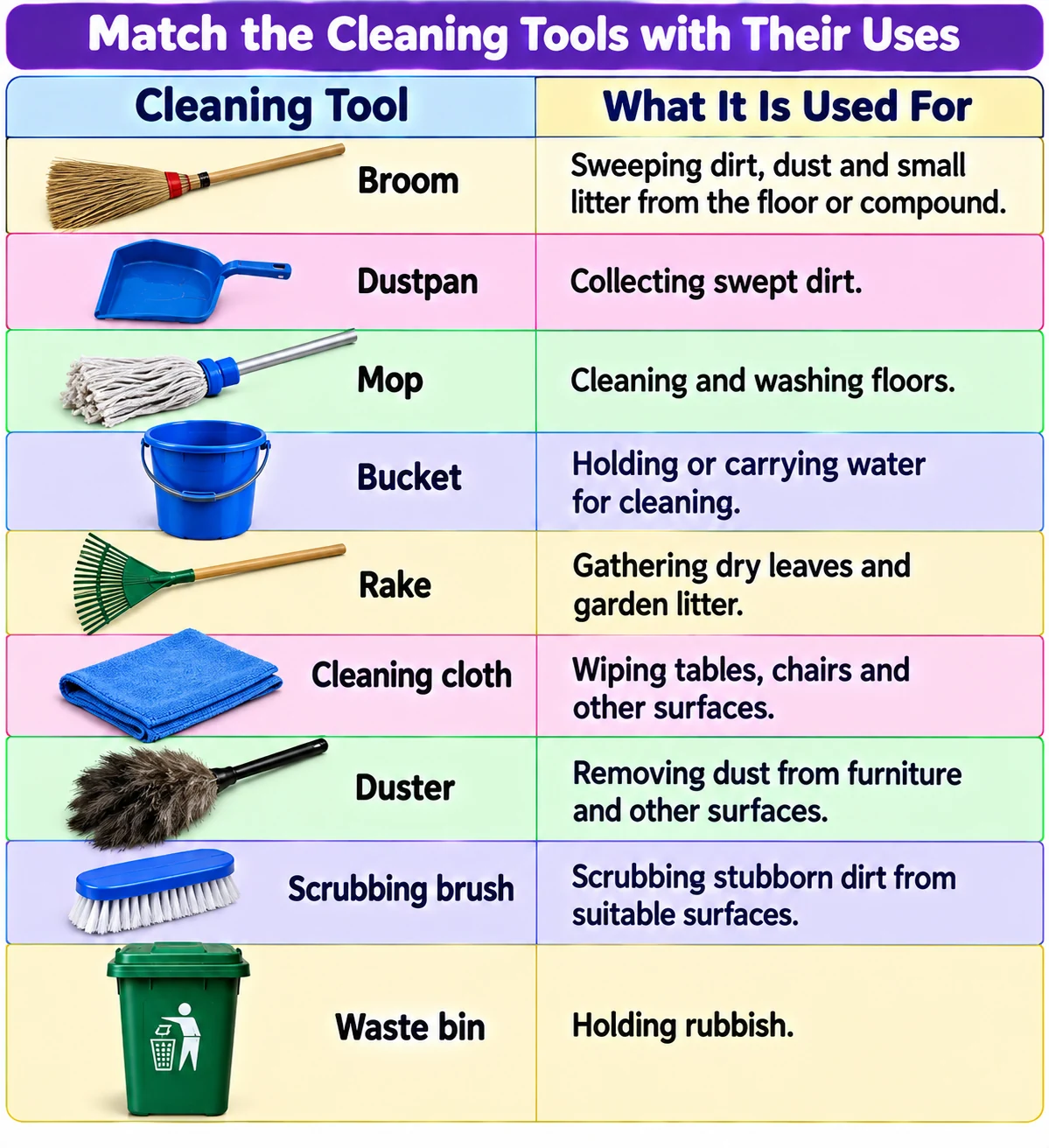
Cleaning Tools at a Glance
|
Tool |
Main Use |
|---|---|
|
Broom |
Sweeping dirt |
|
Dustpan |
Collecting swept dirt |
|
Mop |
Cleaning floors |
|
Bucket |
Holding water |
|
Rake |
Gathering dry leaves |
|
Cleaning cloth |
Wiping surfaces |
|
Duster |
Removing dust |
|
Scrubbing brush |
Scrubbing suitable surfaces |
|
Waste bin |
Holding rubbish |
Meaning of Maintenance
Maintenance means taking good care of something so that it remains useful and lasts longer.
Cleaning tools also need care.
For example:
A pupil should not use a broom and then throw it anywhere.
The broom should be cleaned and kept properly.
Why We Maintain Cleaning Tools
We take care of cleaning tools so that they:
- Stay clean.
- Last longer.
- Remain useful.
- Are easy to find.
- Do not make the storage area untidy.
- Do not cause accidents.
- Are ready for the next cleaning activity.
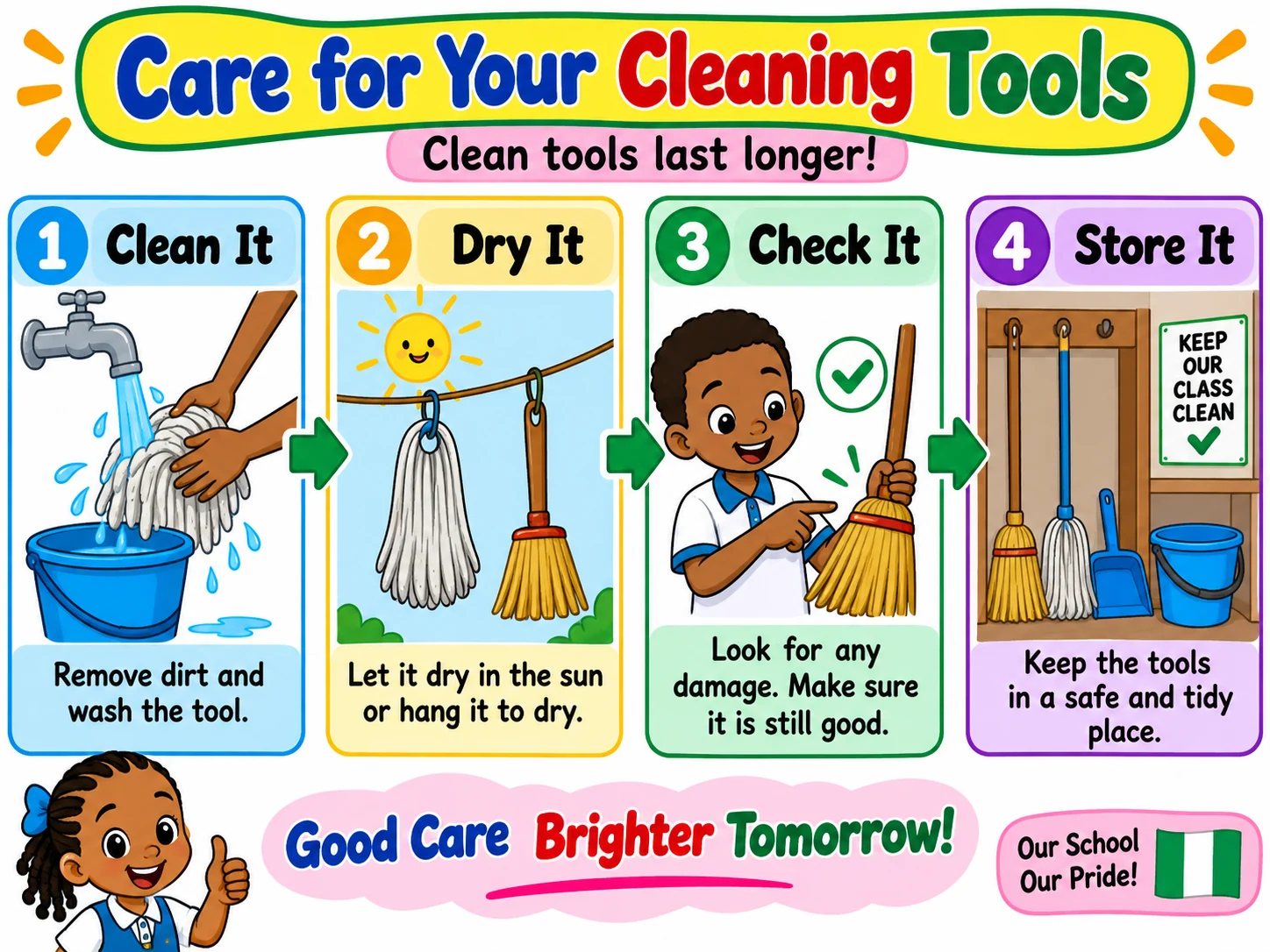
Simple Steps for Maintaining Cleaning Tools
We can remember these four steps:
CLEAN IT
↓
DRY IT
↓
CHECK IT
↓
STORE IT
1. Clean It
Remove dirt from the tool after use.
For example:
- Shake dirt from a broom.
- Rinse a mop.
- Empty a dustpan.
- Wash a dirty cleaning cloth.
2. Dry It
Wet tools should be allowed to dry.
This applies especially to:
- Mop.
- Cleaning cloth.
- Bucket.
- Scrubbing brush.
3. Check It
Look at the tool to make sure it is not damaged.
Tell an adult if:
- The broom handle is broken.
- The mop handle is loose.
- The bucket is badly cracked.
- The rake is damaged.
Children should not try to repair dangerous broken tools themselves.
4. Store It
Put every tool back in its proper place.
Cleaning tools may be kept in:
- A cleaning cupboard.
- A store.
- A safe corner.
- Hooks or racks made for tools.
Proper and Improper Care of Cleaning Tools
|
Proper Care |
Improper Care |
|---|---|
|
Rinse mop after use |
Leave dirty mop on the floor |
|
Empty the dustpan |
Keep dirt inside it |
|
Store broom properly |
Throw broom in the walkway |
|
Dry cleaning cloth |
Leave wet cloth in a heap |
|
Empty and rinse bucket |
Leave dirty water inside |
|
Store rake safely |
Leave rake where someone may step on it |
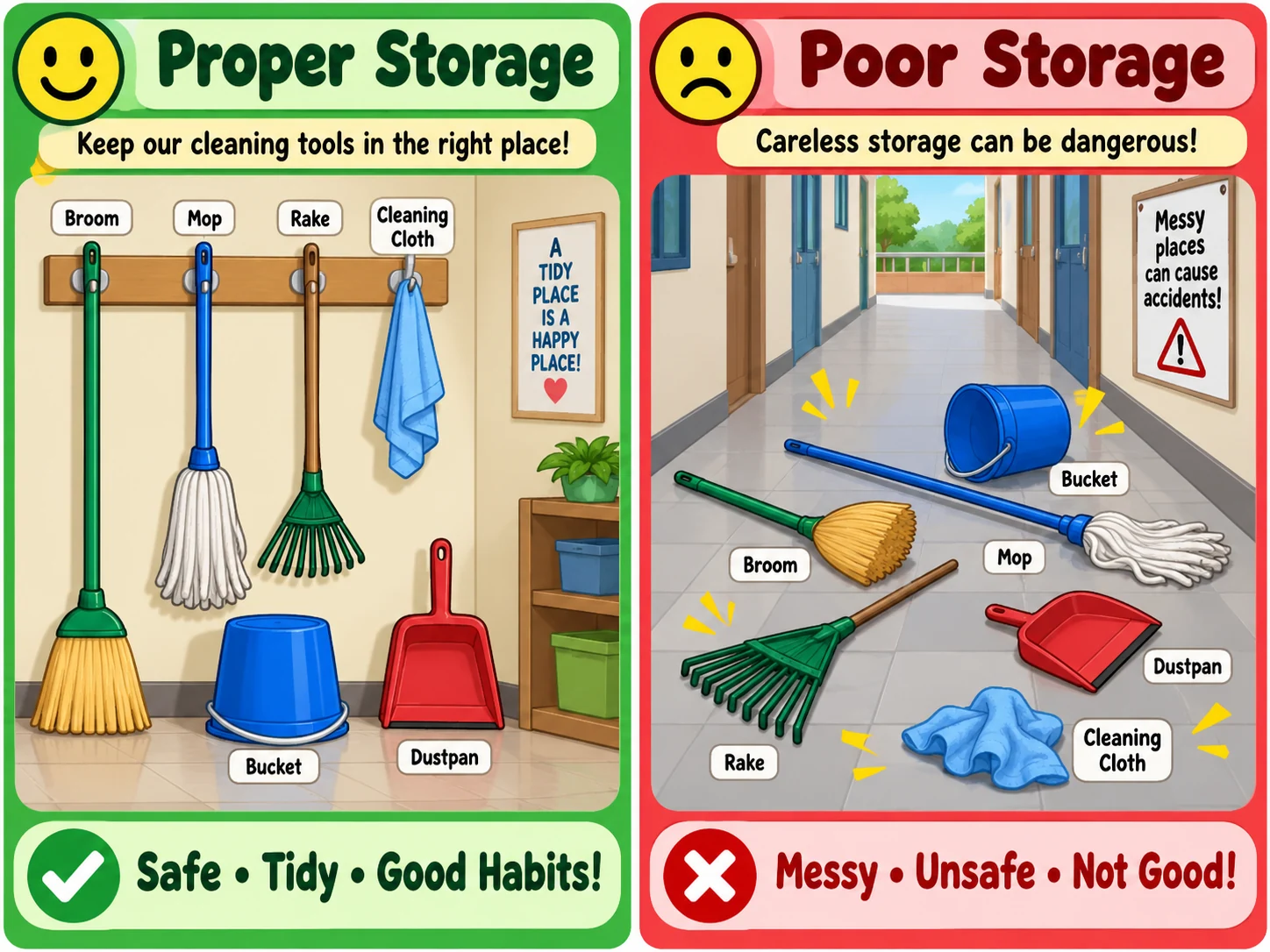
Proper Storage of Cleaning Tools
Cleaning tools should be arranged neatly.
For example:
- Brooms may be hung or placed upright.
- Mops should be allowed to dry.
- Buckets may be stacked or turned upside down when dry.
- Cleaning cloths should be dried before storage.
- Rakes should be stored safely.
- Cleaning products should be kept away from young children.
Why Tools Should Not Be Left on the Floor
A tool left in the walkway can make someone:
- Trip.
- Fall.
- Get hurt.
Tools should therefore be returned to their proper storage places.
Cleaning Tools Are Not Toys
Cleaning tools are made for work.
Children should not:
- Fight with brooms.
- Swing mops at other people.
- Play with rakes.
- Put buckets over their heads.
- Throw cleaning materials.
- Play with cleaning chemicals.
Tools should be used only for their proper purposes.
Safety When Using Cleaning Tools
Pupils should:
- Follow the teacher’s instructions.
- Use only tools suitable for their age.
- Carry tools carefully.
- Keep broom and rake handles away from other people’s faces.
- Avoid running with cleaning tools.
- Keep tools away from walkways after use.
- Avoid strong cleaning chemicals.
- Wash the hands after cleaning.
- Report damaged tools to an adult.
Cleaning Materials That Need Adult Supervision
Some cleaning products can be harmful when they are not used properly.
Young pupils should not handle:
- Bleach.
- Strong disinfectants.
- Strong toilet cleaners.
- Unknown chemicals.
The teacher or another responsible adult should handle them.
Pupils should never:
- Taste cleaning products.
- Smell them closely.
- Pour them on one another.
- Mix different cleaners.
Practical Activity: Care for the Cleaning Tools
The teacher may prepare safe, clean tools for demonstration.
Activity 1: Broom
Pupils:
- Inspect the broom.
- Remove dry dirt.
- Place it in the proper storage area.
Activity 2: Dustpan
Pupils:
- Empty safe practice dirt into the bin.
- Wipe the dustpan.
- Return it to its proper place.
Activity 3: Bucket
Pupils:
- Pour out clean practice water.
- Rinse the bucket.
- Turn it upside down to drain.
Activity 4: Cleaning Cloth
Pupils:
- Rinse a clean practice cloth.
- Squeeze out water.
- Hang it to dry.
The teacher should supervise all activities.
Simple Tool-Care Chart
AFTER SWEEPING → CLEAN THE BROOM
AFTER MOPPING → RINSE AND DRY THE MOP
AFTER USING BUCKET → EMPTY AND RINSE IT
AFTER DUSTING → CLEAN THE CLOTH
AFTER USING TOOLS → RETURN THEM PROPERLY
Good Cleaning-Tool Habits
A good pupil should:
- Use tools carefully.
- Clean tools after use.
- Allow wet tools to dry.
- Return tools to their correct places.
- Report damaged tools.
- Avoid using tools as toys.
- Help keep the cleaning area neat.
Simple Rule to Remember
Use it well.
Clean it.
Dry it.
Store it properly.
F: LESSON PRESENTATION
F1: Teachers’ Activities
- Revises the practical cleaning activities from Week Five.
- Displays different cleaning tools and materials.
- Guides pupils to name each tool.
- Explains the difference between cleaning tools and cleaning materials.
- Demonstrates the use of a broom, dustpan, mop, bucket, rake and cleaning cloth.
- Guides pupils to match each tool with its correct use.
- Explains the meaning of maintenance.
- Demonstrates how to remove dirt from a broom.
- Demonstrates how to rinse and dry a mop.
- Shows pupils how to empty and rinse a bucket.
- Demonstrates how to wash and dry a cleaning cloth.
- Shows the proper way to store cleaning tools.
- Discusses what pupils should do when a tool becomes damaged.
- Explains simple safety rules.
- Guides pupils through a supervised tool-maintenance activity.
- Asks oral questions and corrects pupils where necessary.
F2: Pupils’ Activities
- Recall cleaning methods learnt in Week Five.
- Identify common cleaning tools and materials.
- State the use of each cleaning tool.
- Match tools with the correct cleaning activities.
- Explain maintenance in simple words.
- Demonstrate how to clean a safe practice broom.
- Practise emptying and arranging a dustpan.
- Demonstrate rinsing and drying a safe cleaning cloth.
- Arrange cleaning tools properly.
- Identify properly and poorly stored tools from pictures.
- Mention safety rules for using cleaning tools.
- State what to do when a cleaning tool is damaged.
- Answer the teacher’s questions.
G: CONCLUSION
The teacher revises the different tools and materials used for cleaning and their uses.
The teacher reminds pupils that cleaning tools should not be thrown away carelessly after use. They should be cleaned, dried where necessary and stored properly.
The teacher stresses that cleaning tools are not toys and that young children should not handle strong cleaning chemicals.
Pupils are encouraged to help care for simple cleaning tools at home and at school under proper supervision.
H: EVALUATION GUIDE
Pupils should be able to answer the following questions:
- What are cleaning tools?
- Mention six cleaning tools.
- Mention two cleaning materials.
- What is a broom used for?
- What is a dustpan used for?
- What is a rake used for?
- What is a mop used for?
- What is a bucket used for?
- What is a cleaning cloth used for?
- What does maintenance mean?
- Mention four ways of maintaining cleaning tools.
- What should you do to a mop after using it?
- What should you do to a bucket after cleaning?
- Why should a wet cleaning cloth be dried before storage?
- Why should cleaning tools not be left on a walkway?
- Mention three ways of storing cleaning tools properly.
- What should you do if a cleaning tool is broken?
- Mention three safety rules for handling cleaning tools.
- Should children play with strong cleaning chemicals?
- Complete: Use it well, clean it, dry it and ______ it properly.