
TOPIC: CARE AND ARRANGEMENT OF HOUSEHOLD ITEMS
A: TEACHING AND LEARNING MATERIALS
- Pictures of neatly arranged household items.
- Pictures of scattered household items.
- Safe household items such as plastic cups, plates, books and toys.
- Clean soft cloth.
- Small hand broom.
- Waste bin.
- Clothes hanger.
- Storage basket or box.
- Picture cards showing good and poor care of household items.
- Pupils’ writing books and pencils.
B: REFERENCE MATERIALS
- Scheme of work.
- Recommended Home Economics textbook for Primary 1.
- Online educational resources.
C: PREVIOUS KNOWLEDGE
The pupils have learnt about different household items, the parts of the home where they are commonly found and their uses. They can identify items such as beds, chairs, tables, pots, plates, towels and wardrobes.
Previous lesson: Primary 1 Home Economics Second Term Week 9
D: PERFORMANCE OBJECTIVES
By the end of the lesson, pupils should be able to:
- Explain what it means to care for household items.
- Mention simple ways of caring for household items.
- State why household items should be kept clean.
- Arrange some safe household items correctly.
- Match household items with suitable places where they should be kept.
- Mention items a Primary 1 pupil can safely help to arrange.
- Identify household items that should be handled only by an adult.
- State the importance of keeping the home neat and orderly.
E: CONTENT
Meaning of Caring for Household Items
Caring for household items means using the things in our home properly and keeping them clean, neat and safe.
Household items cost money and are useful to the family.
We should not use them carelessly.
Examples of household items include:
- Chairs.
- Tables.
- Beds.
- Books.
- Toys.
- Clothes.
- Plates.
- Cups.
- Towels.
- Pots.
Ways of Caring for Household Items
We can care for household items by:
- Using them carefully.
- Keeping them clean.
- Returning them to their proper places after use.
- Avoiding rough handling.
- Keeping them away from dirt when possible.
- Reporting broken items to an adult.
- Keeping dangerous items away from children.
Why We Should Care for Household Items
We should care for household items because proper care:
- Keeps the home neat.
- Helps items last longer.
- Makes items easy to find.
- Prevents unnecessary damage.
- Makes the home comfortable.
- Can help prevent accidents caused by scattered objects.
- Teaches us to be responsible.
Meaning of Arrangement
Arrangement means putting things in their correct places in a neat and orderly way.
For example:
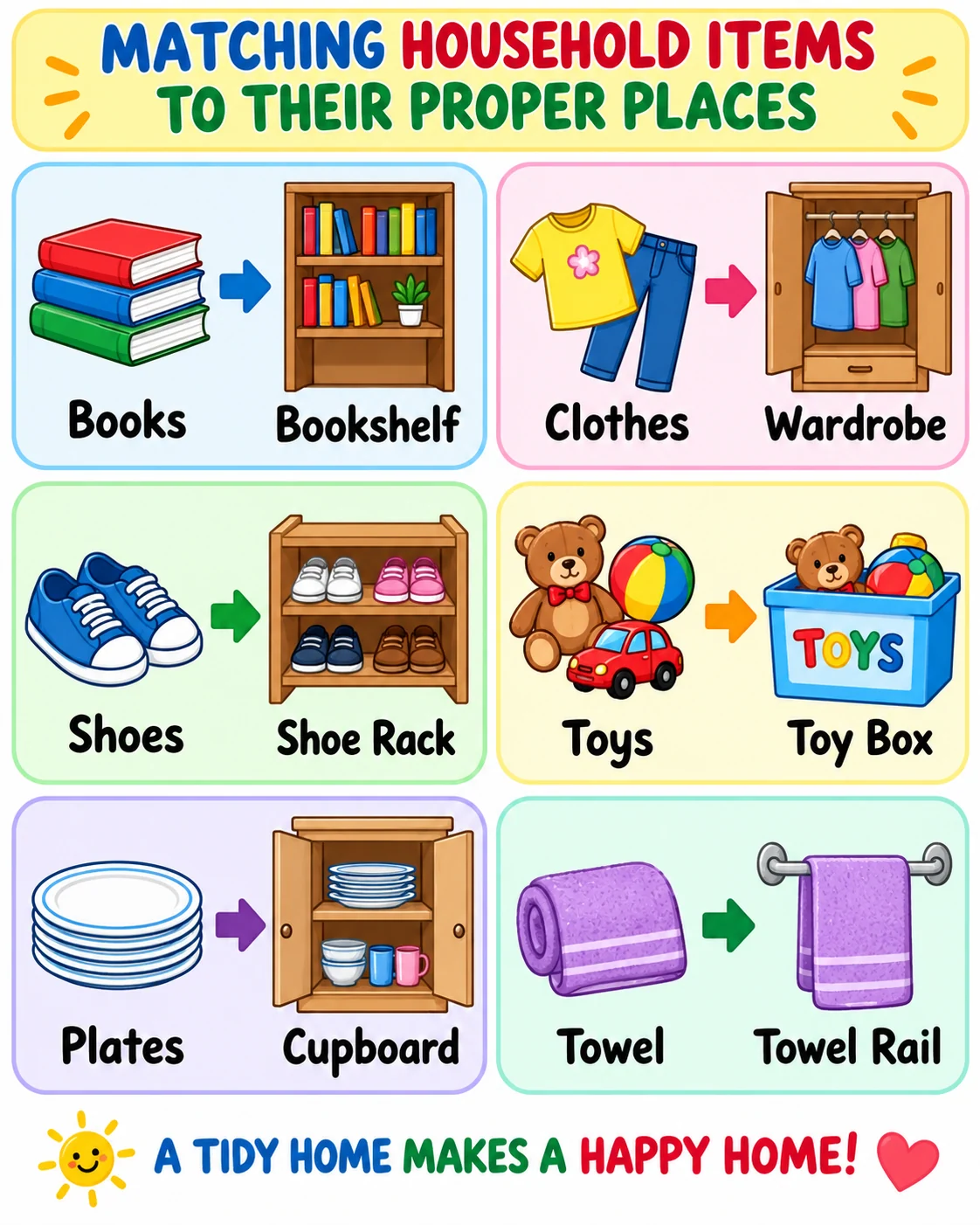
- Books should be arranged on a shelf or table.
- Clothes should be kept in a wardrobe, drawer or suitable basket.
- Shoes should be kept in their proper place.
- Toys should be returned to a toy box or basket after play.
- Chairs should be placed properly around a table or in the room.
Simple Arrangement Chart
|
Household Item |
Where It Can Be Kept |
|---|---|
|
Books |
Bookshelf, desk or table |
|
Clothes |
Wardrobe or drawer |
|
Shoes |
Shoe rack or proper corner |
|
Toys |
Toy box, basket or shelf |
|
Plates |
Kitchen shelf or cupboard |
|
Cups |
Kitchen cupboard or shelf |
|
Towel |
Towel rail or proper drying place |
|
Pillow |
On the bed |
|
Broom |
Proper cleaning-material area |
Caring for Items in the Living Room
Living-room items may include:
- Sofa.
- Chairs.
- Table.
- Television.
- Curtains.
- Rug.
- Books and decorations.
Simple ways of caring for them include:
- Avoid jumping on chairs or sofas.
- Do not scratch furniture.
- Put books back after reading.
- Keep toys off the walkway.
- Wipe safe surfaces with a clean cloth when an adult asks you.
- Do not touch electrical equipment with wet hands.
Arranging the Living Room
The living room should have enough space for people to move around safely.
Chairs and tables should not block the walkway.
Books, toys and other small items should be properly arranged.

Caring for Bedroom Items
Bedroom items may include:
- Bed.
- Mattress.
- Pillow.
- Bedsheet.
- Clothes.
- Shoes.
- Wardrobe.
- Books.
A Primary 1 pupil can help by:
- Straightening the bedsheet.
- Placing the pillow properly.
- Putting dirty clothes in a laundry basket.
- Keeping clean clothes properly.
- Arranging shoes.
- Putting books and toys away.
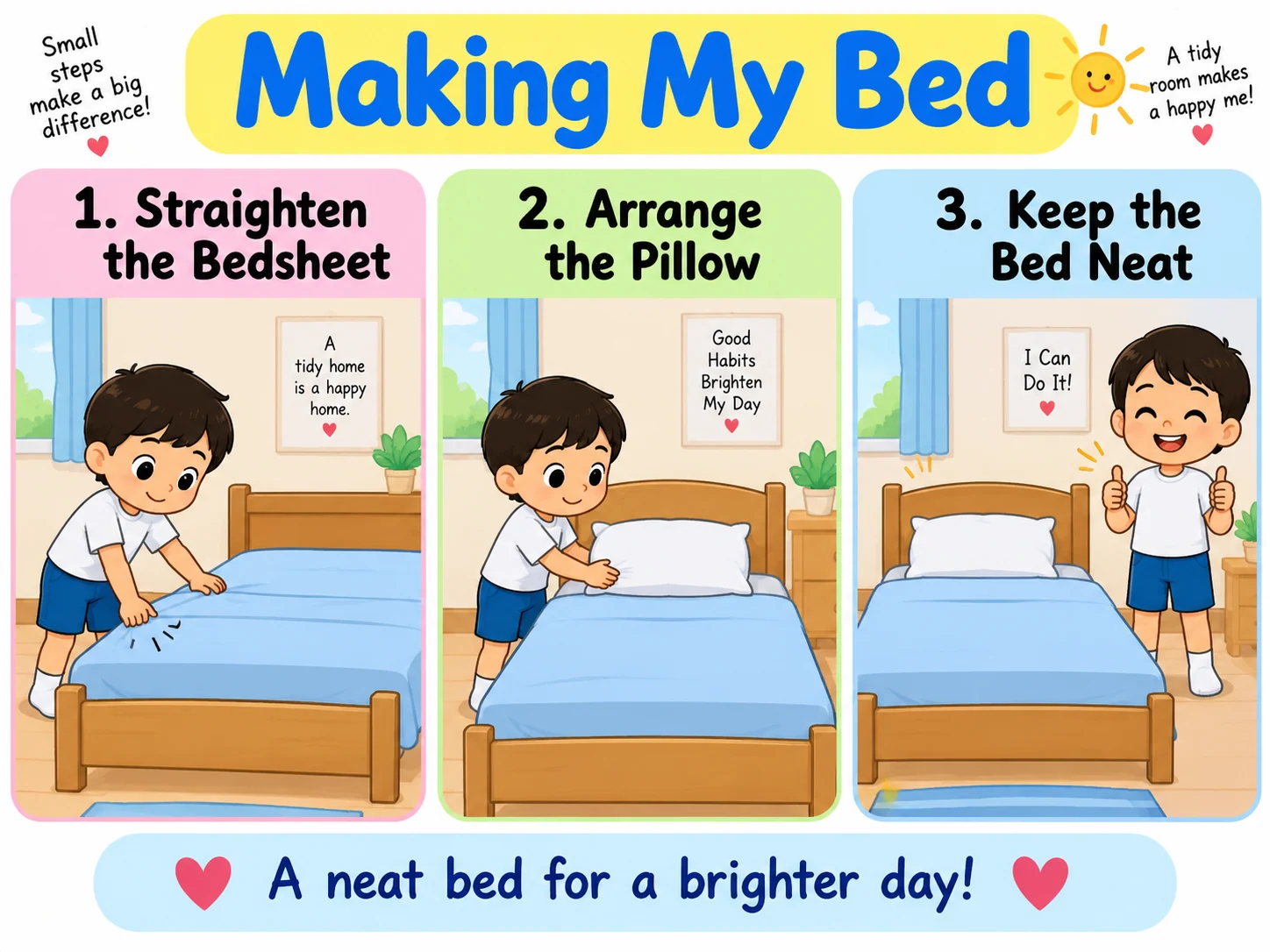
Making the Bed
A simple way of making a bed is to:
- Remove toys or other objects from the bed.
- Straighten the bedsheet.
- Arrange the pillow.
- Fold or arrange the covering neatly.
Young pupils do not need to make the bed perfectly. The aim is to learn neatness and responsibility.
Caring for Clothes
Clothes should not be thrown carelessly on the floor.
Clean clothes can be:
- Folded.
- Hung on a hanger.
- Kept inside a wardrobe or drawer.
Dirty clothes should be placed in a proper laundry basket or container.
Caring for Shoes
Shoes should:
- Be kept together as pairs.
- Be placed on a shoe rack or proper place.
- Not be scattered across the walkway.
- Be cleaned when necessary.
Caring for Kitchen Items
Kitchen items include:
- Plates.
- Cups.
- Spoons.
- Pots.
- Kettles.
- Cooking utensils.
Some kitchen items can be safely handled by children, while others should be handled by adults.
Safe Items and Adult-Only Items
|
A Child May Help With |
Adult Help Is Needed |
|---|---|
|
Plastic cup |
Knife |
|
Plastic plate |
Hot pot |
|
Spoon |
Cooker or stove |
|
Empty plastic bowl |
Boiling water |
|
Table mat |
Matches |
|
Light, safe utensils |
Electrical kitchen appliances |
A young child should never handle a hot pot, fire or sharp knife alone.
Simple Care of Safe Kitchen Items
A pupil may help to:
- Put plastic cups in the correct place.
- Arrange light, unbreakable plates.
- Place spoons together.
- Carry table mats.
- Keep the eating area tidy.
This should be done only when an adult says it is safe.
Caring for Bathroom Items
Bathroom items may include:
- Bucket.
- Basin.
- Soap.
- Sponge.
- Towel.
We should:
- Keep soap in a soap dish.
- Hang towels to dry.
- Keep the sponge in a clean place.
- Keep buckets and basins properly arranged.
- Avoid leaving objects where someone may trip over them.
Wet floors can be slippery, so children should walk carefully.
Keeping Books and Toys Properly
Books should be:
- Kept dry.
- Handled with clean hands.
- Arranged on a shelf or table.
- Protected from tearing.
Toys should be:
- Used carefully.
- Returned to their proper places.
- Kept away from walkways.
- Reported to an adult if broken or sharp.
Why Toys Should Not Be Left on the Floor
A toy left in the middle of a walkway can make someone trip and fall.
After playing, pupils should put toys away.
VISUAL TO INSERT: A two-picture safety illustration showing toys safely inside a toy box and toys scattered on a walkway with a red cross sign.
Cleaning Household Items
Some household items can be cleaned by:
- Dusting.
- Wiping.
- Washing.
- Sweeping around them.
However, children should only carry out simple and safe cleaning tasks suitable for their age.
Examples include:
- Dusting a low table with a clean dry cloth.
- Putting toys away.
- Arranging books.
- Sweeping a small safe area under adult supervision.
- Putting light rubbish into a waste bin.
Children aged about 5–7 can commonly help with simple tasks such as making beds, dusting, putting toys away, arranging books and handling light household tasks.
Cleaning Materials
Some cleaning materials are safe only when used by adults.
Examples include:
- Bleach.
- Strong detergents.
- Toilet cleaners.
- Insecticides.
- Other household chemicals.
Pupils should not play with, taste, smell closely or mix cleaning chemicals.
Cleaning products should be stored away from children.
VISUAL TO INSERT: A safety poster titled Ask an Adult for Help, showing a child staying away from bottles of bleach, detergent, toilet cleaner and insecticide, with red cross signs over the products.
Good and Poor Care of Household Items
|
Good Care |
Poor Care |
|---|---|
|
Returning books to the shelf |
Throwing books on the floor |
|
Putting toys away |
Leaving toys on the walkway |
|
Keeping clothes properly |
Scattering clothes everywhere |
|
Using chairs carefully |
Jumping on furniture |
|
Keeping plates safely |
Throwing plates around |
|
Hanging towels to dry |
Leaving wet towels on the floor |
|
Reporting broken items |
Continuing to play with broken items |
Why Broken Items Should Be Reported
A broken household item may become dangerous.
For example:
- Broken glass can cut the skin.
- A broken chair may cause someone to fall.
- A damaged electrical item may be unsafe.
- A broken toy may have sharp edges.
Children should tell an adult when they see a broken household item.
They should not try to repair dangerous things themselves.
A Simple Rule for Household Items
Pupils can remember:
USE IT CAREFULLY
↓
KEEP IT CLEAN
↓
RETURN IT PROPERLY
↓
REPORT IF BROKEN
How a Primary 1 Pupil Can Help at Home
A Primary 1 pupil can safely help by:
- Making the bed.
- Putting toys away.
- Arranging books.
- Putting dirty clothes in a basket.
- Keeping shoes together.
- Putting light rubbish in a bin.
- Arranging light, safe household items.
- Carrying out other simple tasks given by an adult.
Helping at home should always be safe and suitable for the child’s age.
F: LESSON PRESENTATION
F1: Teachers’ Activities
- Revises household items learnt in Week Nine.
- Displays pictures of well-arranged and poorly arranged household items.
- Explains the meaning of caring for household items.
- Explains the meaning of arrangement.
- Shows pupils safe household objects such as books, toys and plastic cups.
- Demonstrates how to arrange books, toys and other safe items.
- Demonstrates simple bed arrangement using a picture or model.
- Guides pupils to match household items with their correct storage places.
- Discusses safe tasks children can perform at home.
- Shows pictures of dangerous items and cleaning chemicals that require adult handling.
- Explains why broken household items should be reported.
- Guides pupils through the four-step rule: Use Carefully, Keep Clean, Return Properly, Report If Broken.
- Asks oral questions and corrects pupils where necessary.
F2: Pupils’ Activities
- Name some household items learnt in the previous lesson.
- Identify well-arranged and poorly arranged items from pictures.
- Explain care of household items in simple words.
- Arrange books, toys and other safe items demonstrated by the teacher.
- Match household items with their proper places.
- Demonstrate simple ways of making a bed neat.
- Mention household tasks they can safely help with.
- Identify dangerous items that require adult help.
- State what they should do when they see a broken household item.
- Recite the four-step care rule with the teacher.
- Answer the teacher’s questions.
G: CONCLUSION
The teacher revises the meaning of care and arrangement of household items.
The teacher reminds pupils that household items should be used carefully, kept clean, returned to their proper places and reported to an adult when broken.
The teacher also reminds pupils that young children should carry out only safe and age-appropriate household tasks and should never play with fire, sharp objects or cleaning chemicals.
H: EVALUATION GUIDE
Pupils should be able to answer the following questions:
- What does it mean to care for household items?
- Mention four ways of caring for household items.
- What does arrangement mean?
- Where should books be kept?
- Where can clean clothes be kept?
- Where should toys be kept after playing?
- Mention three things you can do to keep a bedroom neat.
- Why should toys not be left on a walkway?
- Mention three safe household tasks a Primary 1 pupil can help with.
- Mention three kitchen items that need adult help.
- What should you do when you see a broken household item?
- Why should towels be hung to dry?
- Should children play with bleach or toilet cleaner?
- Complete the rule: Use it carefully, keep it clean, return it ________, report if ________.
- Mention three reasons why household items should be properly arranged.