
TOPIC: THE HUMAN BODY – NECK, TRUNK, CHEST AND BELLY
A: TEACHING AND LEARNING MATERIALS
- Large labelled chart of the human body.
- Picture of a child showing the head, neck and trunk.
- Picture cards showing the neck, chest and belly.
- Mirror.
- Human-body puzzle or cut-out picture.
- Flash cards labelled Neck, Trunk, Chest and Belly.
- Pupils’ writing books and pencils.
B: REFERENCE MATERIALS
- Primary 1 Home Economics Scheme of Work.
- Recommended Home Economics textbook for Primary 1.
- Online educational resources.
C: PREVIOUS KNOWLEDGE
Review the previous week’s Home Economics lesson.
The pupils have learnt about the human body. They can identify the head, hair, eyes, nose, mouth and ears. They also know some simple functions of these body parts.
D: PERFORMANCE OBJECTIVES
By the end of the lesson, pupils should be able to:
- Identify the neck on their body.
- Identify the trunk on a human-body chart.
- Explain the neck in simple words.
- Explain the trunk in simple words.
- Identify the chest.
- Identify the belly.
- State that the chest and belly are parts of the trunk.
- Point correctly to the neck, chest and belly.
- Match the named body parts with their correct positions.
- Mention simple ways of keeping these parts of the body clean and safe.
E: CONTENT
Revision of the Human Body
The human body has many parts.
In the previous lesson, we learnt about parts found on and around the head.
They include:
- Hair.
- Eyes.
- Nose.
- Mouth.
- Ears.
Today, we will learn about another part of the body called the trunk and the neck that connects the head to the main part of the body.
Main Parts of the Body
For easy understanding, we can look at the human body in three main sections:
- Head
- Trunk
- Arms and legs
The neck is between the head and the trunk.
1. THE NECK
The neck is the part of the body between the head and the trunk.
It connects the head to the main part of the body.
We can feel our neck below our head.
Where Is the Neck?
The neck is:
- Below the head.
- Above the chest.
- Between the head and the trunk.
What Does the Neck Help Us Do?
The neck supports the head.
It also helps us move the head.
We can gently:
- Turn the head from side to side.
- Look up.
- Look down.
These movements should be done gently.
Neck Movement Activity
The teacher asks pupils to sit or stand properly.
Under the teacher’s guidance, pupils gently:
- Look straight ahead.
- Turn the head slightly to the left.
- Return to the centre.
- Turn slightly to the right.
- Return to the centre.
The teacher explains that the neck helps the head to move.
Pupils should not twist or pull another person’s neck.
2. THE TRUNK
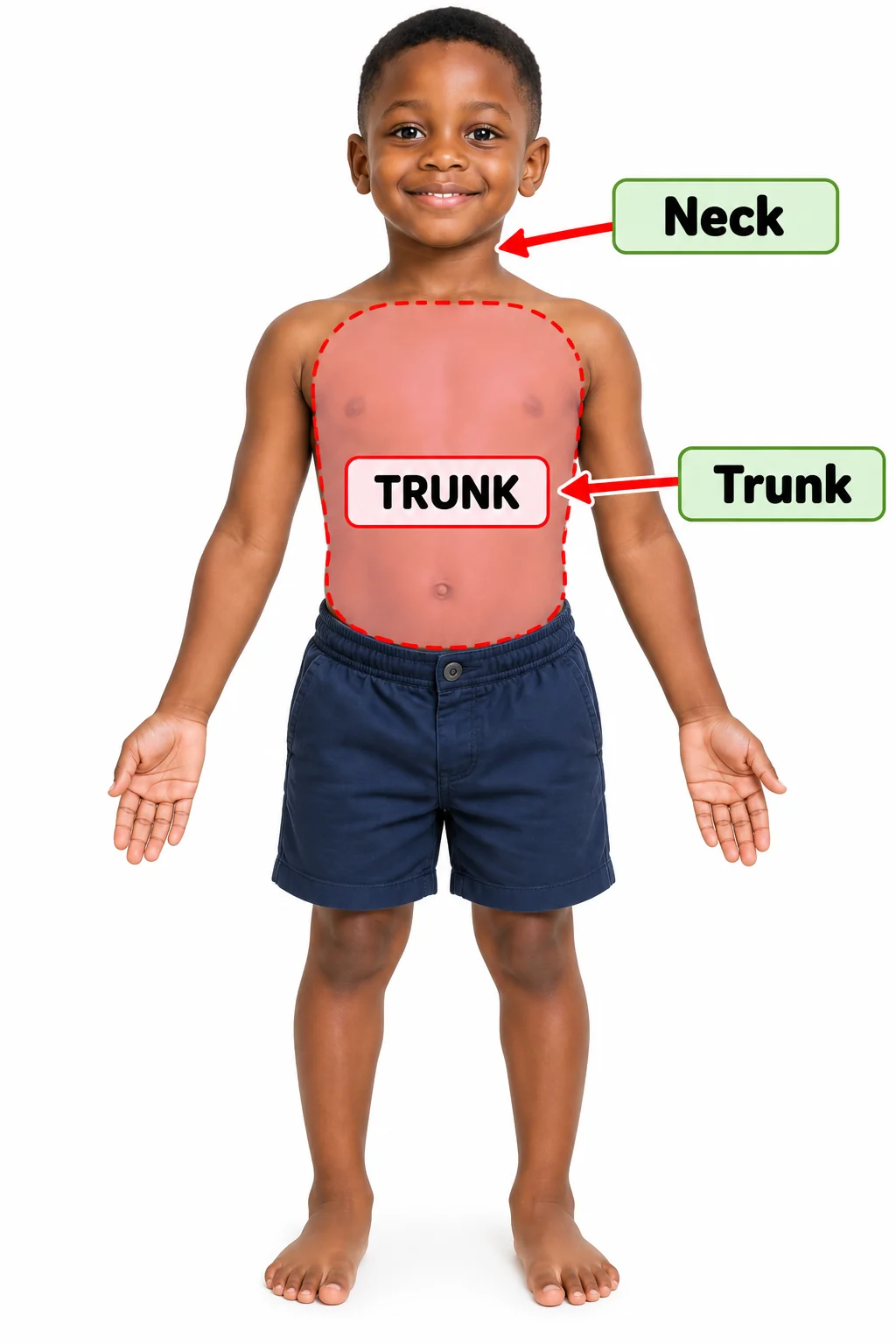
The trunk is the main middle part of the body.
It is below the neck.
The trunk includes the front part of the body where we find the:
- Chest.
- Belly.
The back is also part of the trunk.
Parts of the Trunk
For this lesson, pupils will learn two important parts of the trunk:
- Chest
- Belly
| Part | Position |
|---|---|
| Neck | Between the head and trunk |
| Chest | Upper front part of the trunk |
| Belly | Lower front part of the trunk |
| Trunk | Main middle part of the body |
3. THE CHEST
The chest is the upper front part of the trunk.
It is:
- Below the neck.
- Above the belly.
Pupils can gently place a hand on the front upper part of their trunk to locate the chest.
What Is Inside the Chest?
Important parts of the body are protected inside the chest.
For Primary 1, pupils only need to know that the chest is an important part of the body and should be protected.
The heart and lungs are found inside the chest.
Simple Activity: Feel Your Breathing
The teacher asks pupils to sit quietly.
Pupils may gently place a hand on their chest.
They breathe normally.
They may notice the chest moving slightly as they breathe.
The teacher explains:
Our chest moves as we breathe.
4. THE BELLY
The belly is the lower front part of the trunk.
It is below the chest.
Another word often used for the belly is the abdomen, but for Primary 1 pupils, belly is easier to understand.
Finding the Belly
The teacher asks pupils to gently point to the front of the body below the chest.
The teacher explains:
This is your belly.
The belly contains important organs inside the body.
Pupils do not need to learn the names of these organs in this lesson.
Chest and Belly
The chest and belly are both found on the trunk.
Simple Comparison
| Chest | Belly |
|---|---|
| Found on the upper front part of the trunk | Found below the chest |
| Nearer to the neck | Nearer to the waist |
| Protects important organs inside | Contains important organs inside |
Point and Say Activity
The teacher calls out a body part.
Pupils point to it on their own bodies.
Teacher says:
Neck — pupils point to their neck.
Chest — pupils point to their chest.
Belly — pupils point to their belly.
The teacher then shows the whole middle part and says:
Trunk — pupils identify the main middle part of the body.
Where Is It?
The teacher asks:
What is between your head and your trunk?
Pupils answer:
The neck.
What is below your neck?
Pupils answer:
The chest.
What is below your chest?
Pupils answer:
The belly.
Which main part contains the chest and belly?
Pupils answer:
The trunk.
Looking at Ourselves
The teacher may allow pupils to stand in front of a mirror.
Each pupil may identify:
- Head.
- Neck.
- Chest.
- Belly.
The teacher reminds pupils that children’s bodies may look different in:
- Height.
- Size.
- Shape.
- Skin colour.
These differences are normal.
Caring for the Neck and Trunk
The neck, chest and belly are parts of our body, so we should keep them clean.
Simple ways of caring for them include:
- Bathing regularly.
- Washing the neck properly during bathing.
- Wearing clean clothes.
- Drying the body with a clean towel.
- Avoiding rough play that may cause injury.
- Sitting and standing properly.
Washing the Neck
Sometimes dirt and sweat can collect around the neck.
During bathing:
- Use clean water.
- Use suitable soap.
- Wash around the neck gently.
- Rinse properly.
- Dry with a clean towel.
We should not leave the neck dirty after bathing.
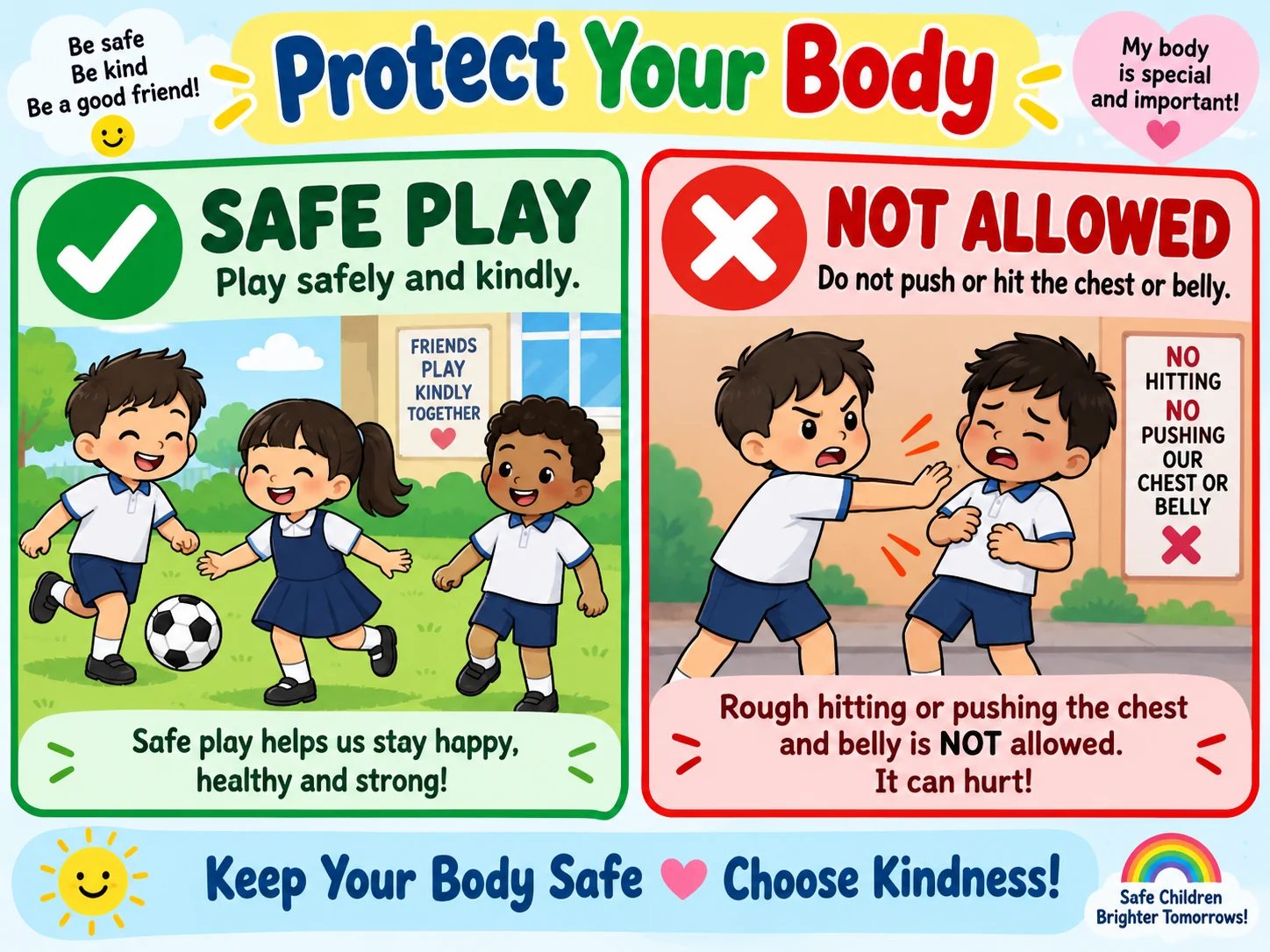
Protecting the Chest and Belly
We should protect our chest and belly.
We should not:
- Hit another person on the chest.
- Punch another person’s belly.
- Push people roughly.
- Jump on another person’s body.
- Play dangerous games.
If someone has a strong pain or injury in the chest or belly, an adult should be told.
Good Posture
Posture means the way we hold our body when we sit, stand or move.
We should try to:
- Stand upright.
- Sit properly.
- Avoid bending badly for a long time.
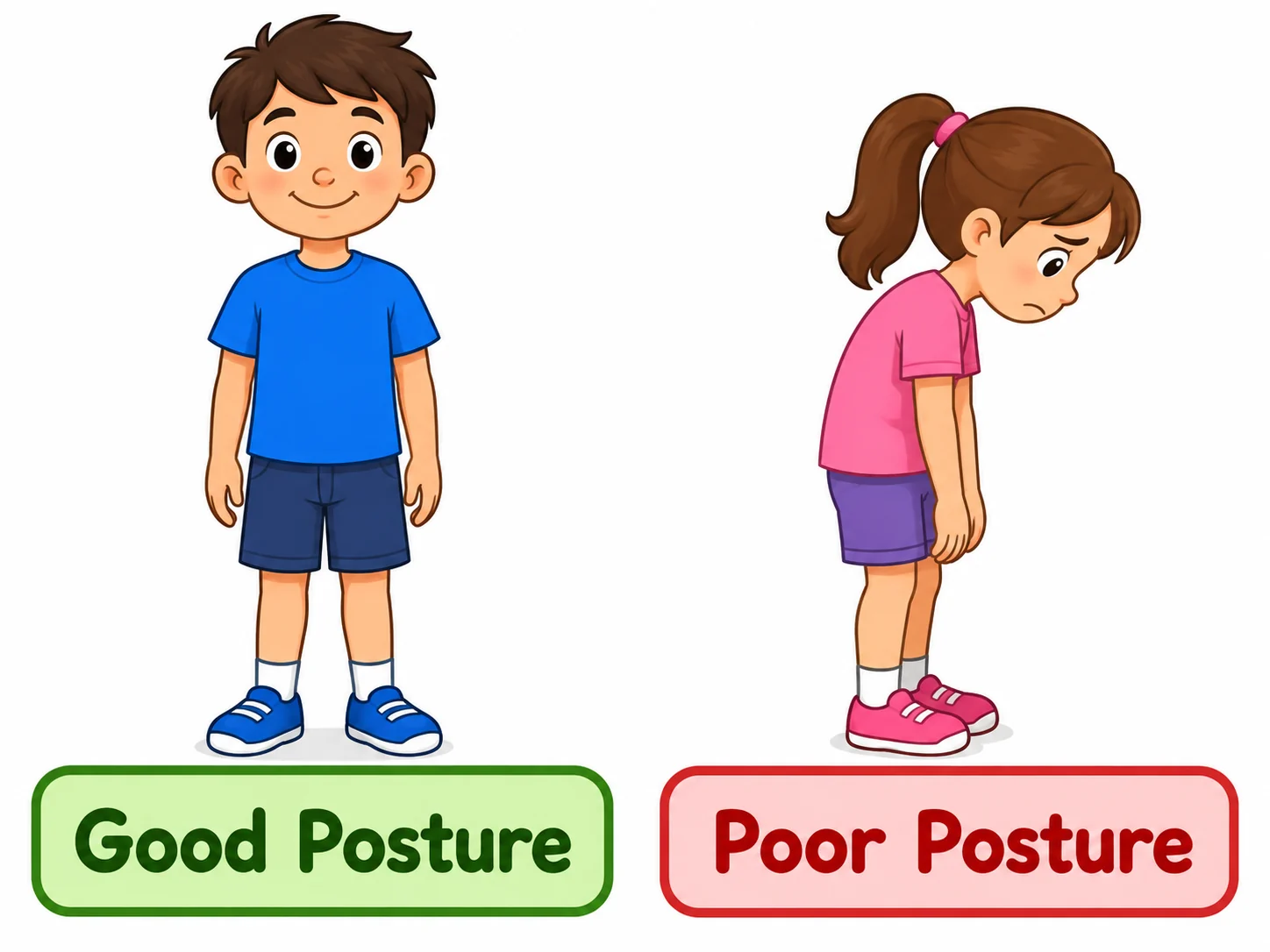
Good posture helps us hold the head, neck and trunk comfortably.
Body-Part Matching Activity
Match each description to the correct body part.
| Description | Body Part |
|---|---|
| Between the head and trunk | Neck |
| Upper front part of the trunk | Chest |
| Lower front part of the trunk | Belly |
| Main middle part of the body | Trunk |
Complete the Body
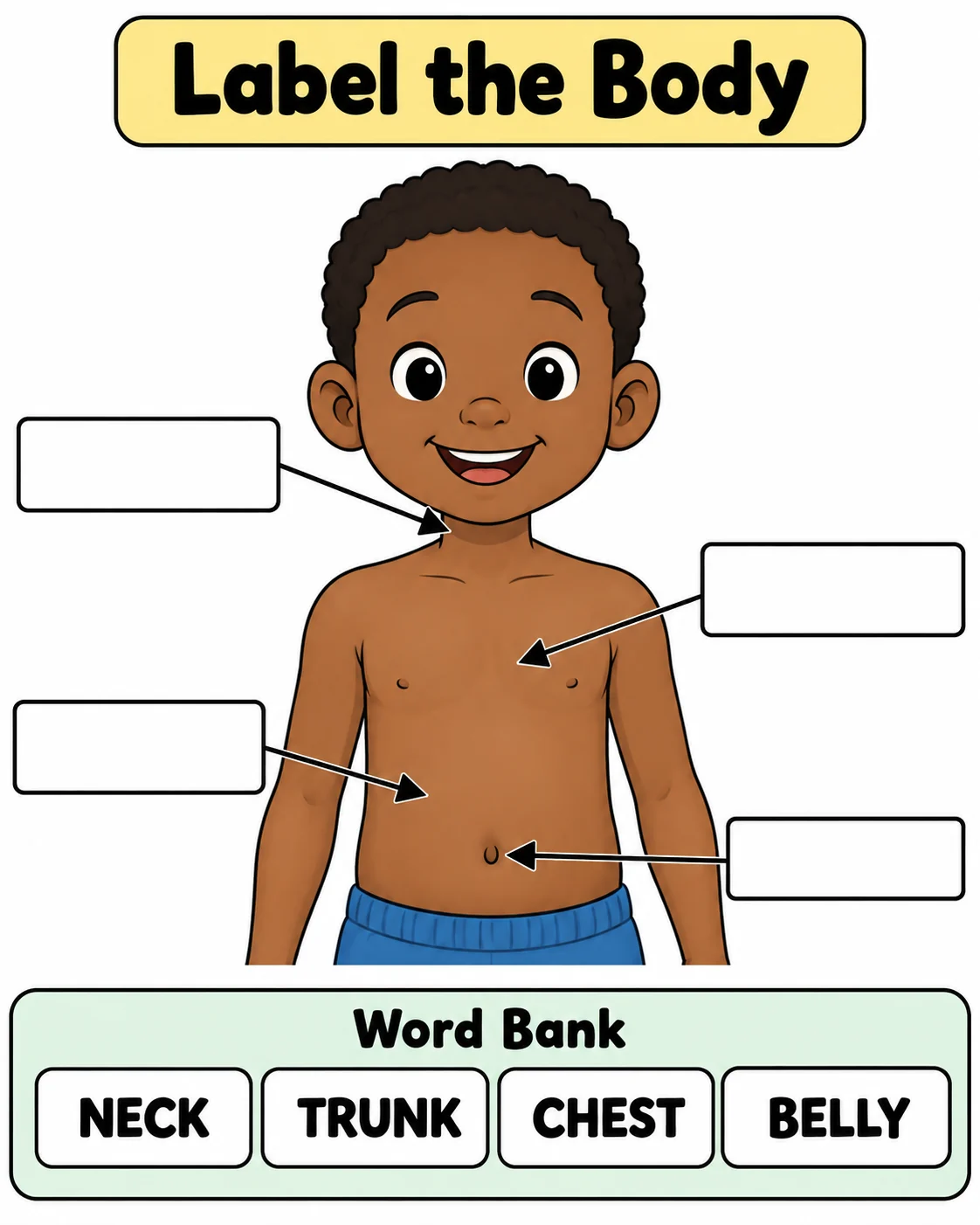
The teacher may provide a simple body picture with missing labels.
Pupils choose from:
NECK – TRUNK – CHEST – BELLY
and place each word in the correct position.
Body-Part Riddles
Riddle 1
I am between your head and trunk. What am I?
Answer: Neck.
Riddle 2
I am the upper front part of your trunk. What am I?
Answer: Chest.
Riddle 3
I am below your chest. What am I?
Answer: Belly.
Riddle 4
I am the main middle part of your body. What am I?
Answer: Trunk.
Remember
The neck connects the head to the trunk.
The trunk is the main middle part of the body.
The chest is the upper front part of the trunk.
The belly is below the chest.
F: LESSON PRESENTATION
F1: Teachers’ Activities
- Revises the parts of the head learnt in Week One.
- Displays a large chart of the human body.
- Points to and names the neck.
- Explains that the neck is between the head and trunk.
- Guides pupils through a gentle neck-movement activity.
- Explains the meaning of the trunk in simple words.
- Shows the trunk on a human-body chart.
- Points out the chest as the upper front part of the trunk.
- Points out the belly below the chest.
- Guides pupils to point to their neck, chest and belly.
- Uses the position chart to show Head → Neck → Chest → Belly.
- Conducts the body-part matching activity.
- Guides pupils through the body-part riddles.
- Explains simple ways of keeping the body clean.
- Discusses safe and unsafe behaviour involving the trunk.
- Uses pictures to introduce good posture.
- Asks oral questions and corrects pupils where necessary.
F2: Pupils’ Activities
- Recall the parts of the head learnt previously.
- Observe the human-body chart.
- Point to their neck.
- Identify the trunk.
- Point to their chest.
- Point to their belly.
- State that the neck is between the head and trunk.
- State that the chest and belly are parts of the trunk.
- Take part in the gentle neck-movement activity.
- Match body parts with their correct positions.
- Complete the simple labelling activity.
- Answer body-part riddles.
- Mention ways of keeping the neck and trunk clean.
- Identify good and poor posture from pictures.
- Answer the teacher’s questions.
G: CONCLUSION
The teacher revises the neck, trunk, chest and belly.
The teacher reminds pupils that:
- The neck is between the head and trunk.
- The trunk is the main middle part of the body.
- The chest is the upper front part of the trunk.
- The belly is below the chest.
Pupils are encouraged to keep their bodies clean, avoid rough play and practise good posture.
Continue with the next week’s Home Economics lesson.
H: EVALUATION GUIDE
Pupils should be able to answer the following questions:
- What part of the body is between the head and trunk?
- What is the trunk?
- Mention two parts found on the front of the trunk.
- Where is the chest found?
- Where is the belly found?
- Which part is below the neck?
- Which part is below the chest?
- What does the neck connect?
- Mention one thing the neck helps us to do.
- Which main body part contains the chest and belly?
- Mention three ways of keeping the body clean.
- Why should we avoid rough play?
- What should you do if your chest or belly is badly hurt?
- Complete: The ______ is between the head and trunk.
- Complete: The chest and belly are parts of the ______.
- Complete: The ______ is below the chest.
- Point to your neck.
- Point to your chest.
- Point to your belly.
- Arrange these from top to bottom: Belly, Head, Neck, Chest.