TOPIC: THE HUMAN BODY
A: TEACHING AND LEARNING MATERIALS
- Large chart showing a child’s body.
- Picture of a child’s head and face.
- Mirror.
- Picture cards showing different parts of the head.
- Flash cards labelled Head, Hair, Eyes, Nose, Mouth and Ears.
- Simple body-parts matching chart.
- Pupils’ writing books and pencils.
B: REFERENCE MATERIALS
- Primary 1 Home Economics Scheme of Work.
- Recommended Home Economics textbook for Primary 1.
- Online educational resources.
C: PREVIOUS KNOWLEDGE
The pupils have seen and used different parts of their bodies since they were young. They can point to some familiar body parts such as the head, eyes, nose and mouth, even if they cannot yet explain their functions clearly.
D: PERFORMANCE OBJECTIVES
By the end of the lesson, pupils should be able to:
- Explain the human body in simple words.
- Identify the head.
- Identify the hair.
- Identify the eyes.
- Identify the nose.
- Identify the mouth.
- Identify the ears.
- Mention a simple function of each part.
- Point correctly to the named body parts.
- Match pictures of body parts with their correct names.
E: CONTENT
Meaning of the Human Body
The human body is the whole physical body of a person.
Every person has a body.
Our body has many different parts.
We use different parts of our body to carry out different activities.
For example:
- We use our eyes to see.
- We use our ears to hear.
- We use our nose to smell.
- We use our mouth to eat and speak.
In this lesson, we will learn about some parts found on and around the head.
The Head
The head is the uppermost part of the human body.
The head contains or carries important parts such as:
- Hair.
- Eyes.
- Nose.
- Mouth.
- Ears.
We should take good care of our head and the parts found on it.
Parts of the Head and Face
The major parts we will identify today are:
- Head.
- Hair.
- Eyes.
- Nose.
- Mouth.
- Ears.
Simple Body-Part Chart
| Part | Where It Is Found | Simple Function |
|---|---|---|
| Head | Top part of the body | Carries the face and important sense organs |
| Hair | On the head | Covers and helps protect the head |
| Eyes | On the face | Used for seeing |
| Nose | Middle part of the face | Used for smelling and breathing |
| Mouth | Below the nose | Used for eating, speaking and drinking |
| Ears | Sides of the head | Used for hearing |
1. The Hair
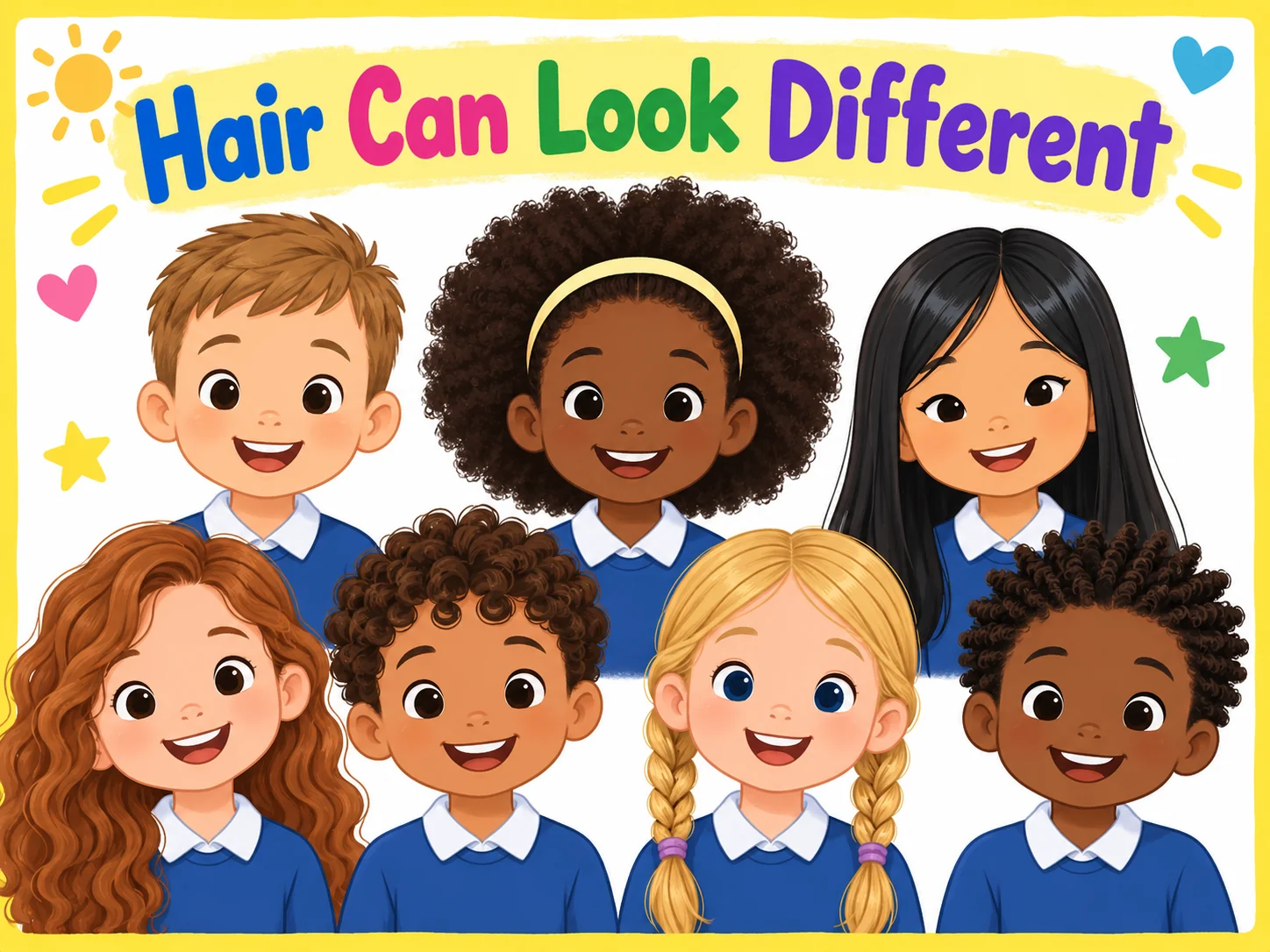
Hair grows on the head.
People may have hair that is:
- Short.
- Long.
- Thick.
- Thin.
- Straight.
- Curly.
People’s hair can look different, and that is normal.
Simple Function of the Hair
Hair helps to cover and protect the head.
Hair should be kept clean and neat.
2. The Eyes
We have two eyes.
The eyes are found on the face.
We use our eyes to see.
With our eyes, we can see:
- People.
- Books.
- Colours.
- Animals.
- Houses.
- Food.
- Things around us.
Simple Activity
The teacher asks pupils to look around the classroom and name one thing they can see.
Possible answers:
- Chair.
- Table.
- Book.
- Board.
- Teacher.
The teacher explains:
We use our eyes to see these things.

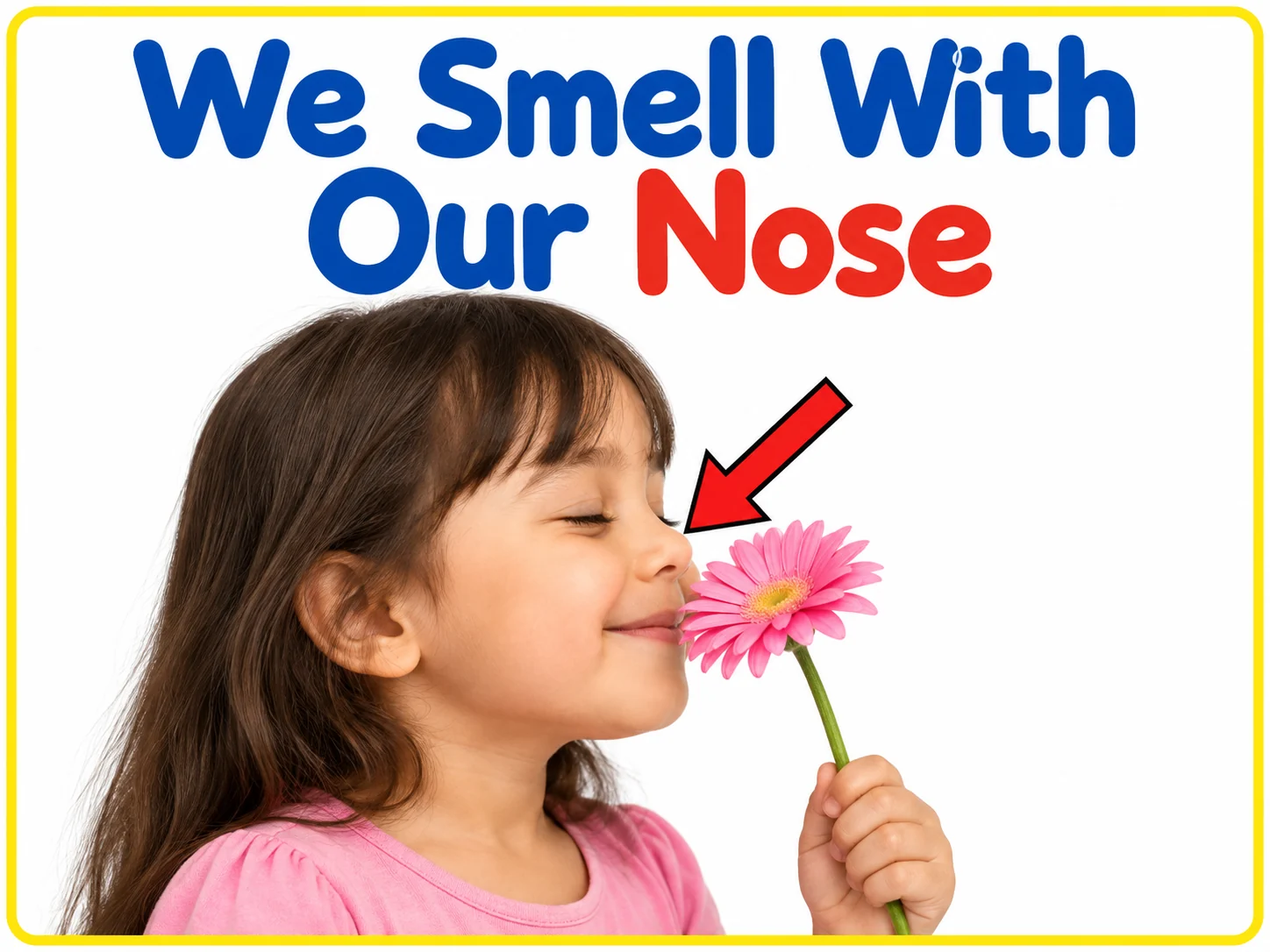
3. The Nose
The nose is found on the face.
It is usually between the eyes and the mouth.
We use the nose mainly for:
- Smelling.
- Breathing.
Things We Can Smell
With the nose, we may smell:
- Food.
- Flowers.
- Soap.
- Perfume.
- Smoke.
We should not put objects inside the nose.
4. The Mouth
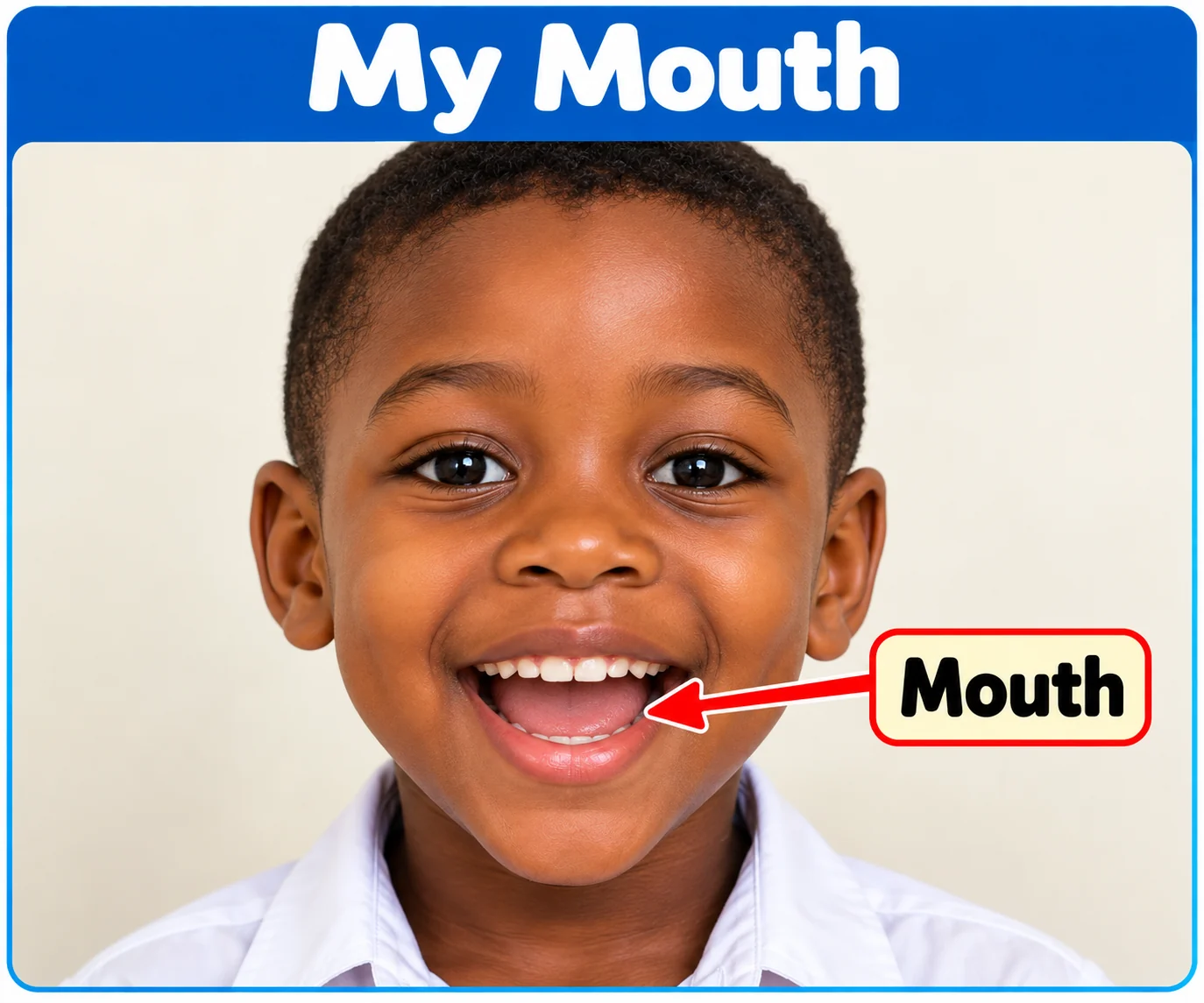
The mouth is found below the nose.
We use the mouth for different activities.
We use the mouth to:
- Eat.
- Drink.
- Speak.
- Sing.
The teeth and tongue are found inside the mouth. Pupils will learn more about their care in later lessons.
Simple Activity
The teacher asks:
Which part of your body do you use to eat?
Pupils answer:
The mouth.
5. The Ears
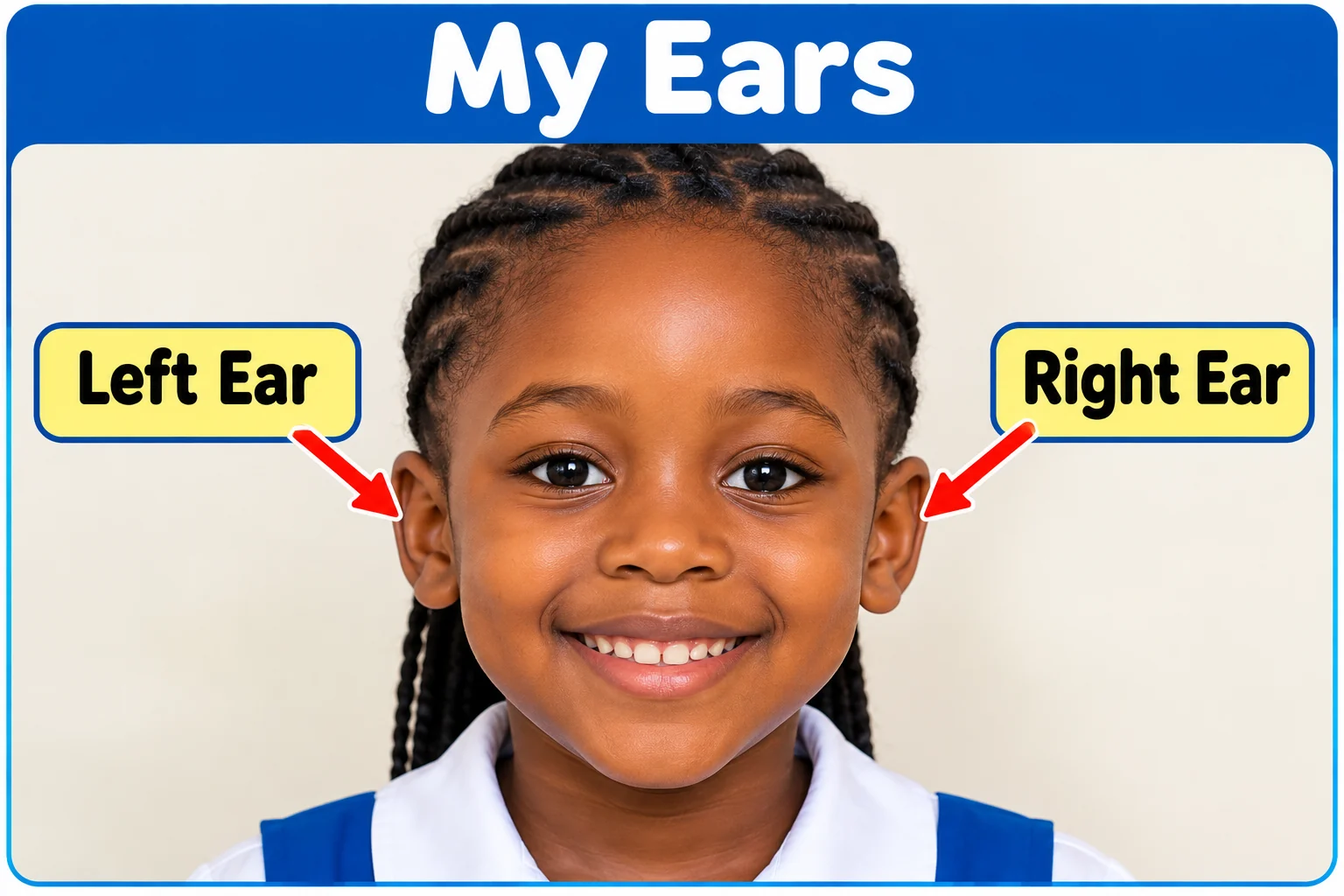
We normally have two ears.
One ear is on each side of the head.
We use the ears to hear sounds.
We can hear:
- People talking.
- Music.
- A bell.
- Animals.
- Cars.
- Clapping.
Classroom Activity
The teacher claps two or three times.
The teacher asks:
Which part of your body helped you hear the clapping?
Pupils answer:
The ears.
Our Sense Parts
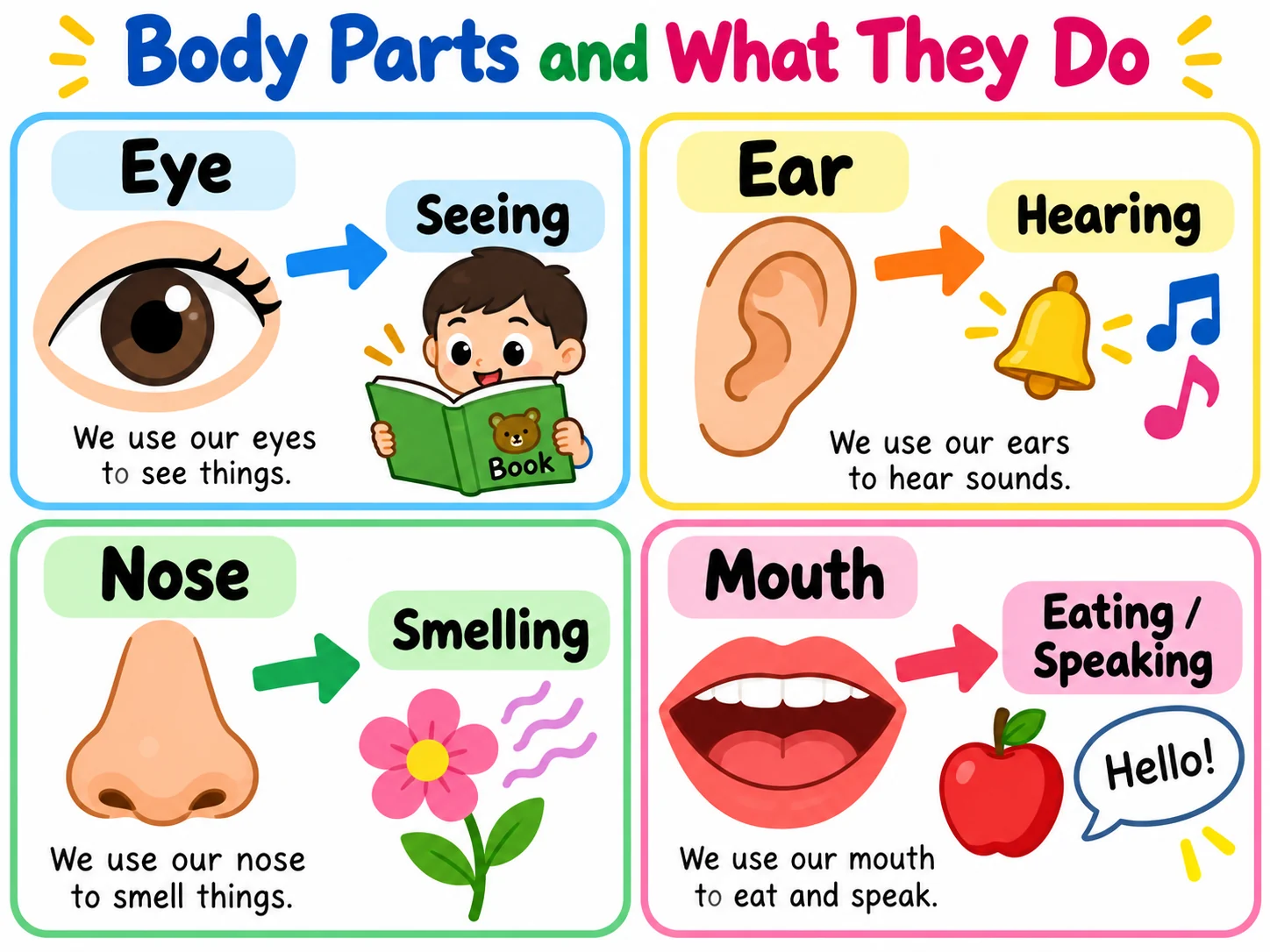
Some parts of our body help us know what is happening around us.
For this lesson:
EYES → SEE
EARS → HEAR
NOSE → SMELL
MOUTH → EAT AND SPEAK
Simple Matching Table
| What We Do | Body Part |
|---|---|
| See a book | Eyes |
| Hear a bell | Ears |
| Smell a flower | Nose |
| Eat rice | Mouth |
| Speak to a friend | Mouth |
Point and Say Activity
The teacher calls out the name of a body part.
Pupils point to the correct part on their own bodies.
The teacher says:
Hair — pupils touch their hair.
Eyes — pupils point to their eyes without touching them.
Nose — pupils point to their nose.
Mouth — pupils point to their mouth.
Ears — pupils point to their ears.
This activity should be done slowly so that every pupil can participate.
Look in the Mirror
The teacher may give pupils a mirror one at a time or allow them to use a large classroom mirror.
Pupils look at their faces and identify:
- Hair.
- Eyes.
- Nose.
- Mouth.
- Ears.
The teacher reminds pupils that people may look different from one another.
Some pupils may have:
- Different hairstyles.
- Different skin tones.
- Different face shapes.
- Different eye shapes.
These differences are normal.
How Many Do We Have?
For most people:
| Body Part | Number |
|---|---|
| Head | 1 |
| Nose | 1 |
| Mouth | 1 |
| Eyes | 2 |
| Ears | 2 |
Hair is made up of many strands, so we do not count it in the same way.
Simple Number Activity
Teacher asks:
How many eyes do you have?
Pupils answer:
Two.
Teacher asks:
How many noses do you have?
Pupils answer:
One.
Teacher asks:
How many ears do you have?
Pupils answer:
Two.

We Should Care for Our Body
Every part of the body is important.
We should keep our body:
- Clean.
- Neat.
- Safe.
Simple habits include:
- Bathing regularly.
- Keeping the hair clean.
- Keeping dirty hands away from the eyes.
- Not putting objects into the nose.
- Not putting objects deep inside the ears.
- Keeping the mouth clean.
Pupils will learn more about caring for these body parts in later lessons.
What Should We Not Do?
We should not:
- Poke the eyes.
- Put pencils or other objects into the ears.
- Put stones or objects into the nose.
- Pull another person’s hair.
- Put dirty objects into the mouth.
These actions may hurt the body.

Body-Part Riddle Activity
The teacher reads each clue.
Riddle 1
I help you to see. What am I?
Answer: Eyes.
Riddle 2
I help you to hear. What am I?
Answer: Ears.
Riddle 3
I help you to smell. What am I?
Answer: Nose.
Riddle 4
You use me to eat and speak. What am I?
Answer: Mouth.
Riddle 5
I grow on your head. What am I?
Answer: Hair.
Remember
Eyes help us to see.
Ears help us to hear.
The nose helps us to smell.
The mouth helps us to eat and speak.
Hair grows on the head.
F: LESSON PRESENTATION
F1: Teachers’ Activities
- Introduces the lesson by asking pupils to point to their heads.
- Displays a large chart of a child.
- Explains the meaning of the human body in simple words.
- Shows pupils the head on the chart.
- Identifies the hair, eyes, nose, mouth and ears one after another.
- Guides pupils to repeat the names of the body parts.
- Explains one or two simple functions of each part.
- Asks pupils to point to the named parts on their bodies.
- Uses a mirror to help pupils observe their faces.
- Demonstrates seeing, hearing and smelling activities.
- Uses picture cards for a body-part matching activity.
- Conducts the How Many? counting activity.
- Conducts the body-part riddle activity.
- Discusses simple ways of keeping the body safe.
- Asks oral questions and corrects pupils where necessary.
F2: Pupils’ Activities
- Point to their heads.
- Observe the human-body chart.
- Identify the hair, eyes, nose, mouth and ears.
- Repeat the names of the body parts after the teacher.
- Point correctly to each named part.
- State that the eyes are used for seeing.
- State that the ears are used for hearing.
- State that the nose is used for smelling.
- State that the mouth is used for eating and speaking.
- Look at their faces in a mirror.
- Count their eyes, ears, nose and mouth.
- Match pictures of body parts with their functions.
- Answer the body-part riddles.
- Mention actions that may hurt the body.
- Answer the teacher’s questions.
G: CONCLUSION
The teacher revises the lesson by pointing to the head, hair, eyes, nose, mouth and ears on the chart.
Pupils are reminded that different parts of the body perform different functions.
The teacher emphasises:
We see with our eyes, hear with our ears, smell with our nose, and use our mouth for eating and speaking.
The teacher encourages pupils to identify these parts correctly and to keep their bodies clean and safe.
Continue with the next week’s Home Economics lesson.
H: EVALUATION GUIDE
Pupils should be able to answer the following questions:
- What is the human body?
- Where is the head found?
- Mention five parts found on or around the head.
- Where does hair grow?
- What do we use our eyes for?
- How many eyes do we normally have?
- What do we use our ears for?
- How many ears do we normally have?
- What do we use our nose for?
- What do we use our mouth for?
- Which body part helps you hear a bell?
- Which body part helps you smell a flower?
- Which body part helps you see your teacher?
- Which body part do you use to eat?
- Mention two things you should not put inside your ears or nose.
- Complete: We see with our ______.
- Complete: We hear with our ______.
- Complete: We smell with our ______.
- Complete: Hair grows on the ______.
- Point to your eyes, nose, mouth and ears.