
TOPIC: FOOD FOR HEALTH – BASIC METHODS OF COOKING
A: TEACHING AND LEARNING MATERIALS
- Pictures of different cooked foods.
- Samples or pictures of boiled rice.
- Boiled yam.
- Fried plantain or akara.
- Bread.
- Roasted maize.
- Cooking pot.
- Frying pan.
- Baking tray.
- Wooden spoon.
- Picture cards showing boiling, frying, baking and roasting.
- Chart showing basic methods of cooking.
- Pupils’ writing books and pencils.
B: REFERENCE MATERIALS
- Scheme of work.
- Recommended Home Economics textbook for Primary 1.
- Online educational resources.
C: PREVIOUS KNOWLEDGE
The pupils have learnt about the classes of food. They can identify foods such as rice, yam, beans, fish, eggs, fruits and vegetables. They also know that food gives us energy, helps us to grow and helps us to stay healthy.
Previous lesson: Primary 1 Home Economics Third Term Week 8
D: PERFORMANCE OBJECTIVES
By the end of the lesson, pupils should be able to:
- Explain cooking in simple words.
- State some reasons why food is cooked.
- Mention four basic methods of cooking.
- Explain boiling in simple words.
- Explain frying in simple words.
- Explain baking in simple words.
- Explain roasting in simple words.
- Give examples of foods prepared by each method.
- Match familiar foods with their methods of cooking.
- Identify simple cooking utensils.
- State basic kitchen-safety rules.
- Explain why young children should not handle hot oil, fire or hot cooking utensils.
E: CONTENT
Meaning of Cooking
Cooking means preparing food by using heat so that the food becomes ready to eat.
Many foods are cooked before we eat them.
Examples include:
- Rice.
- Yam.
- Beans.
- Meat.
- Fish.
- Plantain.
- Maize.
Some foods, such as certain fruits, may be eaten without cooking after they have been properly washed.
Why Do We Cook Food?
We cook food for different reasons.
Cooking can:
- Make some foods soft.
- Make some foods easier to chew.
- Make food pleasant to eat.
- Improve the taste and smell of food.
- Make many foods safer to eat when cooked properly.
- Help us prepare different meals from the same food.
For example, yam may be:
- Boiled.
- Fried.
- Roasted.
This means one food can be prepared in different ways.
BASIC METHODS OF COOKING
The four basic methods for this lesson are:
- Boiling
- Frying
- Baking
- Roasting
Methods of Cooking at a Glance
|
Method |
How It Is Done |
Examples |
|---|---|---|
|
Boiling |
Food is cooked in hot or boiling water |
Rice, yam, eggs |
|
Frying |
Food is cooked in hot oil |
Akara, plantain, yam |
|
Baking |
Food is cooked with dry heat in an oven |
Bread, cake |
|
Roasting |
Food is cooked by dry heat |
Maize, yam, plantain |
1. BOILING
Meaning of Boiling
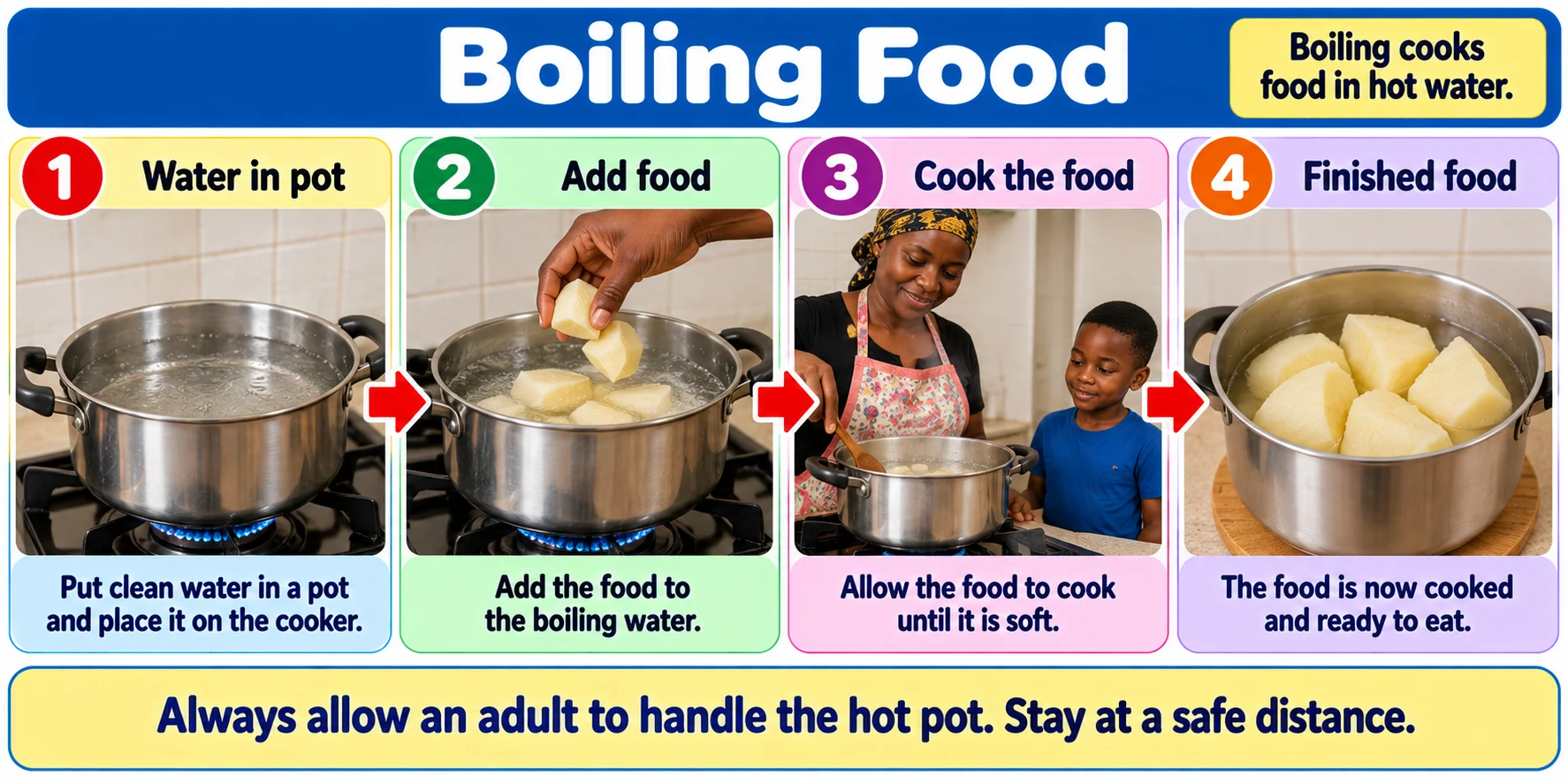
Boiling is a method of cooking food in hot or boiling water.
Water is put into a pot and heated.
The food is placed in the water and allowed to cook.
Foods That Can Be Boiled
Examples include:
- Rice.
- Yam.
- Eggs.
- Potatoes.
- Plantain.
- Beans.
Example: Boiling Yam
An adult may:
- Wash the yam.
- Peel the yam.
- Cut it into suitable pieces.
- Put the pieces into a pot.
- Add water.
- Place the pot on the cooker.
- Allow the yam to cook until it is soft.
- Remove it carefully from the heat.
Primary 1 pupils should observe the process rather than handle knives, boiling water or hot pots.
Cooking Utensils Used for Boiling
Some items used for boiling include:
- Cooking pot.
- Pot cover.
- Cooking spoon.
- Cooker or stove.
These items should be handled carefully because they can become hot.
2. FRYING
Meaning of Frying
Frying is cooking food in hot oil.
The oil is heated before or while the food is cooked.
Foods That Can Be Fried
Examples include:
- Akara.
- Plantain.
- Yam.
- Fish.
- Eggs.
- Potatoes.
Example: Fried Plantain
An adult:
- Peels the plantain.
- Cuts it into pieces.
- Heats oil in a frying pan.
- Carefully puts the plantain into the hot oil.
- Allows it to cook.
- Removes it carefully when ready.
Important Safety Rule
Hot oil can cause serious burns.
Primary 1 pupils should never:
- Pour hot oil.
- Touch a hot frying pan.
- Stand too close to frying oil.
- Play around a cooker.
- Put wet objects into hot oil.
Frying should be demonstrated only by the teacher or another responsible adult.

Boiling and Frying Are Different
|
Boiling |
Frying |
|---|---|
|
Uses water |
Uses oil |
|
Food cooks in hot water |
Food cooks in hot oil |
|
Example: boiled yam |
Example: fried yam |
|
Example: boiled egg |
Example: fried egg |
3. BAKING
Meaning of Baking
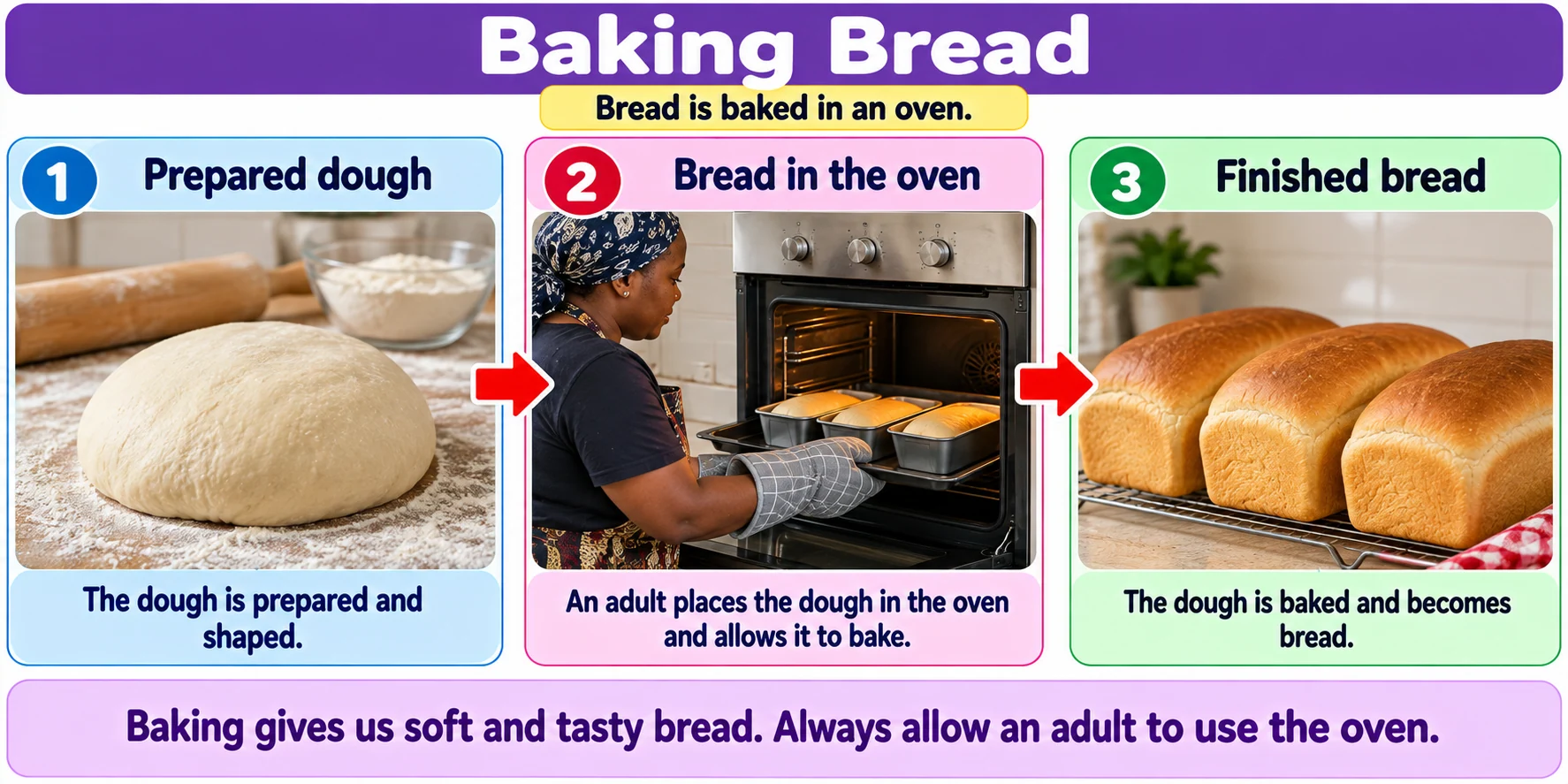
Baking means cooking food with dry heat, usually inside an oven.
The food is placed in the oven and allowed to cook.
Foods That Can Be Baked
Examples include:
- Bread.
- Cake.
- Meat pie.
- Biscuits.
- Buns prepared by baking.
Example: Baking Bread
Bread may be made from dough.
The prepared dough is put in a baking pan or tray and placed inside an oven.
The heat of the oven cooks the dough and changes it into bread.
Cooking Items Used for Baking
Examples include:
- Oven.
- Baking tray.
- Baking pan.
- Oven gloves used by adults.
Baking Safety
An oven can become very hot.
Pupils should:
- Stay away from a hot oven.
- Never touch an oven door without permission.
- Allow an adult to put food into the oven.
- Allow an adult to remove hot food.
- Never play near cooking equipment.
4. ROASTING
Meaning of Roasting
Roasting is cooking food by exposing it to dry heat.
Depending on the equipment used, the heat may come from:
- An oven.
- A grill.
- Hot coals or another controlled heat source used by an adult.
Foods That Can Be Roasted
Examples include:
- Maize.
- Yam.
- Plantain.
- Fish.
- Meat.
Roasted Maize
Maize can be roasted until it becomes cooked and ready to eat.
Roasted maize is commonly eaten in Nigeria.
Roasted Yam
Yam can also be cooked by roasting.
Roasted yam may look and taste different from boiled or fried yam.
One Food, Different Cooking Methods
The same food may sometimes be cooked in more than one way.
Yam
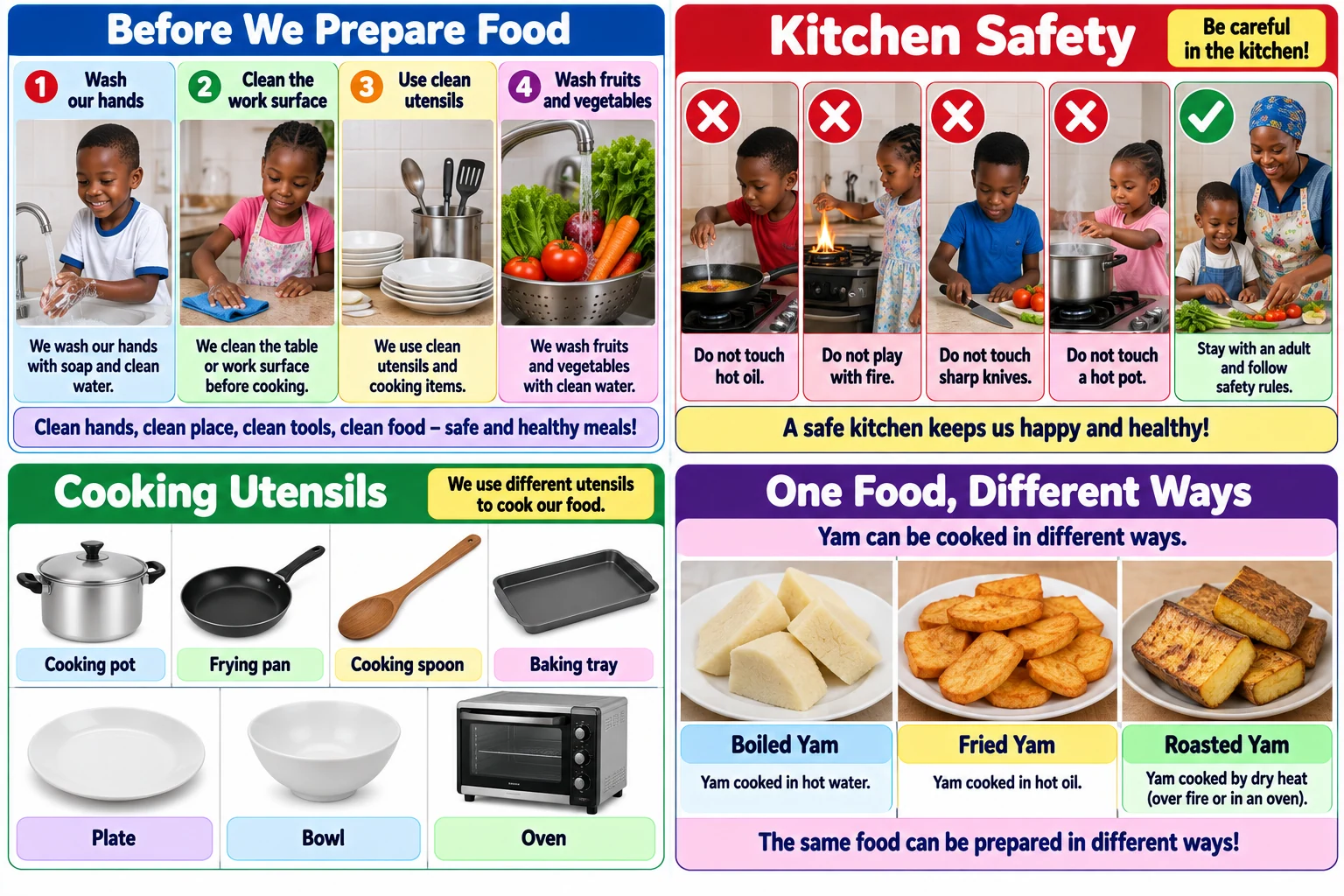
Yam can be:
- Boiled.
- Fried.
- Roasted.
Plantain
Plantain can be:
- Boiled.
- Fried.
- Roasted.
Egg
Egg can be:
- Boiled.
- Fried.
Simple Comparison
|
Food |
Boiled |
Fried |
Roasted |
|---|---|---|---|
|
Yam |
Yes |
Yes |
Yes |
|
Plantain |
Yes |
Yes |
Yes |
|
Egg |
Yes |
Yes |
No |
|
Maize |
Yes |
Sometimes |
Yes |
Identifying Cooked Foods
The teacher may display pictures or safe prepared samples.
Pupils identify them as:
- Boiled.
- Fried.
- Baked.
- Roasted.
Example
BOILED RICE → BOILING
AKARA → FRYING
BREAD → BAKING
ROASTED MAIZE → ROASTING
Cooking Utensils
Different utensils are used when cooking.
Common Cooking Utensils
|
Utensil |
Simple Use |
|---|---|
|
Pot |
Used for cooking food |
|
Frying pan |
Used for frying |
|
Cooking spoon |
Used for stirring food |
|
Baking tray |
Used for baking |
|
Plate |
Used for serving food |
|
Bowl |
Used for holding food |
|
Oven |
Used for baking |

Kitchen Safety
The kitchen can contain hot and sharp objects.
A Primary 1 pupil should be taught to behave safely.
Things That Can Be Dangerous
Examples include:
- Fire.
- Hot pots.
- Hot water.
- Hot oil.
- Cookers.
- Ovens.
- Knives.
- Sharp kitchen tools.
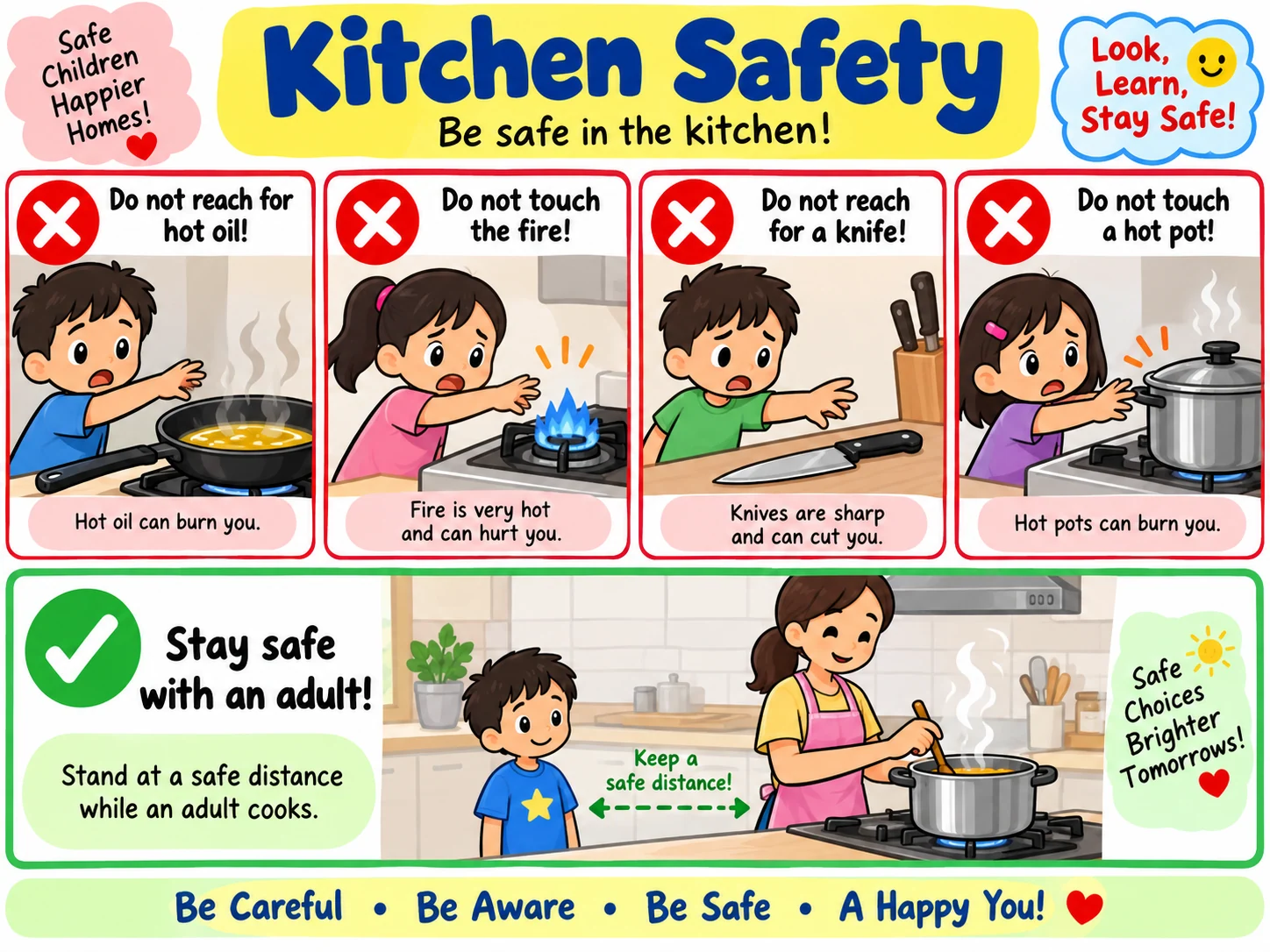
Kitchen Safety Rules
Pupils should:
- Stay away from fire.
- Do not touch a hot pot.
- Do not touch hot oil.
- Do not play with knives.
- Do not run inside the kitchen.
- Do not play with the cooker.
- Tell an adult if something spills.
- Keep away from hot food until an adult says it is safe.
- Follow adult instructions in the kitchen.
Cleanliness Before Cooking
Food should be prepared in a clean place.
Before preparing food:
- Wash the hands with soap and clean water.
- Keep cooking surfaces clean.
- Use clean utensils.
- Wash fruits and vegetables properly.
- Keep rubbish away from food.
Hands should also be washed when necessary during food preparation.
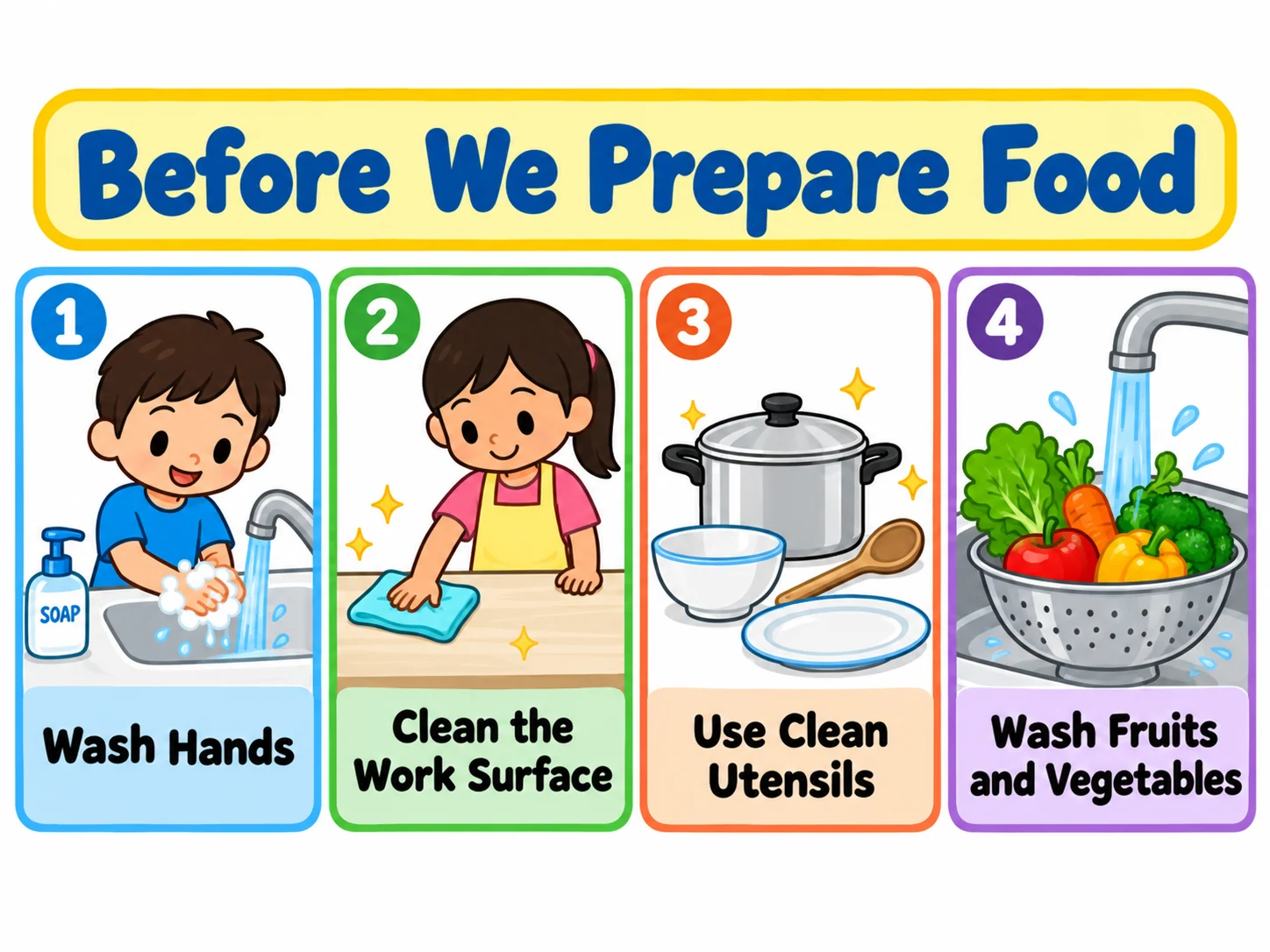
Why We Wash Our Hands Before Handling Food
Hands may carry dirt and germs.
Washing with soap and clean water helps to keep food cleaner.
The simple steps are:
- Wet the hands.
- Apply soap.
- Rub properly.
- Wash between the fingers.
- Rinse.
- Dry.
Cooked Food Should Be Handled Properly
After food has been cooked:
- Use clean utensils.
- Keep the food covered where necessary.
- Serve it on clean plates.
- Avoid touching food with dirty hands.
- Do not put cooked food on dirty surfaces.
Teacher-Led Practical Activity
Because this lesson involves heat, the practical should be mainly a demonstration and identification activity.
Activity 1: Look and Identify
The teacher displays:
- Boiled rice or its picture.
- Fried plantain or akara.
- Bread.
- Roasted maize.
Pupils identify the cooking method used.
Activity 2: Match the Food
The teacher gives pupils picture cards.
Pupils match:
RICE → BOILING
AKARA → FRYING
BREAD → BAKING
MAIZE → ROASTING
Activity 3: Sort the Pictures
Four headings are placed on the board:
BOILING — FRYING — BAKING — ROASTING
Pupils place food pictures under the correct headings.
Activity 4: Safe Observation
If facilities are available, the teacher may demonstrate one simple method, such as boiling, while pupils observe from a safe distance.
Pupils should not handle:
- Flames.
- Boiling water.
- Hot pots.
- Hot oil.
- Sharp knives.
Good Cooking Habits
Good habits include:
- Washing hands before preparing food.
- Using clean utensils.
- Keeping the kitchen clean.
- Washing food properly.
- Cooking food properly.
- Keeping cooked food clean.
- Following kitchen-safety rules.
Poor Cooking Habits
Poor habits include:
- Cooking with dirty hands.
- Using dirty utensils.
- Leaving rubbish near food.
- Playing near fire.
- Touching hot pots carelessly.
- Leaving food uncovered where flies can reach it.
F: LESSON PRESENTATION
F1: Teachers’ Activities
- Revises the classes of food taught in Week Eight.
- Displays pictures or samples of cooked foods.
- Explains the meaning of cooking.
- Discusses simple reasons why food is cooked.
- Introduces the four basic cooking methods.
- Demonstrates boiling with pictures or a safe teacher-led activity.
- Explains frying and shows examples of fried foods.
- Explains baking and shows bread or other baked food.
- Explains roasting and shows roasted maize or yam.
- Uses a chart to compare the four methods.
- Shows pupils common cooking utensils.
- Guides pupils in matching foods with their cooking methods.
- Discusses kitchen-safety rules.
- Demonstrates handwashing before food preparation.
- Conducts a food-picture sorting activity.
- Asks oral questions and corrects pupils where necessary.
F2: Pupils’ Activities
- Recall the classes of food.
- Identify cooked foods shown by the teacher.
- Explain cooking in simple words.
- Mention the four basic methods of cooking.
- Identify boiled foods.
- Identify fried foods.
- Identify baked foods.
- Identify roasted foods.
- Match food pictures with the correct cooking methods.
- Identify common cooking utensils.
- Mention dangerous things found in the kitchen.
- State kitchen-safety rules.
- Arrange cooking-method picture cards correctly.
- Answer the teacher’s questions.
G: CONCLUSION
The teacher revises the meaning of cooking and the four basic methods taught: boiling, frying, baking and roasting.
The teacher reminds pupils that boiling mainly uses water, frying uses oil, baking commonly uses an oven, while roasting uses dry heat.
The teacher emphasises that Primary 1 pupils should not handle fire, hot oil, boiling water, hot pots, ovens or sharp kitchen tools without responsible adult supervision.
Pupils are encouraged to observe how foods are prepared at home and identify the cooking methods used.
H: EVALUATION GUIDE
Pupils should be able to answer the following questions:
- What is cooking?
- Mention three reasons why we cook food.
- Mention the four basic methods of cooking taught in this lesson.
- What is boiling?
- Mention three foods that can be boiled.
- What is frying?
- Mention three foods that can be fried.
- What is baking?
- Mention two foods that can be baked.
- What is roasting?
- Mention three foods that can be roasted.
- Which cooking method uses water?
- Which cooking method uses hot oil?
- Which cooking method is used to make bread?
- Mention four cooking utensils.
- Mention four things in the kitchen that may be dangerous to young children.
- State four kitchen-safety rules.
- What should we do with our hands before preparing food?
- Complete: Rice may be ______, akara is usually ______, bread is ______ and maize may be ______.
- Why should young children not play near hot oil or fire?