TOPIC: GOOD FEEDING HABITS – TABLE MANNERS
A: TEACHING AND LEARNING MATERIALS
- Dining table and chairs.
- Plate.
- Spoon.
- Fork.
- Cup.
- Bowl.
- Clean drinking water.
- Table mat.
- Napkin or clean serviette.
- Pictures showing good and poor table manners.
- Picture cards showing actions before, during and after eating.
- Sample food or model food for classroom demonstration.
- Chart showing a simple table arrangement.
- Pupils’ writing books and pencils.
B: REFERENCE MATERIALS
- Scheme of work.
- Recommended Home Economics textbook for Primary 1.
- Online educational resources.
C: PREVIOUS KNOWLEDGE
The pupils have learnt about good feeding habits. They know that they should wash their hands before eating, eat clean food, drink clean water, sit properly, chew food carefully and avoid wasting food.
Previous lesson: Primary 1 Home Economics Third Term Week 10
D: PERFORMANCE OBJECTIVES
By the end of the lesson, pupils should be able to:
- Explain table manners in simple words.
- Mention at least six good table manners.
- Identify poor table manners from pictures.
- Demonstrate proper handwashing before a meal.
- Demonstrate the correct way to sit while eating.
- Explain why food should be chewed properly.
- Show how to use simple eating utensils correctly.
- Explain why a person should not talk with food in the mouth.
- Arrange simple eating items neatly on a table.
- State what to do before, during and after eating.
- Demonstrate good table manners in a simple classroom activity.
E: CONTENT
Meaning of Table Manners
Table manners are the good and polite ways we behave when eating.
They tell us how to behave:
- Before eating.
- While eating.
- After eating.
Good table manners help to make mealtime clean, orderly, peaceful and pleasant.
Table manners may be practised:
- At home.
- At school.
- At a restaurant.
- At a party.
- At any other place where people eat together.
Why Are Table Manners Important?
Good table manners help us to:
- Eat in a neat way.
- Show respect for other people.
- Keep food and the eating area clean.
- Avoid disturbing people during meals.
- Develop good feeding habits.
- Eat calmly and carefully.
- Avoid unnecessary food waste.
Good table manners should be practised by both children and adults.
BEFORE EATING
There are things we should do before we begin a meal.
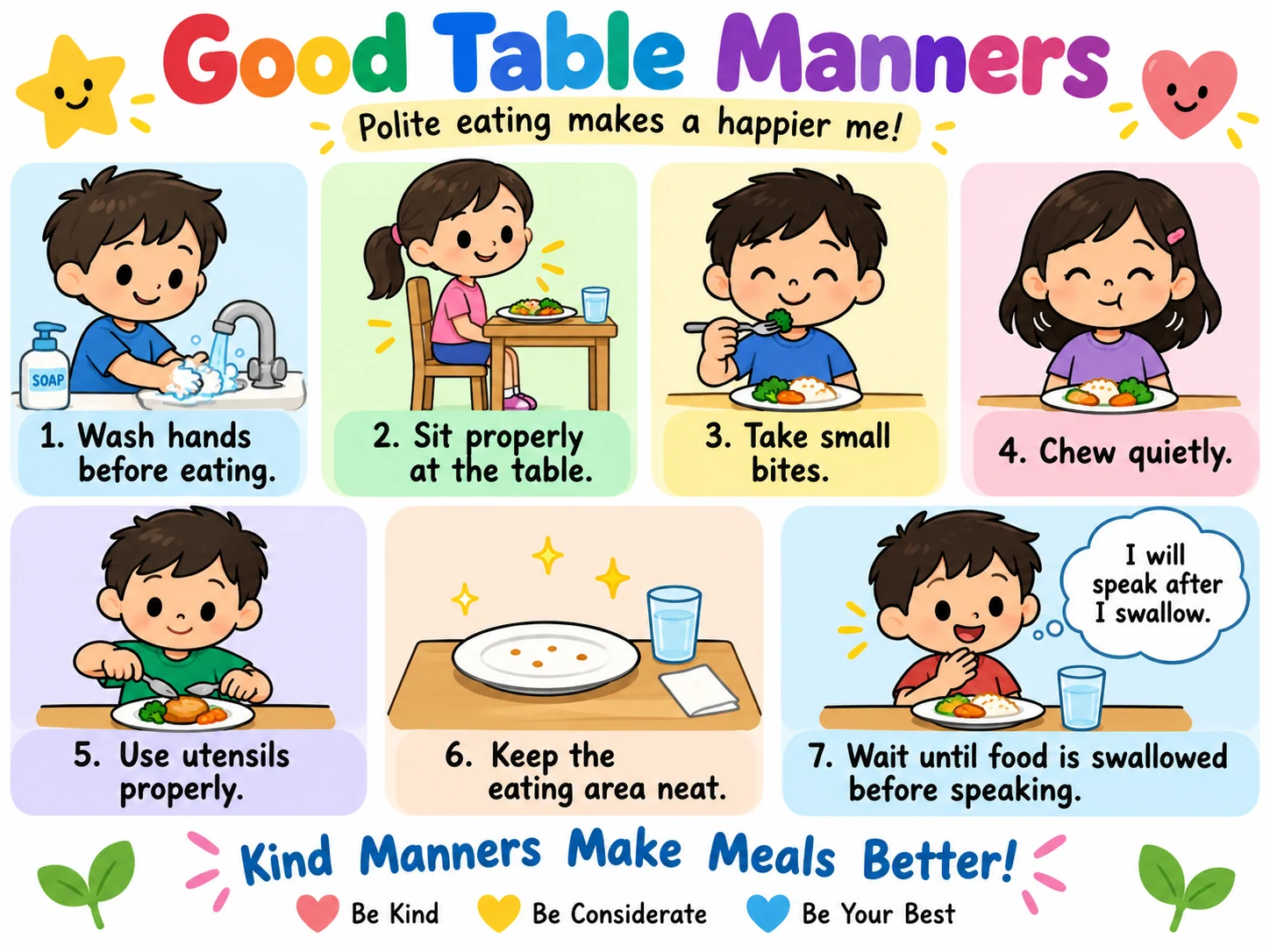
1. Wash Your Hands
Hands should be washed with soap and clean water before eating.
This helps to remove dirt and germs that may be on the hands.
Simple Handwashing Steps
- Wet the hands.
- Apply soap.
- Rub the hands properly.
- Wash between the fingers.
- Rinse with clean water.
- Dry the hands.
2. Make Sure the Eating Area Is Clean
Before sitting down to eat:
- The table should be clean.
- The floor around the eating area should be neat.
- Rubbish should not be left around the food.
Food should not be placed on a dirty surface.
3. Use Clean Eating Utensils
Eating utensils should be clean.
Examples include:
- Plate.
- Bowl.
- Spoon.
- Fork.
- Cup.
A dirty plate or spoon should not be used for eating.
Common Eating Items and Their Uses
|
Item |
Use |
|---|---|
|
Plate |
Holds food |
|
Bowl |
Holds some foods |
|
Spoon |
Used for eating suitable foods |
|
Fork |
Used for picking some foods |
|
Cup |
Used for drinking |
|
Napkin |
Used for keeping the mouth or hands neat where appropriate |
SIMPLE TABLE ARRANGEMENT
Eating items should be arranged neatly.
A simple arrangement may have:
- Plate in front of the pupil.
- Spoon or fork beside the plate.
- Cup placed safely beside the plate.
- Napkin kept nearby.
DURING EATING
4. Sit Properly
Sit upright and comfortably while eating.
A pupil should:
- Sit on the chair properly.
- Keep the body reasonably upright.
- Keep the plate in front.
- Remain calm.
Do not:
- Run around with food in the mouth.
- Bend very badly over the plate.
- Play while eating.
5. Take a Small or Manageable Amount at a Time
Do not put too much food into the mouth at once.
Take an amount that can be chewed comfortably.
For example:
Good habit: Take one manageable spoonful, chew it and swallow it.
Poor habit: Fill the mouth with too much food.
Taking manageable bites makes eating more comfortable and orderly.
6. Chew Food Properly
Food should be chewed well before swallowing.
We use the teeth to break food into smaller pieces.
While chewing:
- Keep the mouth reasonably closed.
- Chew calmly.
- Do not rush.
- Swallow before taking another large bite.
7. Do Not Talk With Food in Your Mouth
A person should finish chewing and swallow before speaking.
Talking with food in the mouth may:
- Look untidy.
- Disturb other people.
- Cause food to fall from the mouth.
- Make eating less safe.
A pupil can remember:
Chew first. Swallow. Then speak.
8. Do Not Make Unnecessary Noise
A meal should be peaceful.
We should avoid:
- Shouting at the table.
- Banging plates.
- Hitting spoons against plates.
- Making unnecessary noise with cups or utensils.
- Chewing noisily on purpose.
Speak politely and at a suitable volume when conversation is allowed.
9. Use Eating Utensils Properly
Spoons and forks should be used carefully.
We should not:
- Play with a spoon.
- Bang a spoon on the table.
- Point a fork at another person.
- Throw utensils.
- Put dirty utensils on another person’s food.
Utensils are for eating, not for playing.
Eating With Clean Hands
Not every food must be eaten with a spoon or fork.
Some familiar foods may traditionally be eaten with the hand.
When eating with the hand:
- Wash the hands properly before eating.
- Use the appropriate hand according to the family’s practice.
- Take manageable amounts of food.
- Keep the eating area neat.
- Wash the hands properly afterward.
Good table manners can therefore be practised whether a meal is eaten with utensils or with clean hands.
10. Do Not Stretch Across Other People
If something is far away, do not stretch your arm across another person’s food.
Instead, politely ask for it.
For example:
“Please, may I have the water?”
This shows respect and prevents accidents.
11. Do Not Play With Food
Food should be treated properly.
Do not:
- Throw food.
- Make toys with food.
- Pour food on another person.
- Scatter food on the table.
- Mix food unnecessarily just for play.
Food is meant to nourish the body.
12. Avoid Wasting Food
Take an amount that you can reasonably eat.
If you are still hungry, an adult may give you more.
Do not take a very large amount and then throw most of it away.
Good Practice
Take enough → Eat carefully → Ask for more if needed.
13. Keep the Table Neat
Try to keep the eating area clean.
If a small spill happens:
- Tell an adult if help is needed.
- Wipe it safely when appropriate.
- Do not spread the spill around.
After eating, food and utensils should not be scattered everywhere.
POLITE BEHAVIOUR AT MEALTIME
Good table manners also involve being polite.
Examples include:
- Waiting patiently for food.
- Saying “please” when asking.
- Saying “thank you” when appropriate.
- Respecting other people at the table.
- Avoiding fighting over food.
- Waiting for your turn.
Polite Words
|
Situation |
Polite Words |
|---|---|
|
Asking for something |
Please |
|
Receiving something |
Thank you |
|
Needing to pass |
Excuse me |
|
Asking someone to pass an item |
Please pass the water |
AFTER EATING
Good manners continue after the meal.
14. Finish Eating Neatly
When you finish:
- Do not scatter leftover food.
- Keep utensils together.
- Leave the eating area neat.
15. Take Used Utensils to the Proper Place
At home or school, follow the adult’s instructions.
Used plates, spoons and cups may be taken to:
- The kitchen.
- The washing area.
- A place provided for used dishes.
Children should carry breakable items only when it is safe and an adult permits it.
16. Clean the Eating Area
The table should be kept neat after eating.
Remove:
- Food crumbs.
- Used napkins.
- Other rubbish.
Suitable waste should be put in the proper waste bin.
17. Wash Your Hands After Eating
Hands may become dirty during a meal.
Wash them with soap and clean water afterward when necessary, especially after eating foods with the hands.
BEFORE, DURING AND AFTER EATING
|
Before Eating |
During Eating |
After Eating |
|---|---|---|
|
Wash hands |
Sit properly |
Keep the table neat |
|
Use clean utensils |
Take manageable bites |
Put waste in the bin |
|
Keep eating area clean |
Chew properly |
Take utensils to the proper place |
|
Arrange eating items |
Eat calmly |
Wash hands where necessary |
GOOD AND POOR TABLE MANNERS
|
Good Table Manners |
Poor Table Manners |
|---|---|
|
Washing hands before eating |
Eating with dirty hands |
|
Sitting properly |
Running around while eating |
|
Taking manageable bites |
Filling the mouth with too much food |
|
Chewing properly |
Rushing the food |
|
Swallowing before speaking |
Talking with food in the mouth |
|
Asking politely |
Stretching across people |
|
Using utensils properly |
Playing with utensils |
|
Keeping the table neat |
Scattering food |
|
Taking enough food |
Wasting food |
Classroom Practical: Setting an Eating Place
The teacher places the following items on a table:
- Plate.
- Cup.
- Spoon.
- Fork.
- Napkin.
The teacher demonstrates how they may be placed neatly.
Pupils are then invited one at a time or in small groups to arrange the items.
The teacher should remember that table arrangements differ between homes and types of meals. The main lesson is neatness, cleanliness and good behaviour, not one rigid arrangement.
Practical Activity: Let Us Eat Politely
The teacher may use model food or a simple safe snack.
One pupil sits at the table and demonstrates:
- Washing the hands.
- Sitting properly.
- Using a clean plate.
- Taking a manageable amount.
- Chewing quietly.
- Swallowing before speaking.
- Asking politely for water.
- Keeping the table neat.
- Putting used items in the proper place afterward.
Other pupils observe and mention the good table manners they see.
Picture Activity: Good or Poor?
The teacher displays pictures showing:
- A child washing hands.
- A child talking with a full mouth.
- A child sitting properly.
- A child throwing food.
- A child asking for water politely.
- A child stretching across another person’s plate.
- A child chewing properly.
- A child banging a spoon on a plate.
Pupils say:
Good Table Manner or Poor Table Manner.
Simple Table-Manners Rule
Pupils can remember:
WASH YOUR HANDS
↓
SIT PROPERLY
↓
EAT CALMLY
↓
CHEW PROPERLY
↓
BE POLITE TO OTHERS
↓
KEEP THE AREA NEAT
Our Table-Manners Promise
Pupils can recite:
I will wash my hands before eating.
I will sit properly.
I will eat calmly.
I will chew my food well.
I will swallow before I speak.
I will be polite to others.
I will not waste food.
I will keep my eating area neat.
F: LESSON PRESENTATION
F1: Teachers’ Activities
- Revises good and poor feeding habits from Week Ten.
- Introduces the meaning of table manners.
- Displays pictures showing good and poor behaviour during meals.
- Demonstrates handwashing before eating.
- Displays common eating utensils and states their uses.
- Demonstrates a simple table arrangement.
- Demonstrates correct sitting posture.
- Shows pupils how to take manageable bites and eat calmly.
- Explains why pupils should swallow before speaking.
- Demonstrates polite ways of requesting an item.
- Shows the correct way to pass or receive an item at the table.
- Explains why pupils should not make unnecessary noise with utensils.
- Discusses food waste and the importance of taking suitable portions.
- Demonstrates what to do after eating.
- Guides pupils through the Setting an Eating Place practical.
- Guides pupils through the Good or Poor? picture activity.
- Leads pupils in reciting the Table-Manners Promise.
- Asks oral questions and corrects pupils where necessary.
F2: Pupils’ Activities
- Recall good feeding habits learnt in Week Ten.
- Explain table manners in simple words.
- Identify good table manners from pictures.
- Identify poor table manners from pictures.
- Demonstrate proper handwashing.
- Identify a plate, spoon, fork, cup, bowl and napkin.
- Arrange simple eating items neatly.
- Demonstrate proper sitting posture.
- Show how to eat calmly.
- Demonstrate how to ask for an item politely.
- State why they should not talk with food in the mouth.
- Mention ways of avoiding food waste.
- Demonstrate what should be done after eating.
- Participate in the classroom table-manners demonstration.
- Recite the Table-Manners Promise.
- Answer the teacher’s questions.
G: CONCLUSION
The teacher revises the meaning and examples of good table manners.
The teacher reminds pupils that good table manners include washing the hands, sitting properly, eating calmly, taking manageable bites, chewing food properly, swallowing before speaking, behaving politely, avoiding food waste and keeping the eating area neat.
The teacher emphasises that table manners may differ slightly from one family or culture to another, but cleanliness, safety, respect and neatness are important everywhere.
Pupils are encouraged to practise good table manners at home, at school and whenever they eat with other people.
H: EVALUATION GUIDE
Pupils should be able to answer the following questions:
- What are table manners?
- Mention six good table manners.
- What should you do before eating?
- Why should the hands be washed before a meal?
- Mention four eating utensils.
- How should you sit while eating?
- Why should you take a manageable amount of food into the mouth?
- What should you do before speaking during a meal?
- Should you make unnecessary noise with your spoon or plate?
- What should you do when an item you need is far from you?
- Mention two polite words that may be used at the table.
- Why should we not play with food?
- Why should we avoid wasting food?
- Mention three things to do after eating.
- What should you do with used plates and cups?
- State whether this is a good or poor table manner: talking with food in the mouth.
- State whether this is a good or poor table manner: asking politely for water.
- State whether this is a good or poor table manner: throwing food at another pupil.
- Complete: Wash your hands, sit properly, eat calmly and ______ your food well.
- Mention two reasons why good table manners are important.