
TOPIC: CARE AND FUNCTIONS OF THE MOUTH, TEETH AND TONGUE
A: TEACHING AND LEARNING MATERIALS
- Large picture of the human face.
- Diagram of an open mouth showing the teeth and tongue.
- Hand mirror.
- Model of the mouth and teeth where available.
- Picture cards showing the mouth, teeth and tongue.
- Pictures showing biting, chewing, speaking and tasting.
- Toothbrush.
- Toothpaste.
- Cup of clean water.
- Pictures of clean and dirty teeth.
- Word cards labelled Mouth, Teeth and Tongue.
- Pupils’ writing books and pencils.
B: REFERENCE MATERIALS
- Primary 1 Home Economics Scheme of Work.
- Recommended Home Economics textbook for Primary 1.
- Online educational resources.
C: PREVIOUS KNOWLEDGE
Review the previous week’s Home Economics lesson.
The pupils have learnt about caring for the hands, feet and nails. They know that different parts of the body have different uses and that every part of the body should be kept clean and safe.
D: PERFORMANCE OBJECTIVES
By the end of the lesson, pupils should be able to:
- Identify the mouth.
- Identify the teeth.
- Identify the tongue.
- State at least three functions of the mouth.
- State at least three functions of the teeth.
- State at least three functions of the tongue.
- Explain in simple words how the mouth, teeth and tongue work together when eating.
- Match the mouth, teeth and tongue with their correct functions.
- Mention simple habits that help keep the mouth, teeth and tongue clean.
- Identify safe and unsafe habits involving the mouth and teeth.
- Demonstrate simple actions showing biting, chewing, tasting and speaking.
E: CONTENT
The Mouth, Teeth and Tongue
The mouth, teeth and tongue are important parts of our body.
They work together when we:
- Eat.
- Drink.
- Speak.
- Taste food.
We use them every day.
We should know what they do and learn to keep them clean.
1. THE MOUTH
The mouth is found on the face.
It is below the nose.
When we open the mouth, we can see the:
- Teeth.
- Tongue.
The mouth is where food and drinks enter the body.
Functions of the Mouth
The mouth has many uses.
1. The Mouth Helps Us to Eat
We put food into the mouth when we eat.
For example:
- Rice.
- Yam.
- Bread.
- Beans.
- Fruits.
Food enters the body through the mouth.
2. The Mouth Helps Us to Drink
We use the mouth when drinking:
- Water.
- Milk.
- Other suitable drinks.
3. The Mouth Helps Us to Speak
We use the mouth when talking.
Try saying:
Good morning.
The mouth moves as we speak.
4. The Mouth Helps Us Make Sounds
We can use the mouth to:
- Talk.
- Sing.
- Call someone.
- Make different sounds.
2. THE TEETH
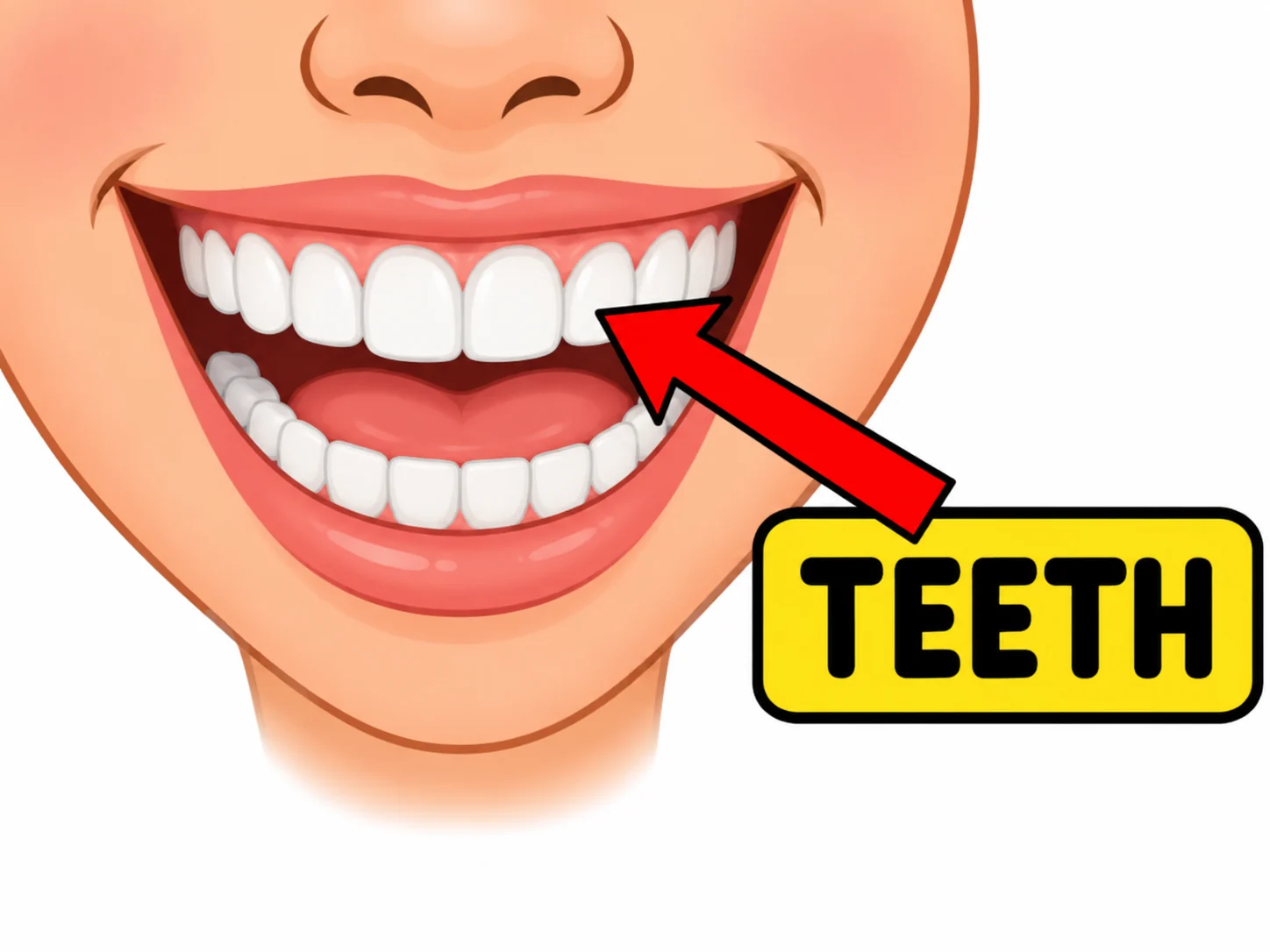
The teeth are the hard white parts found inside the mouth.
Young children have smaller teeth often called milk teeth or baby teeth.
Teeth are important when we eat.
The teeth should be kept clean and protected.
Functions of the Teeth
1. Teeth Help Us to Bite Food
We use our teeth to bite pieces from some foods.
Examples include:
- Bread.
- Apple.
- Carrot.
- Meat.
For example, when we bite an apple, our teeth help to break off a piece.
2. Teeth Help Us to Chew Food
Chewing means breaking food into smaller pieces inside the mouth.
We chew food before swallowing it.
Food that is properly chewed is easier to swallow.
3. Teeth Help to Crush and Grind Food
Some foods need to be broken into smaller and softer pieces.
The teeth help to crush and grind food as we chew.
Simple Sequence
FOOD
↓
BITE
↓
CHEW
↓
SMALLER PIECES
Different Teeth Can Do Different Jobs
Pupils do not need to learn the scientific names of all the teeth in this lesson.
They only need to understand that some teeth help us bite, while others help us chew and grind food.
The teacher can allow pupils to smile into a mirror and observe that the teeth at the front and back do not all look exactly the same.
No pupil should put fingers inside another pupil’s mouth.
3. THE TONGUE
The tongue is the soft, movable part inside the mouth.
It can move in different directions.
The tongue has several important functions.
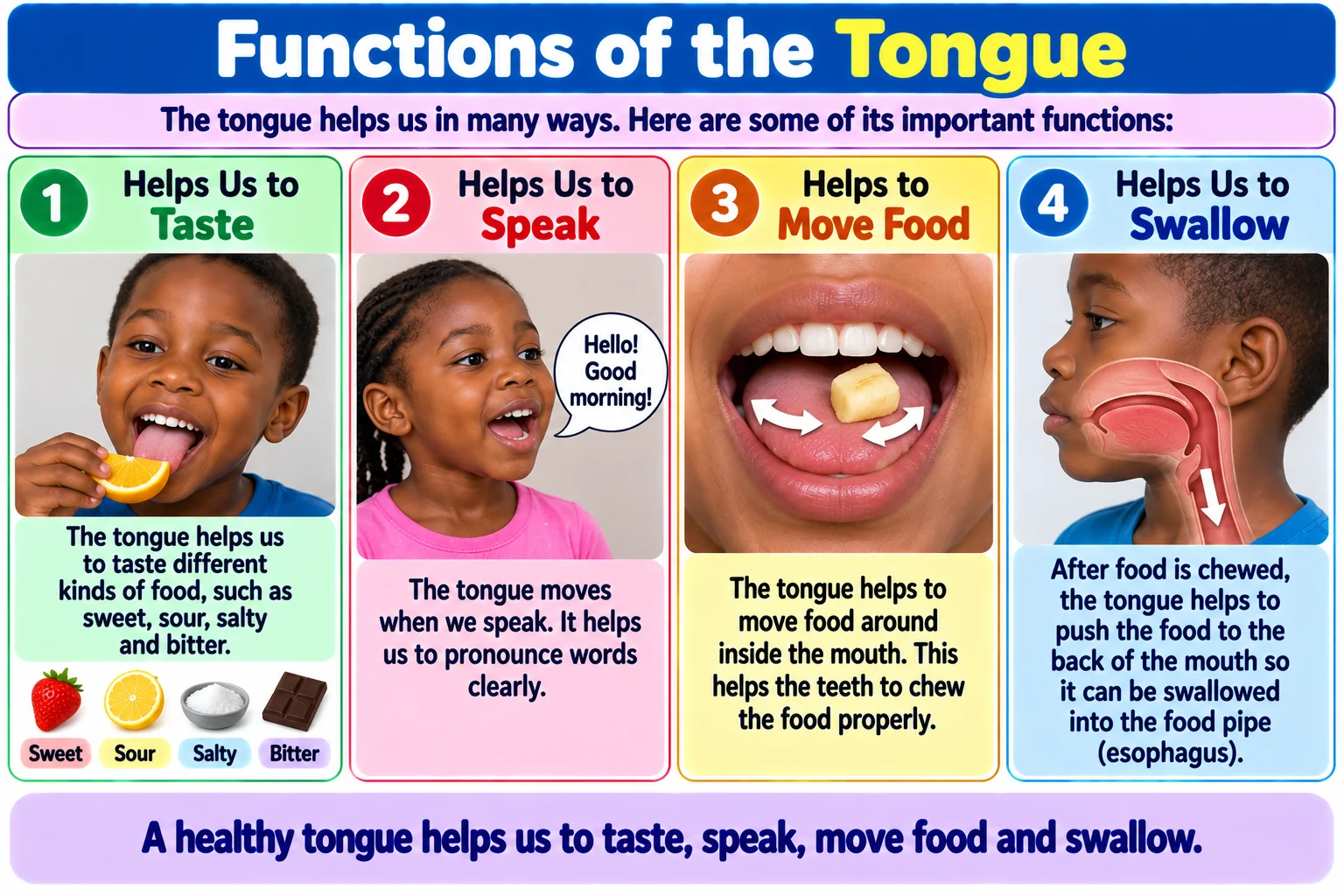
Functions of the Tongue
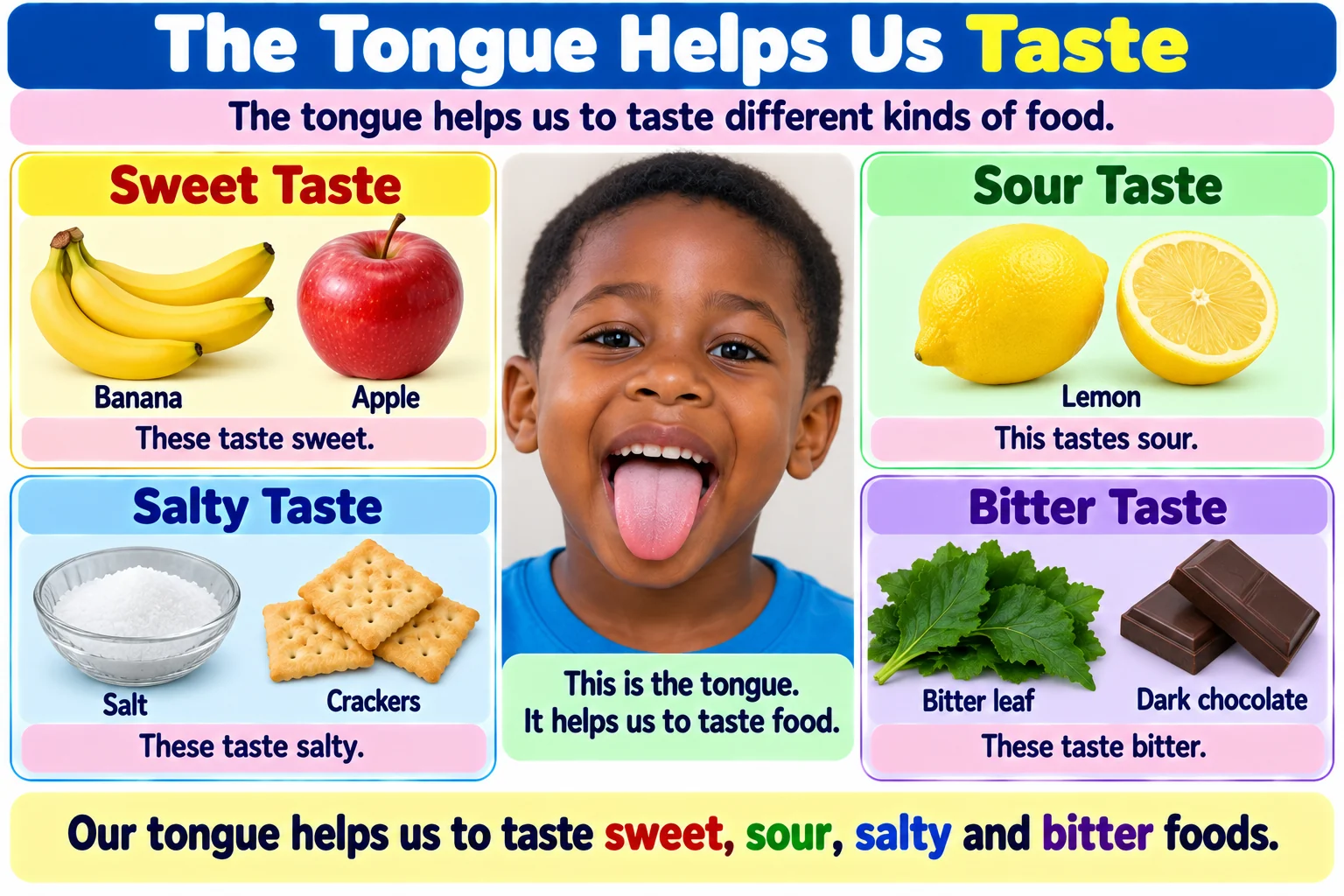
1. The Tongue Helps Us to Taste
The tongue helps us notice different tastes in foods.
For example, foods may taste:
- Sweet.
- Sour.
- Salty.
- Bitter.
Pupils do not need to taste unknown substances during the lesson.
Only safe, familiar foods supplied or approved by responsible adults should ever be used for tasting activities.
2. The Tongue Helps Us to Speak
The tongue moves when we pronounce many words.
Try saying:
- Hello.
- Thank you.
- Teacher.
The tongue, mouth and other parts work together when we speak.
3. The Tongue Helps Us Move Food in the Mouth
While we are eating, the tongue helps move food around inside the mouth.
This helps the teeth to chew the food.
4. The Tongue Helps Us to Swallow
After food has been chewed, the tongue helps move it towards the back of the mouth so it can be swallowed.
Children should chew food properly and should not rush while eating.
Tongue Functions
How the Mouth, Teeth and Tongue Work Together
The mouth, teeth and tongue do not work separately when we eat.
They work together.
Example: Eating a Piece of Bread
- The mouth receives the bread.
- The teeth bite and chew it.
- The tongue helps move the food around.
- The tongue also helps us taste the food.
- After chewing, the food is swallowed.
Simple Eating Process
MOUTH
Receives food
↓
TEETH
Bite and chew
↓
TONGUE
Tastes and moves food
↓
SWALLOW
Mouth, Teeth and Tongue at a Glance
| Part | Some of Its Functions |
|---|---|
| Mouth | Eating, drinking and speaking |
| Teeth | Biting, chewing and grinding food |
| Tongue | Tasting, speaking, moving food and helping with swallowing |
Matching Activity
Match each body part with its function.
| Body Part | Function |
|---|---|
| Mouth | Receives food and helps us speak |
| Teeth | Bite and chew food |
| Tongue | Tastes and moves food |
Simple Care of the Mouth, Teeth and Tongue
The mouth, teeth and tongue should be kept clean.
At this stage, pupils should remember a few simple habits.
We should:
- Brush our teeth regularly.
- Use our own toothbrush.
- Use suitable toothpaste.
- Rinse or clean the mouth appropriately after meals where necessary.
- Avoid putting dirty objects into the mouth.
- Avoid using the teeth to break hard objects.
- Tell an adult when a tooth or other part of the mouth is painful.
Detailed materials and methods for cleaning the mouth, teeth and tongue will be studied in the following lessons.
Brushing the Teeth
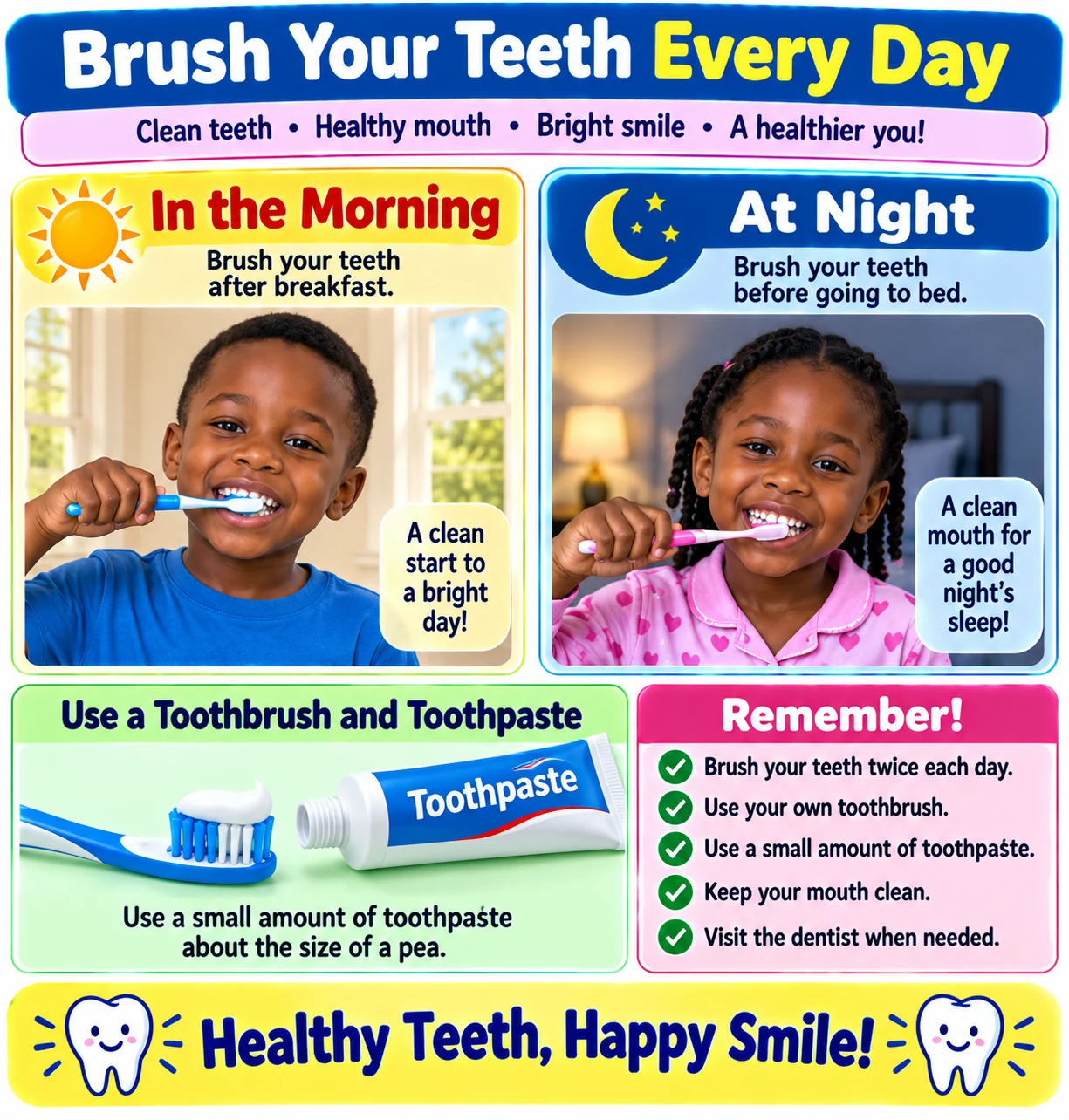
Young children should develop a regular toothbrushing habit.
Teeth should be brushed twice each day, including before going to bed.
A responsible adult should supervise young children where necessary.
Basic Materials
- Toothbrush.
- Suitable fluoride toothpaste.
Do Not Share Toothbrushes
A toothbrush is a personal item.
Each person should have his or her own toothbrush.
We should not use another person’s toothbrush.
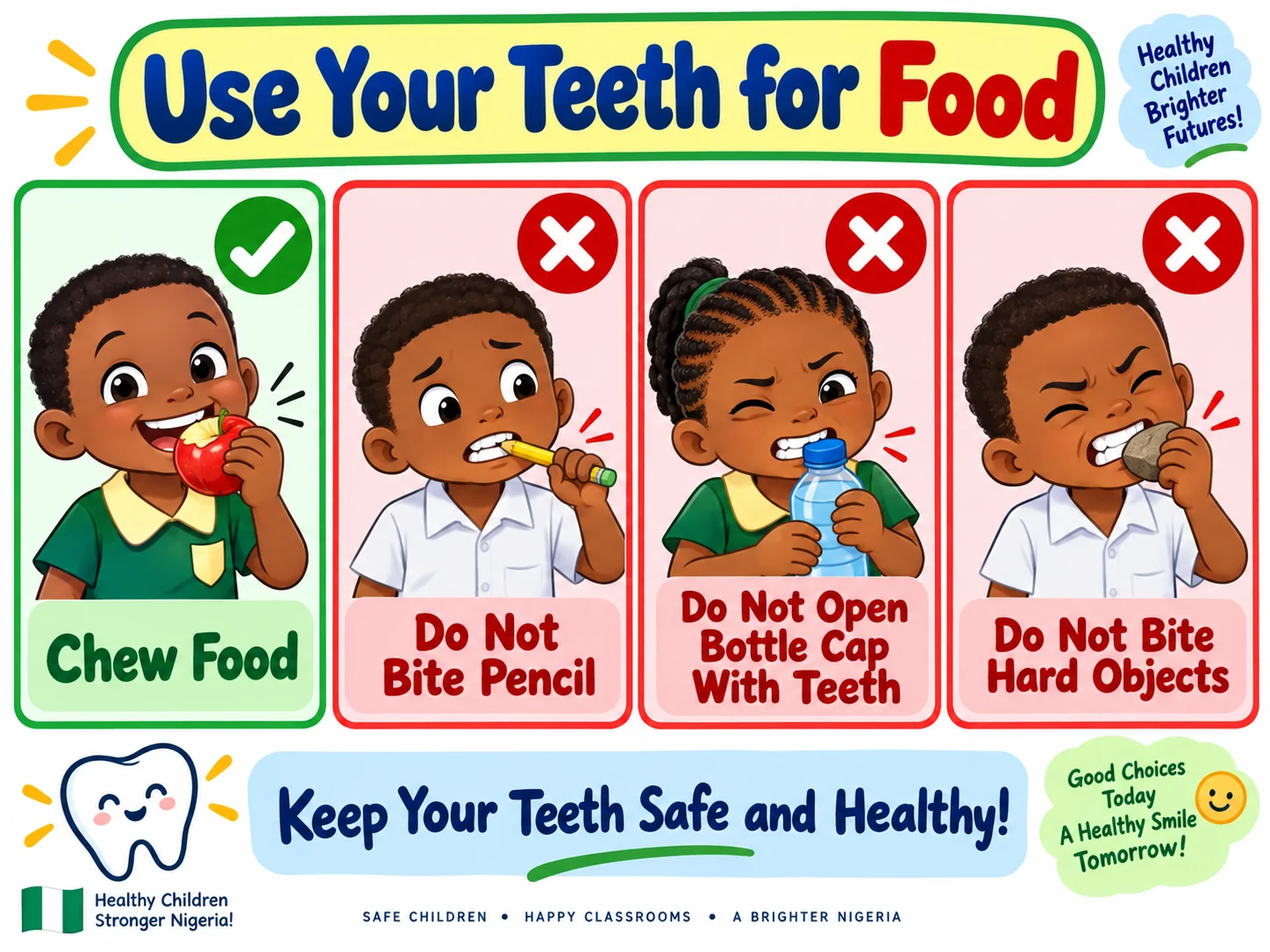
Things We Should Not Use Our Teeth For
Teeth are mainly for eating.
We should not use our teeth to:
- Open bottle tops.
- Break pencils.
- Crack very hard objects.
- Tear dangerous materials.
These activities can hurt the teeth.
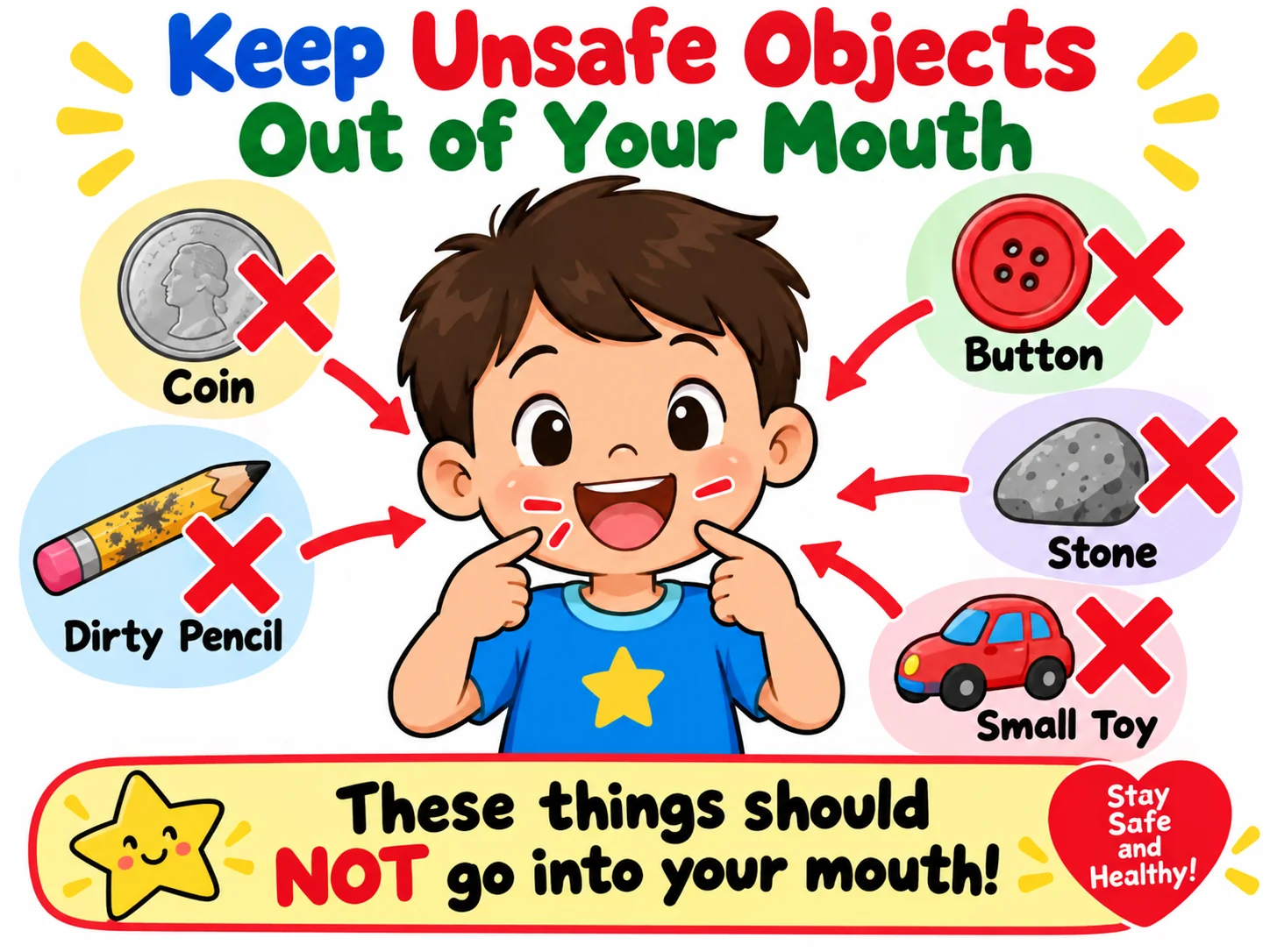
Keep Unsafe Things Out of the Mouth
Children should not put:
- Coins.
- Dirty pencils.
- Small toys.
- Stones.
- Buttons.
- Other unsafe objects
inside the mouth.
Small objects can also be dangerous if swallowed or breathed into the airway.
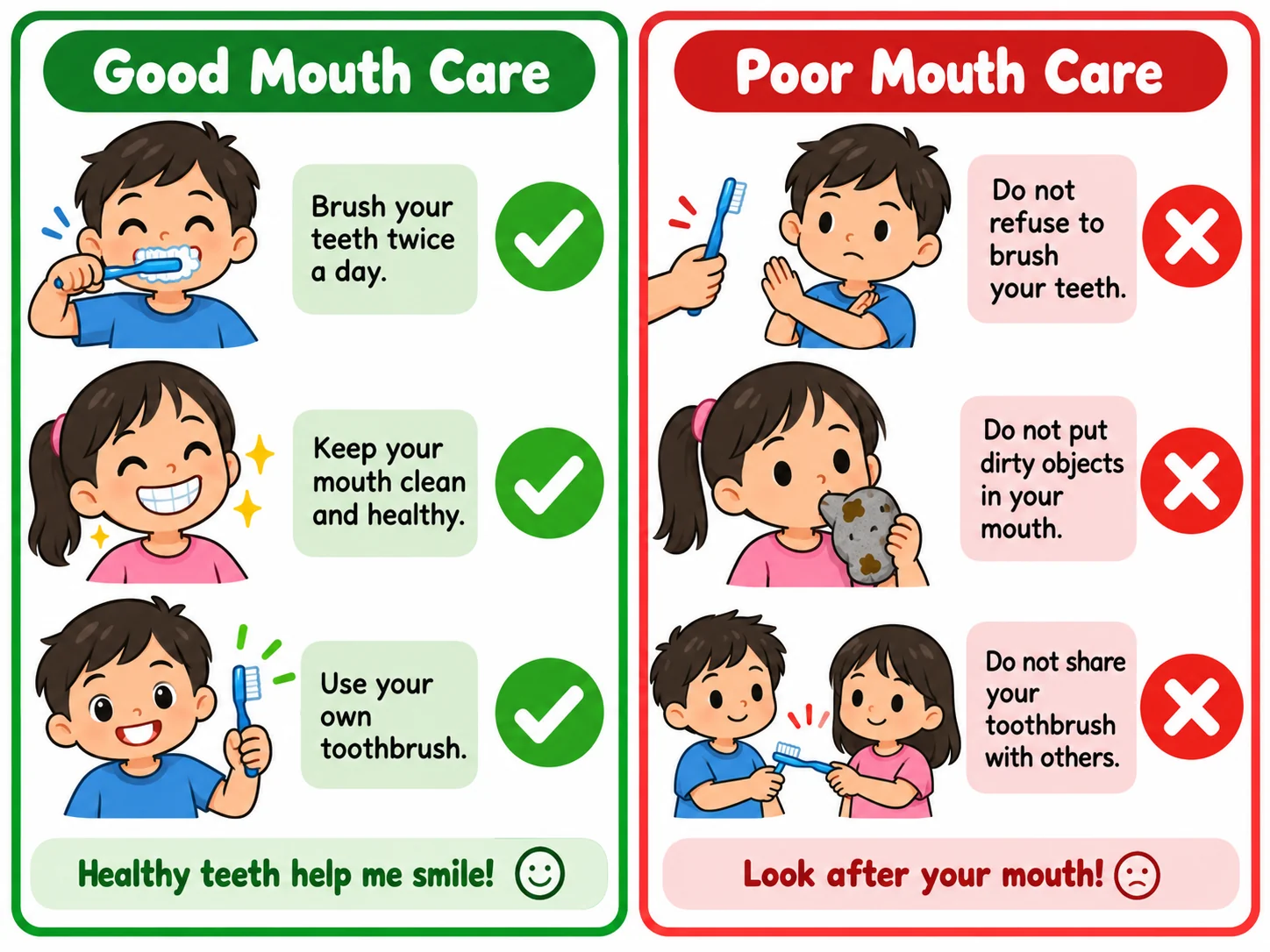
Clean Mouth and Dirty Mouth
A clean mouth should have:
- Teeth that are cared for.
- No obvious food left around the mouth.
- Good regular hygiene habits.
Poor mouth-care habits include:
- Refusing to brush.
- Using a dirty toothbrush.
- Sharing toothbrushes.
- Keeping food around the teeth for long periods.
- Putting dirty objects into the mouth.
Classroom Mirror Activity
The teacher gives each pupil access to a safe hand mirror or demonstrates with one mirror.
Pupils observe their own:
- Mouth.
- Teeth.
- Tongue.
The teacher asks:
Where are your teeth?
Pupils point without putting dirty fingers into their mouths.
Where is your tongue?
Pupils may open their mouths gently and observe.
The teacher reminds pupils not to touch another person’s mouth.
Action Activity: What Am I Using?
The teacher calls out an action.
Pupils name the main part being discussed.
Biting an apple
Teeth.
Tasting food
Tongue.
Drinking water
Mouth.
Chewing rice
Teeth.
Speaking
Mouth and tongue.
Moving food while chewing
Tongue.
Guess the Body Part
Riddle 1
I am inside the mouth.
I am hard.
I help you bite and chew.
Answer: Teeth.
Riddle 2
I am soft and movable.
I help you taste food.
Answer: Tongue.
Riddle 3
Food and drinks enter through me.
I also help you speak.
Answer: Mouth.
Good Habit or Poor Habit?
Brushing the teeth every day
Good habit.
Sharing a toothbrush
Poor habit.
Biting food with the teeth
Good habit.
Using the teeth to break a pencil
Poor habit.
Keeping dirty objects out of the mouth
Good habit.
Putting a coin in the mouth
Poor habit.
VISUAL TO INSERT: A two-column poster titled Good Mouth Habits and Poor Mouth Habits, using green ticks and red crosses with simple Primary 1 pictures.
F: LESSON PRESENTATION
F1: Teachers’ Activities
- Revises the care of hands, feet and nails from Week Eight.
- Introduces the mouth, teeth and tongue using a chart.
- Guides pupils to identify the mouth.
- Shows the teeth on a picture or mouth model.
- Shows the tongue on an open-mouth diagram.
- Explains the functions of the mouth.
- Demonstrates biting and chewing using pictures or safe examples.
- Explains the functions of the teeth.
- Explains the functions of the tongue.
- Demonstrates how the mouth, teeth and tongue work together during eating.
- Uses the comparison table to reinforce learning.
- Discusses a few simple mouth-care habits without moving into the detailed Week 10 and Week 11 content.
- Conducts the mirror-observation activity.
- Conducts the What Am I Using? activity.
- Conducts the body-part riddles.
- Uses pictures for the Good Habit or Poor Habit? activity.
- Asks oral questions and corrects pupils where necessary.
F2: Pupils’ Activities
- Recall the previous lesson.
- Point to their mouth.
- Identify teeth from a chart or model.
- Identify the tongue.
- Mention functions of the mouth.
- Mention functions of the teeth.
- Mention functions of the tongue.
- Demonstrate simple biting and chewing movements without food where appropriate.
- Observe their own teeth and tongue using a mirror.
- Match the mouth, teeth and tongue with their functions.
- Explain in simple words how the three parts work together.
- Identify good and poor mouth habits.
- Answer the riddles.
- Answer the teacher’s questions.
G: CONCLUSION
The teacher revises the mouth, teeth and tongue and their functions.
Pupils are reminded that:
- The mouth helps us eat, drink and speak.
- The teeth help us bite, chew and grind food.
- The tongue helps us taste, speak, move food and swallow.
The teacher reminds pupils that these parts should be kept clean and protected.
Pupils are informed that the next lesson will focus on reasons for cleaning the mouth, teeth and tongue and the materials used for cleaning them.
Continue with the next week’s Home Economics lesson.
H: EVALUATION GUIDE
Pupils should be able to answer the following questions:
- Where is the mouth found?
- Mention two things found inside the mouth.
- Mention three functions of the mouth.
- What are teeth?
- Mention three functions of the teeth.
- What does chewing mean?
- Which body part helps us bite food?
- Which body part helps us taste?
- Mention three functions of the tongue.
- Which part helps to move food around inside the mouth?
- Which parts work together when we eat?
- What happens to food when we chew it?
- Mention two simple ways of keeping the mouth and teeth clean.
- Should we share toothbrushes?
- Should we use our teeth to break pencils?
- Complete: The ______ help us bite and chew food.
- Complete: The ______ helps us taste food.
- Complete: Food enters the body through the ______.
- State whether this is a good or poor habit: brushing the teeth regularly.
- State whether this is a good or poor habit: putting a dirty coin into the mouth.